
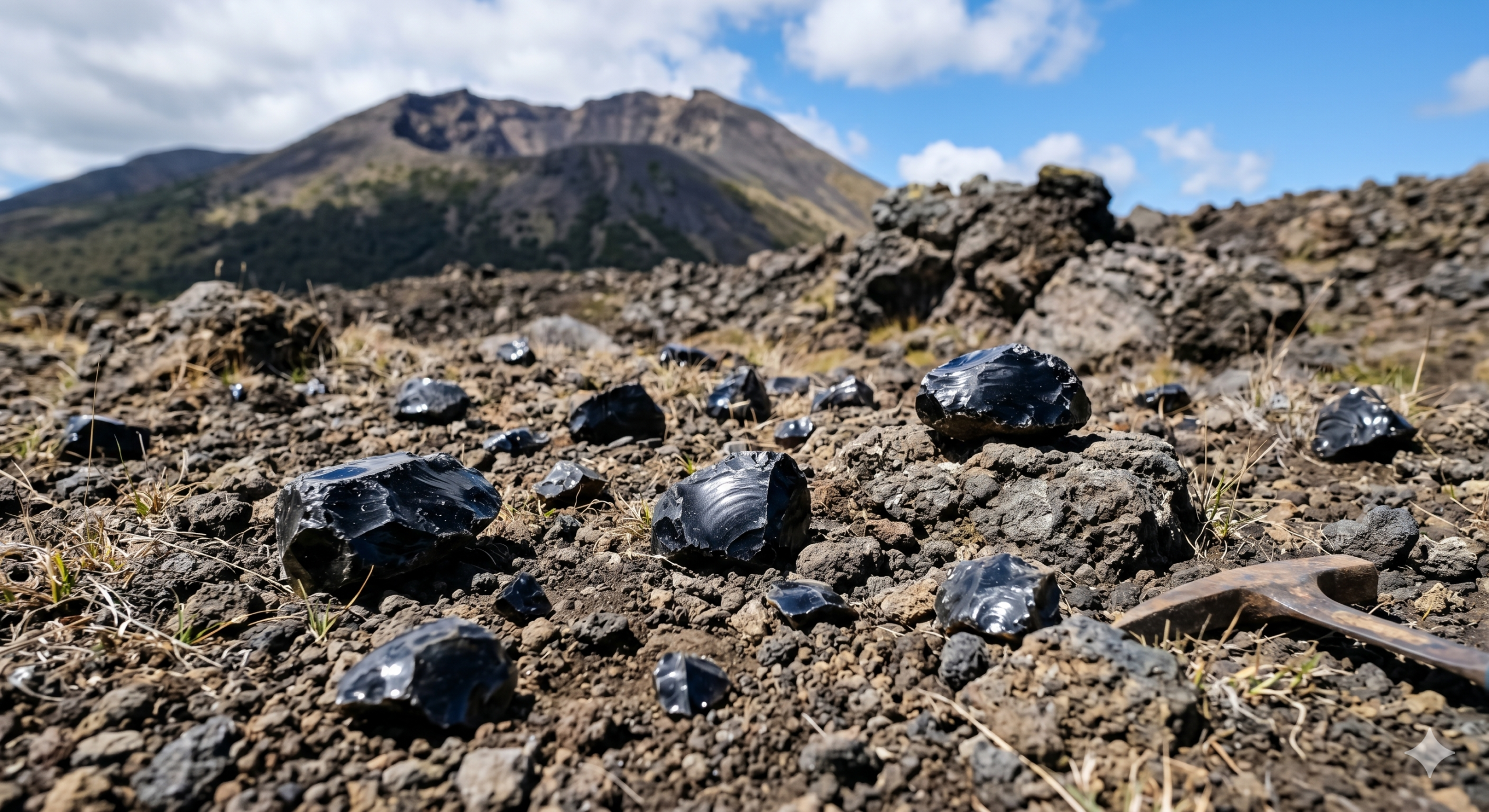
Obsidian is an extrusive igneous rock, but with a fascinating twist: it is a naturally occurring volcanic glass. Unlike gabbro or basalt, which are defined by their interlocking crystals, obsidian lacks a true crystalline structure. It is born from the violent, rapid events of volcanism, creating a material so uniquely smooth and sharp that it has shaped human history.
How Does It Form?

The Formation of Obsidian: A Step-by-Step Process
Part 1: High-Silica Magma Accumulation
The process begins deep within the Earth’s crust.
- Composition: Obsidian forms from felsic magma, which is exceptionally rich in silica ($SiO_2$).
- Viscosity: This high silica content makes the magma very viscous, meaning it is thick, sticky, and resistant to flow.
- Magma Chamber: The diagram shows this “Rhyolitic Magma Chamber” where the material accumulates before ascending.
Part 2: Volcanic Eruption
Pressure eventually forces the viscous magma toward the surface.
- Extrusion: A volcanic eruption occurs, pushing the thick magma through a volcanic vent.
- Surface Flow: Once it reaches the surface, it becomes a lava flow. At this stage, it is chemically identical to rhyolite, but the cooling conditions will determine its final form.
Part 3: The Cooling Mechanism (Core Concept)
This is the most critical stage of the process, where the speed of cooling dictates whether the rock becomes a crystalline stone or volcanic glass.
- Standard Cooling (Non-Obsidian): Slow to moderate cooling allows atoms enough time to organize into a geometric, ordered crystal structure. This results in rocks like granite or rhyolite.
- Rapid Cooling (Quenching): For obsidian to form, the lava must undergo extremely rapid cooling.
- Air-Quenching: Rapid cooling through contact with the atmosphere.
- Water-Quenching: Even faster cooling when lava flows into a lake or ocean.
- Atomic Result: This sudden “quenching” freezes the atoms in place before they can form crystals, resulting in a disordered (amorphous) structure.
Part 4: Final Product: Obsidian (Volcanic Glass)
Because it lacks a crystalline structure, obsidian is technically a natural volcanic glass rather than a traditional rock.
Microscopic View: Under a microscope (PPL), the “Glassy Matrix” may still contain tiny crystallites or vesicles (gas bubbles), but remains largely non-crystalline.
Vitreous Luster: It possesses a distinct, shiny, and glassy appearance.
Conchoidal Fracture: When broken, it exhibits characteristic curved breaks. These edges are extremely sharp, often reaching molecular levels of thinness.
What is Its Mineral Composition?
Here is the classic geological trick question: What minerals make up obsidian? Technically, none. Because it lacks an ordered internal atomic structure, obsidian is not composed of true minerals; it is classified as a mineraloid.
- The Silica Matrix: Chemically, it is predominantly composed of silicon dioxide (SiO2), typically reflecting a rhyolitic or granitic composition.
- The Color Paradox: Why is it so dark if it is felsic? The characteristic black or dark brown color comes from microscopic inclusions of dark minerals (like magnetite) or tiny rock fragments dispersed evenly throughout the clear glass matrix.
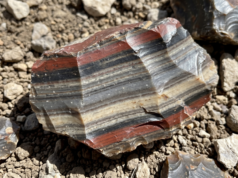
- Variations: Slight changes in impurities create stunning varieties. Iron oxide (hematite) creates reddish-brown “Mahogany Obsidian,” while microscopic gas bubbles can produce a golden or silver sheen.
How to Identify It in the Field (Outcrop and Core)?
Identifying obsidian is usually straightforward due to its distinctive physical properties:
- Conchoidal Fracture: This is its most defining diagnostic feature. When broken, it fractures along smooth, curved surfaces that resemble the inside of a bivalve shell (conchoidal).
- Glassy Luster: The surface reflects light sharply and cleanly, exactly like a piece of manufactured glass.
- Razor-Sharp Edges: Because it breaks along conchoidal planes without the interference of crystal boundaries, the fractured edges can taper down to molecular thinness.
- Amorphous Texture: You will not see any individual crystals or grains, no matter how closely you look.
Economic and Historical Importance
While it is not mined for massive industrial applications or VMS deposits like basalt, obsidian holds an unparalleled place in human and specialized economic history:
- Ancient Toolmaking: Because of its conchoidal fracture and razor-sharp edges, obsidian was the ultimate “high-tech” material for ancient civilizations. The Aztecs and Mayans extensively mined it to craft deadly spearheads, arrowheads, and the famous macuahuitl swords.
- Modern Surgical Scalpels: Even today, specialized surgical scalpels are manufactured from obsidian. An expertly knapped obsidian blade has a cutting edge many times sharper and smoother than high-quality steel surgical scalpels, causing less tissue damage and scarring.
- Gemstones and Jewelry: Due to its striking appearance (especially variants like Snowflake or Rainbow Obsidian), it is widely cut and polished for the gemstone and ornamental market.


Link exchange is nothing else however it is just placing the other person’s blog
link on your page at suitable place and other
person will also do same in support of you.
I’m very happy to uncover this page. I need to to
thank you for your time for this particularly fantastic read!!
I definitely savored every little bit of it and I have you saved to
fav to look at new information in your website.
Have you ever considered writing an ebook or guest authoring on other
websites? I have a blog based on the same information you discuss and would really like
to have you share some stories/information. I know my viewers would appreciate your work.
If you are even remotely interested, feel free to send me an email.
It’s nearly impossible to find experienced people in this particular topic, however, you sound like you know what
you’re talking about! Thanks
I don’t even know how I ended up here, however I
believed this submit used to be great. I don’t recognize who you are but certainly you’re
going to a well-known blogger in case you aren’t already.
Cheers!
Fantastic beat ! I would like to apprentice even as you amend your web site, how can i subscribe for a blog website?
The account helped me a applicable deal. I have been tiny
bit familiar of this your broadcast offered vivid transparent
concept
I know this if off topic but I’m looking into starting my own blog
and was wondering what all is required to get setup? I’m assuming having a blog like yours would
cost a pretty penny? I’m not very internet smart so I’m not 100%
sure. Any recommendations or advice would be greatly appreciated.
Cheers
Thank you for some other excellent post. The place else could anybody get that kind of info in such a perfect
manner of writing? I’ve a presentation subsequent week, and I am on the look for
such info.