
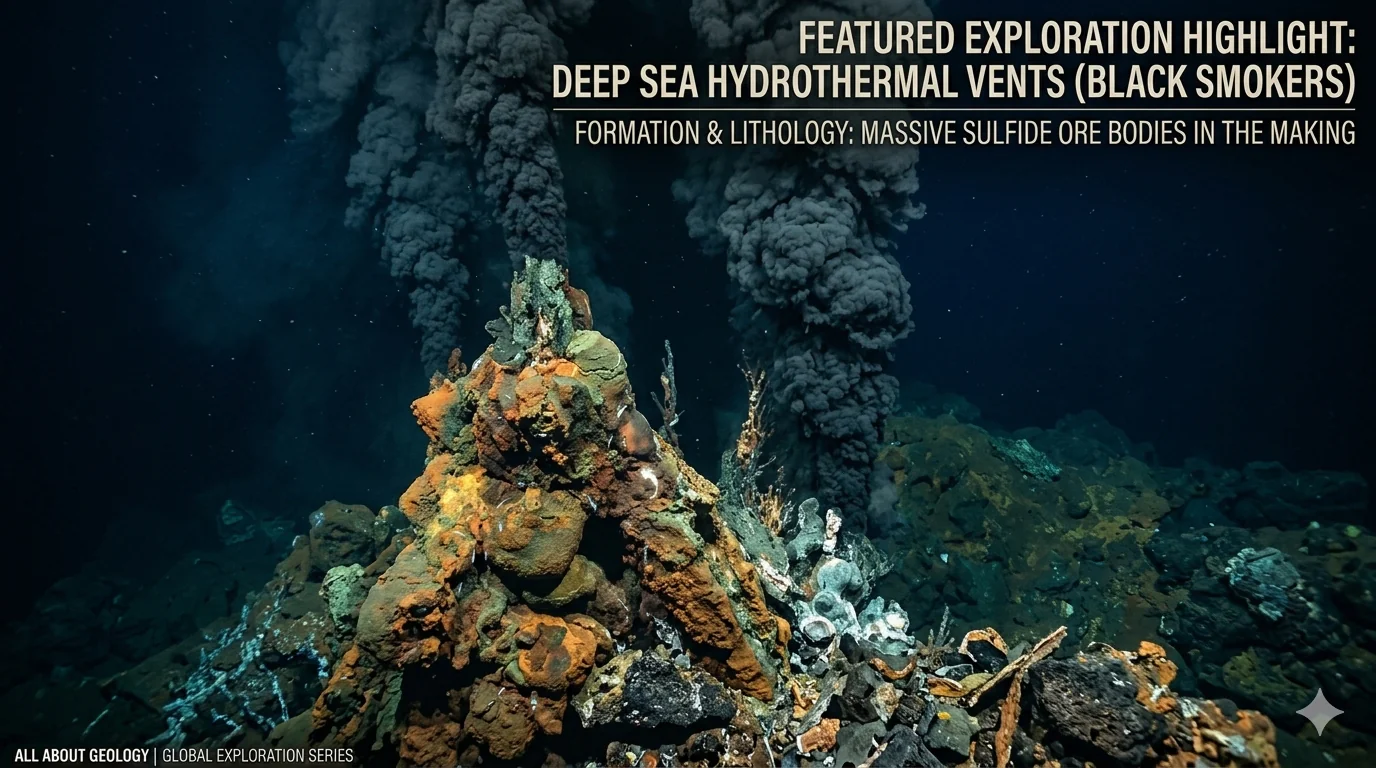
Volcanogenic Massive Sulfide (VMS) deposits represent some of the richest polymetallic mineral accumulations on Earth. Serving as premier global resources for copper (Cu), zinc (Zn), and lead (Pb)—often carrying high-grade credits of gold (Au), silver (Ag), and critical technology metals like indium (In), selenium (Se), and germanium (Ge)—Volcanogenic Massive Sulfide (VMS) deposits systems are primary exploration targets for juniors and major mining companies alike.
Formed on or immediately beneath submarine seafloors through the discharge of high-temperature hydrothermal fluids, VMS deposits are contemporary fossilized analogs of modern hydrothermal “black smoker” vents discovered along mid-ocean ridges and back-arc rifts.
This comprehensive geological guide examines the geodynamic environments, genetic circulation models, internal architecture, modern lithotectonic classifications, alteration vectoring indices, and key geophysical methods utilized to target VMS deposits globally.
1. Geodynamic and Tectonic Settings of Volcanogenic Massive Sulfide Deposits

Geodynamic settings of major VMS deposit subtypes across oceanic spreading ridges, oceanic island arcs, and continental back-arc rifts (modified after Franklin et al., 2005).
Volcanogenic Massive Sulfide (VMS) deposits are syn-genetic, stratiform to stratabound accumulations occurring within volcano-sedimentary sequences across dynamic extensional tectonic regimes. Crustal extension and elevated thermal regimes are critical prerequisites for generating and driving deep hydrothermal convection cells.
Key tectonic environments include:
- Oceanic Spreading Centers (Mid-Ocean Ridges – MORs): Characterized by juvenile oceanic crust and primitive tholeiitic to boninitic magmas. Hydrothermal activity is localized along axial graben bounding faults (e.g., modern East Pacific Rise, TAG hydrothermal field).
- Back-Arc Basins (Intra-Oceanic and Continental): Back-arc rifting triggers crustal thinning, crustal-scale fault reactivation, and mantle decompression melting. Continental back-arc settings (e.g., Bathurst, Iberian Pyrite Belt) produce enormous tonnages due to thick sediment blankets and abundant felsic magmatism.
- Island Arc Rifts and Calderas: Formed during arc extension where calderas act as focal collapse structures channeling intense, long-lived magmatic-hydrothermal fluid discharge (e.g., Kuroko district of Japan).
2. Hydrothermal Circulation and Genetic Model Volcanogenic Massive Sulfide (VMS) Deposits

The genesis of a VMS deposit relies on a convective plumbing engine powered by an underlying subvolcanic magma chamber acting as the driving thermal heat engine at 1.5 to 5 km depth beneath the seafloor.
          Cold Seawater Drawdown (Mg-Recharge)
                         │
                         ▼
        ┌──────────────────────────────────┐  Seafloor (Exhalative Massive Lens)
        │      MASSIVE SULFIDE MOUND       │  ◄── Black Smokers (300°C - 380°C)
        └────────────────┬─────────────────┘
                         │
              Chlorite-Quartz Core
            (Footwall Stringer Pipe)
                         │
        ▲                ▲                ▲
        │ Recharge Cell  │ Hydrothermal   │ Recharge Cell
        │ (Seawater-Rock │ Plume Ascent   │ (Fluid Stripping)
        │  Interaction)  │                │
        └────────────────┴────────────────┘
                         ▲
               Heat Engine / Intrusion
              (Subvolcanic Magma Body)
The 4-Stage Genetic Lifecycle
- Recharge and Downwelling: Ambient, oxygenated, cold (~2°C) seawater infiltrates the volcanic pile along deep extensional fracture systems. As seawater is heated (>150°C), magnesium reacts with rocks to form smectites and chlorite, stripping Mg from seawater and dropping solution pH to acidic levels (pH 2–3).
- High-Temperature Deep Reaction Zone: At temperatures exceeding 350°C near the subvolcanic intrusion boundary, the acidic, reduced fluid strips base and precious metals (Cu, Zn, Pb, Fe, Au, Ag) and silica from the surrounding volcanic wallrocks. Magmatic volatile degassing can contribute direct metal and sulfur budgets.
- Buoyant Hydrothermal Upflow: Driven by thermal buoyancy, the metal-bearing, reduced fluid ascends rapidly along focused syn-volcanic faults, preventing premature boiling through sufficient seafloor hydrostatic pressure (water depths typically >1,000–1,500 m).
- Discharge and Massive Sulfide Precipitation: As the 300°C–380°C fluid discharges into cold ambient seawater, violent thermal and chemical shock triggers instantaneous precipitation of sulfide minerals, building black smoker chimneys, collapse breccias, and bedded sulfide mounds.
3. Deposit Architecture and Mineral Zoning Volcanogenic Massive Sulfide (VMS) Deposits
In typical Volcanogenic Massive Sulfide deposits, the system exhibits a distinct bipolar architectural profile consisting of an upper stratiform massive sulfide lens and an underlying discordant footwall feeder pipe.
A. Stratiform Massive Sulfide Lens (Exhalative Body)
- Geometry: Sheet-like, mound-shaped, or stratiform lens resting conformably on footwall volcanics and capped by distal or syn-mineralization hanging wall units. Typically contains >50% sulfide minerals by volume.
- Mineralogy: Dominated by pyrite, pyrrhotite, sphalerite, chalcopyrite, and galena.
- Thermal and Chemical Zoning: High-temperature copper-rich core at the base (chalcopyrite + pyrrhotite), grading upward and outward into lower-temperature zinc-lead-silver-gold zones (sphalerite + galena + tetrahedrite + barite), capped by exhalative jaspers and cherts.
B. Footwall Feeder (Stringer / Stockwork Pipe)
- Geometry: A discordant, funnel-shaped vertical conduit crosscutting underlying stratigraphy.
- Mineralogy: Crosscutting vein networks, stringers, and disseminations of chalcopyrite, pyrite, quartz, and pyrrhotite.
- Significance: Represents the primary fluid highway; characterized by pervasive chloritization and intense silicification.
4. Lithotectonic Classification of Volcanogenic Massive Sulfide Deposits
| VMS Type | Dominant Host Rocks | Tectonic Setting | Base Metal Association | Key Examples |
|---|---|---|---|---|
| Mafic (Cyprus-type) | Ophiolitic MORB pillow basalts, minor pelagic sediments | Oceanic spreading ridges, fore-arcs | Cu (± Zn, Au, Ag); Pb-poor | Troodos (Cyprus), Semail (Oman) |
| Bimodal-Mafic (Noranda-type) | Basalt/mafic dominant; 15–25% rhyolitic domes | Oceanic island arcs, incipient rifts | Cu – Zn (± Au, Ag) | Noranda, Flin Flon, Kidd Creek (Canada) |
| Pelitic-Mafic (Besshi-type) | Equal proportions of mafic volcanics and clastic turbidites | Fore-arc or post-arc sedimented rifts | Cu – Zn (± Co, Ag, Au) | Besshi (Japan), Windy Craggy (Canada) |
| Bimodal-Felsic (Kuroko-type) | Rhyolites, dacites, and felsic pyroclastics dominant over basalts | Mature volcanic island arcs, arc calderas | Zn – Pb – Cu (± Ag, Au, Ba) | Hokuroku Basin (Japan), Buchans (Canada) |
| Siliciclastic-Felsic (Bathurst-type) | Thick continental sedimentary sequences and felsic subvolcanics | Continental back-arc rifts | Zn – Pb – Cu – Ag (± Au) | Bathurst (Canada), Iberian Pyrite Belt (Spain/Portugal) |
5. Hydrothermal Alteration Halos and Vectoring Indices

The Alteration Box Plot (Ishikawa AI vs. CCPI after Large et al., 2001). Exploration vector arrows show progression from unaltered volcanic host rocks toward the chlorite-pyrite-rich hydrothermal upflow pipe (AI > 85, CCPI > 85).
Hydrothermal alteration pipes beneath Volcanogenic Massive Sulfide deposits form systematic, concentric footprints. These footprints are often 5 to 20 times larger than the massive sulfide body, serving as critical vectors during exploration drilling.
         [ Distal Propylitic Alteration (Epidote - Calcite - Albite) ]
                                      │
                                      ▼
             [ Intermediate Sericite - Quartz - Pyrite Halo ]
                                      │
                                      ▼
       [ Proximal Chlorite - Quartz Core + Chalcopyrite Stringers ]
                (Total Na2O Leaching | Ishikawa AI: 85 - 100)
                                      │
                                      ▼
             ═══════════ STRATIFORM MASSIVE ORE LENS ═══════════
Concentric Footwall Alteration Zonation
- Inner Core (Fluid Conduit): Quartz + Mg-Fe Chlorite ± Chalcopyrite stringers. Characterized by total destruction of feldspars and primary rock textures.
- Intermediate Halo: Sericite (White Mica) + Quartz + Pyrite.
- Outer Fringe (Recharge/Outflow): Albite + Epidote + Calcite + Chlorite (propylitic assemblage).
- Hanging Wall Footprint: Semiconformable clay-carbonate-sericite alteration and geochemical enrichment (Na2O depletion, Ba, Tl, Sb, As anomalies) vectoring toward blind targets.
Key Quantitative Alteration Indices for Geochemists
Exploration teams rely on whole-rock lithogeochemical ratios to identify proximity to fluid upflow centers:
- Ishikawa Alteration Index (AI):
AI = 100 * (K2O + MgO) / (K2O + MgO + Na2O + CaO)
Interpretation: Unaltered volcanic rocks yield values between 20 and 40. Values approaching 80 to 100 signify intense sericite-chlorite metasomatism and proximal vent facies due to complete plagioclase breakdown and sodium leaching. - Chlorite-Carbonate-Pyrite Index (CCPI):
CCPI = 100 * (MgO + FeO) / (MgO + FeO + Na2O + K2O)
Interpretation: Measures chlorite and pyrite enrichment relative to muscovite/illite. Paired with the Ishikawa Index in a Box Plot (Large et al., 2001), this vectors directly toward the central high-temperature hydrothermal pipe.
6. Modern Geophysical and Geochemical Exploration Toolkits

Geophysics
- Electromagnetic (EM) Surveys (VTEM, Airborne, Ground & Borehole EM): Massive sulfide lenses (especially those rich in pyrrhotite, pyrite, and chalcopyrite) exhibit high electrical conductivity compared to resistive silicate host rocks. Borehole EM (BHEM) is essential for off-hole drill targeting.
- Gravity Surveys: Because sulfide assemblages possess significantly higher rock densities (3.8 – 4.8 g/cm³) than surrounding felsic/mafic host lithologies (2.6 – 2.9 g/cm³), positive residual gravity anomalies reliably pinpoint massive accumulations, including sphalerite-rich (non-conductive) zones.
- Magnetics: High magnetic anomalies highlight pyrrhotite- or magnetite-bearing stockworks and exhalite horizons.
Geochemistry and Mineral Chemistry
- Pathfinder Elements: Systematic soil, stream sediment, and drill-core assays tracking volatile and mobile elements: Hg, As, Sb, Tl, Ba, and Bi.
- SWIR/VNIR Spectral Mineralogy (TerraSpec / Halo): Mapping white mica composition shifts. Aluminum-poor, Fe-Mg rich phengitic white micas vector systematically toward hotter, proximal hydrothermal cores.
Summary & Key Takeaways
- Syn-Genetic Seafloor Origin: Volcanogenic Massive Sulfide deposits form synchronously on the paleo-seafloor via high-temperature fluid venting.
- Dual Architecture: A stratiform, exhalative massive sulfide lens zoned from Cu-rich bases to Zn-Pb-Ag-Ba tops, underlain by a discordant footwall stringer feeder pipe.
- Vectoring Power: Lithogeochemical indices (Na2O depletion, Ishikawa AI > 85, CCPI > 85) combined with borehole EM and residual gravity represent the modern industry standard for discovery.
Frequently Asked Questions (FAQ)
What is the main difference between Volcanogenic Massive Sulfide deposits and SEDEX deposits?
While both are seafloor exhalative sulfide deposits, VMS systems are driven by subvolcanic magmatic heat engines within volcanically active tectonic rifts (island arcs, oceanic ridges). In contrast, Sedimentary Exhalative (SEDEX) deposits form in passive intracontinental or continental-margin sedimentary basins driven by geothermal basin-dewatering without proximate volcanic activity, primarily hosting Zn-Pb-Ag.
Why do some Volcanogenic Massive Sulfide (VMS) deposits fail to show an electromagnetic (EM) conductor anomaly?
Zinc-rich VMS deposits dominated by sphalerite and barite without abundant interconnected pyrrhotite, pyrite, or chalcopyrite are poor electrical conductors. In such cases, high-resolution ground or airborne gravity surveys provide the primary geophysical targeting tool due to density contrast.
What is the economic lifespan of a typical Volcanogenic Massive Sulfide (VMS) deposits camp?
VMS deposits characteristically occur in distinct clusters or “camps” sharing common volcanic stratigraphy (e.g., Noranda, Flin Flon, Iberian Pyrite Belt). Discovery of a single lens frequently indicates the presence of multiple stacked or adjacent pods, sustaining mining camps for several decades.