Dacite is a light-colored, fine-grained (aphanitic) to porphyritic extrusive (volcanic) igneous rock. It occupies the compositional middle ground between the intermediate andesite and the highly felsic rhyolite. Petrologically, it is the exact volcanic equivalent of granodiorite. When the magma that would normally cool deep underground to form granodiorite erupts onto the surface, it forms dacite.
How Does It Form?

Primary Mafic Magma (1): The initial mantle-derived basaltic melt.
Fractional Crystallization (2): As the magma begins to cool, minerals with high melting points (such as olivine and pyroxene) crystallize first and are removed from the melt, primarily by settling. This process, fractional crystallization, makes the remaining liquid progressively more silicic (rich in SiO2).
Crustal Assimilation & Magma Mixing (3): The ascending magma may encounter pools of existing felsic magma, leading to magma mixing, or it can melt and assimilate parts of the surrounding silicic continental crust. Both processes introduce significant silica and alkalies into the melt, pushing its composition toward intermediate.
Intermediate Magma (4): The result of early differentiation and crustal contamination is an intermediate (e.g., andesitic) magma, with a silica content between 52% and 63%.
Continued Fractional Crystallization (5): This is a critical stage. In an intermediate magma chamber, a new set of large crystals—phenocrysts—crystallize: primarily plagioclase feldspar, along with amphiboles (like hornblende) and micas (like biotite). Some early quartz may also form, but it often becomes unstable, leading to the rounded and corroded forms (corroded quartz phenocrysts) seen in the final rock.
Dacitic Magma (6): After extensive differentiation, with a silica content between 63% and 69%, the result is dacitic magma. It is highly viscous due to its high silica content and often contains large dissolved water contents, making it prone to explosive eruption.
Panel C. Final Stage: Eruption & Texture
Dacite Texture and Composition: The final volcanic rock, dacite, has a distinctive porphyritic texture, composed of two separate cooling stages. Large crystals (phenocrysts), which grew slowly in the magma chamber (visible plagioclase, quartz, hornblende, and biotite), are embedded in a fine-grained groundmass (visible in the thin section micrograph), which formed by rapid cooling upon eruption. As noted in the Dacite Composition Key, it is composed predominantly of plagioclase feldspar and quartz.
Eruption: When the pressure of trapped gases in the viscous dacitic magma becomes too great, it erupts explosively at the surface, forming stratovolcanoes, pyroclastic flows, and viscous lava flows or domes.
What is Its Mineral Composition?
Dacite represents an intermediate-felsic composition, meaning it is rich in light-colored minerals but still contains a noticeable amount of mafic (dark) components:
- Plagioclase Feldspar (Andesine to Oligoclase): The most abundant mineral, often forming distinct, blocky white crystals.
- Quartz: A defining characteristic of dacite. Unlike andesite, which rarely has visible quartz, dacite frequently contains rounded, glassy quartz crystals.
- Mafic Minerals: Biotite (black mica) and hornblende (amphibole) are the typical dark minerals, providing a speckled appearance against the lighter groundmass. Pyroxene can sometimes be present in minor amounts.
How to Identify It in the Field (Outcrop and Core)?

Identifying dacite in a core box or in the field often requires careful observation of its texture and mineralogy:
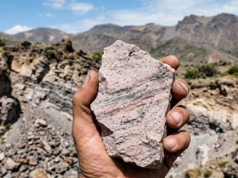
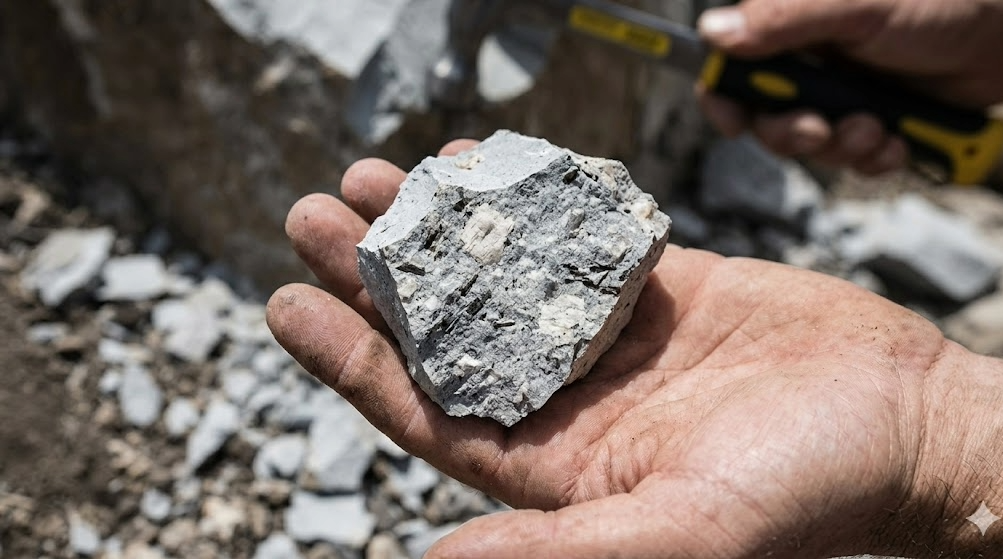
- Porphyritic Texture: Dacite is very frequently porphyritic. You will typically see large, visible crystals (phenocrysts) of white plagioclase and glassy quartz embedded in a very fine-grained, grey, light brown, or pale green groundmass.
- Color Index: It is usually light to medium grey, sometimes with brownish or greenish tints depending on alteration. It is generally lighter than andesite but can be difficult to distinguish without a petrographic microscope.
- The Quartz Clue: The most reliable field test to differentiate dacite from andesite is the presence of visible quartz phenocrysts (“quartz eyes”). If you see glassy, rounded quartz grains in an intermediate volcanic rock, you are likely looking at dacite.
Economic Importance (The Porphyry & Epithermal Link)
Dacite and its sub-volcanic (porphyritic) equivalents are absolute heavyweights in the mining industry.
- Porphyry Copper-Molybdenum Deposits: Dacitic porphyries are classic host rocks for massive, world-class copper and molybdenum deposits. Because these sub-volcanic intrusions and their associated alteration halos (like potassic, phyllic, and argillic zones) are highly complex, resource geologists frequently rely on advanced 3D modeling environments like Leapfrog Geo to accurately visualize the structural controls, map the intrusive contacts, and build grade shells before planning deep drilling campaigns.
- High-Sulfidation Epithermal Gold: The explosive volcanic centers and dome complexes formed by dacite are the prime geological engines for high-sulfidation epithermal gold and silver deposits. The highly acidic hydrothermal fluids associated with these systems create massive vuggy silica alteration zones, which act as primary targets for exploration.