

Sphalerite mineral (zinc sulfide, ZnS) represents the undisputed global cornerstone of zinc production. Accounting for more than 95% of primary zinc extracted worldwide, this versatile sulfide is also the premier geological host for critical high-technology byproducts, including indium (In), gallium (Ga), and germanium (Ge)—elements vital for semiconductor manufacturing, fiber optics, and photovoltaic solar cells.
From deep-sea volcanic hydrothermal vents to epigenetic carbonate replacements in intracontinental basins, the Sphalerite mineral exhibits exceptional physical diversity. Its appearance ranges from honey-yellow gemmy crystals to pitch-black, iron-saturated masses historically termed “blackjack.”
This comprehensive economic geology guide investigates the crystallographic properties, optical characteristics, trace element chemistry, deposit associations, petrographic textures (such as the famous chalcopyrite disease), and field identification criteria of the Sphalerite mineral.
1. Crystallography and Chemical Composition of Sphalerite Mineral
Sphalerite crystallizes in the isometric (cubic) crystal system, specifically belonging to the hextetrahedral crystal class (space group F-43m). Its internal atomic architecture consists of a face-centered cubic (FCC) close-packed lattice of sulfur anions, with zinc cations occupying half of the tetrahedral interstices.
Formula: ZnS (Pure: 67.1% Zn, 32.9% S)
Crystal System: Isometric (Hextetrahedral, 43m)
Unit Cell Dimensions: a = 5.41 Å, Z = 4
Cleavage: Perfect Dodecahedral in 6 directions {110}
Polymorph: Wurtzite (High-Temperature Hexagonal Polymorph, >1020°C)
Key Substitutions: Fe, Cd, Mn, In, Ga, Ge, Se, Hg
While stoichiometric zinc sulfide is purely ZnS, natural Sphalerite mineral specimens invariably deviate toward a solid-solution series with iron sulfide (FeS):
- Cleiophane (Iron-Poor): Transparent to translucent, pale yellow, green, or colorless varieties containing less than 1% to 2% Fe. Characterized by high optical transmission and brilliant adamantine luster.
- Marmatite (Iron-Rich / “Blackjack”): Dark brown to submetallic pitch-black Sphalerite containing up to 20% to 26% Fe replacing Zn in the crystal lattice. Iron substitution drastically lowers the optical bandgap, rendering the mineral opaque in thin sections and giving it a dark brown streak.
2. Physical and Optical Diagnostic Properties
Identifying the Sphalerite mineral in drill core, hand specimens, and under the reflected-light petrographic microscope relies on a distinct combination of physical and optical properties:
| Diagnostic Property | Hand Specimen & Physical Expression | Reflected Light Microscopy |
|---|---|---|
| Color | Yellow, honey-brown, red (“ruby zinc”), dark brown to pitch black. | Medium gray, isotropic. Reflectance ~17% (low for a sulfide). |
| Luster | Resinous to adamantine; submetallic in iron-rich marmatite varieties. | Non-metallic sheen, displays abundant internal reflections. |
| Cleavage | Perfect dodecahedral {110} in 6 directions at 60° and 90° angles. | Characteristic triangular polishing pits along cleavage intersections. |
| Streak | White to pale yellow in low-Fe types; brownish-yellow in dark types. | N/A |
| Hardness & Density | Mohs 3.5 – 4.0 | Specific Gravity: 3.9 – 4.1 g/cm³ (moderately heavy). | Low polishing relief relative to pyrite and chalcopyrite. |
| Internal Reflections | Visible under strong sunlight on crystal edges. | Spectacular internal reflections under crossed polars (yellow, orange, ruby-red). |
3. Critical Technology Elements Hosted in Sphalerite Mineral
In modern critical minerals geology, the Sphalerite mineral is prized not only for zinc base metal but as the primary geopolitical reservoir for strategic high-tech critical metals. These trace elements substitute into the tetrahedral Zn site via coupled substitution mechanisms:
- Indium (In): Sphalerite is the world’s primary commercial source of indium. Enters the crystal structure through coupled substitution:
2 Zn²⁺ ↔ Cu⁺ + In³⁺. Indium is indispensable for Indium Tin Oxide (ITO) touchscreens and flat-panel displays. - Germanium (Ge): Highly enriched in low-temperature Sphalerite mineral occurrences (such as MVT and sediment-hosted deposits). Replaces zinc via:
3 Zn²⁺ ↔ 2 Fe³⁺ + Ge⁴⁺. Essential for fiber-optic cables, infrared optics, and high-efficiency solar cells. - Gallium (Ga): Associated with epithermal and carbonate-hosted systems. Operates as a critical component in gallium arsenide (GaAs) semiconductors and 5G telecommunication chips.
- Cadmium (Cd): Complete diadochy exists between ZnS and greenockite (CdS) due to identical ionic radii, often reaching concentrations of 0.1% to 0.5% Cd.
4. Major Ore Deposit Associations
The Sphalerite mineral precipitates across a wide range of hydrothermal conditions, from shallow low-temperature diagenetic aquifers to high-temperature submarine exhalative brine pools:
A. Volcanogenic Massive Sulfide (VMS) Deposits
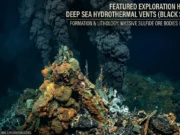
In submarine exhalative VMS systems (e.g., Kidd Creek, Flin Flon, Kuroko), the Sphalerite mineral dominates the upper, cooler rooftop facies and peripheral fringes of the massive sulfide mound (150°C–250°C). It coexists with galena, tetrahedrite, and barite, underlain by high-temperature chalcopyrite-pyrrhotite footwall stringers.
B. Sedimentary Exhalative (SEDEX) Deposits
SEDEX deposits host the largest zinc accumulations on the planet (e.g., Red Dog in Alaska, Mount Isa and McArthur River in Australia). Sphalerite occurs as fine-grained, rhythmically laminated, stratiform sulfide bands interbedded with carbonaceous shales and cherts, precipitated from dense saline brine pools.
C. Mississippi Valley-Type (MVT) Deposits

In passive continental carbonate platforms (e.g., Tri-State District, Pine Point, Viburnum Trend), epigenetic basinal brines at 80°C–150°C replace dolostones and limestones. Sphalerite occurs as coarse, banded, botryoidal (“schalenblende”) crusts and magnificent vug-filling crystals exhibiting delicate color zoning.
D. Polymetallic Skarns and Epithermal Veins
In contact metasomatic skarns (calcic and magnesian) and intermediate-sulfidation epithermal quartz veins, the Sphalerite mineral precipitates alongside galena, chalcopyrite, calcite, and fluorite, often carrying exceptional precious metal credits.
5. Petrographic Texture: The “Chalcopyrite Disease” in Sphalerite

One of the most famous and debated micro-textures in economic geology is “chalcopyrite disease”—the ubiquitous occurrence of micron-sized blebs, droplets, and worm-like vermicular stringers of chalcopyrite (CuFeS2) oriented along crystallographic planes within host Sphalerite mineral grains.
[ Copper-Bearing Hydrothermal Fluid Infiltration (Cu²⁺) ]
                           │
                           ▼
          Diffusion along {111} Cleavage Planes
                           │
                           ▼
       ZnS + Cu²⁺ (aq) + Fe²⁺ (aq) ──► CuFeS₂ (Blebs) + Zn²⁺ (aq)
                           │
                           ▼
    ════════ MICRO-TEXTURE: CHALCOPYRITE DISEASE ════════
       (Micron-scale chalcopyrite droplets inside Sphalerite)
Genetic Debate and Metallurgical Impact:
- Exsolution Hypothesis: Historically interpreted as high-temperature solid solution unmixing of Cu-Fe from ZnS upon cooling.
- Hydrothermal Replacement Hypothesis (Modern Consensus): Experimental evidence (Barton & Bethke, 1987) proved that chalcopyrite disease is primarily a sub-solidus metasomatic replacement texture produced when copper-rich hydrothermal fluids interact with pre-existing iron-bearing Sphalerite.
- Metallurgical Challenge: The sub-micron size of these chalcopyrite inclusions prevents complete physical liberation during milling, resulting in unwanted copper misplacement into zinc flotation concentrates.
6. Field Identification and How to Differentiate Look-Alikes
In the field, geologists can definitively identify the Sphalerite mineral using these core diagnostic tests:
- 6-Direction Perfect Cleavage: Rotated under sunlight, Sphalerite displays countless flashing cleavage planes reflecting light simultaneously from multiple angles.
- Resinous “Rosin Jack” Luster: Even dark varieties exhibit a characteristic amber-resinous sheen along fresh fracture edges that distinctly separates it from purely metallic sulfides like galena.
- Streak Test: Despite its frequently pitch-black color, scraping marmatite on an unglazed porcelain streak plate produces a distinct, pale brownish-yellow streak, unlike the dark lead-gray streak of galena or the greenish-black streak of chalcopyrite.
- Hydrochloric Acid (HCl) Reaction: Powdered Sphalerite dissolves in concentrated HCl, releasing characteristic hydrogen sulfide gas (rotten egg smell).
Summary & Key Takeaways
- Primary Zinc Resource: The Sphalerite mineral is the foremost global ore of zinc and the primary supply source for strategic technology metals (In, Ga, Ge).
- Compositional Spectrum: Solid solution ranges from pale, iron-poor cleiophane to pitch-black, iron-rich marmatite containing over 20% FeS.
- Geological Settings: Dominates submarine exhalative mounds (VMS, SEDEX), carbonate-replacement aquifers (MVT), and hydrothermal vein/skarn complexes.
- Diagnostic Footprint: Identified by 6-directional perfect cleavage, resinous luster, pale yellow-brown streak, and distinctive internal reflections under reflected light microscopy.
Frequently Asked Questions (FAQ)
What is the difference between Sphalerite and Galena?
While frequently intergrown as co-genetic lead-zinc sulfides, Galena (PbS) has cubic cleavage in 3 directions at 90°, a metallic silvery luster, a much higher specific gravity (7.6 g/cm³), and a lead-gray streak. In contrast, Sphalerite (ZnS) exhibits dodecahedral cleavage in 6 directions, a resinous to adamantine luster, lower density (~4.0 g/cm³), and a pale yellow to brown streak.
Why does iron content change the color of Sphalerite?
Pure zinc sulfide has a wide electronic bandgap (~3.6 eV), making it transparent and nearly colorless. As Fe²⁺ progressively substitutes for Zn²⁺ in the tetrahedral crystal lattice, electronic d-d transitions introduce energy states into the bandgap, shifting the transmitted light from yellow to ruby-red, dark brown, and finally opaque black (marmatite).
Why is Sphalerite critical for the green energy transition?
Beyond traditional galvanized steel rust-proofing, Sphalerite is the exclusive industrial host for indium and germanium. Indium is critical for Indium Tin Oxide (ITO) conductive coatings on solar panels and touchscreens, while germanium is irreplaceable in next-generation high-efficiency multi-junction photovoltaic cells and fiber optics.
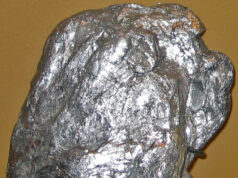
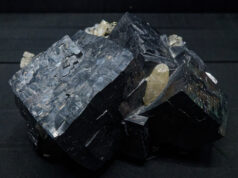
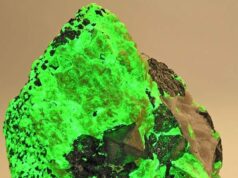


[…] economic geology, the Galena mineral is the inseparable paragenetic twin of sphalerite (ZnS). Together, they anchor the world’s largest base-metal accumulations across submarine […]