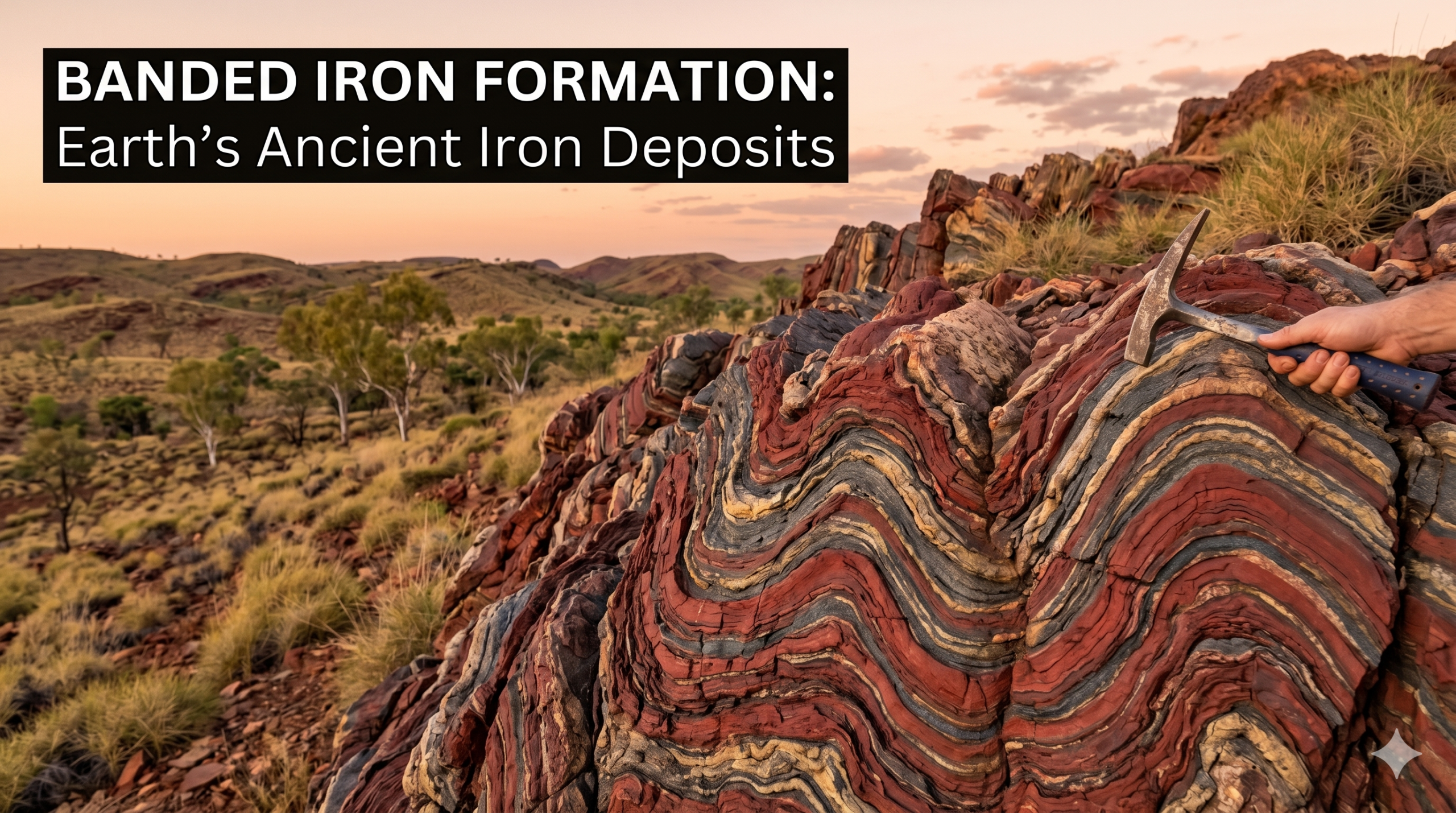
If you want to understand the history of Earth’s atmosphere and the driving force behind modern human civilization’s steel industry, you must look at Banded Iron Formations (BIFs). These visually stunning, layered sedimentary rocks are not just the world’s most important source of iron ore; they are chemical time capsules recording the exact moment our planet took its first breath of oxygen.
In this geological guide, we will explore what banded iron formations are, the unique planetary conditions that created them, and where these massive deposits are mined today.
What is a Banded Iron Formation?

A banded iron formation (BIF) is a distinct type of sedimentary rock characterized by its alternating, millimeter-to-centimeter scale layers (bands).
- The Iron Bands: These dark gray, black, or reddish layers are rich in iron oxide minerals, primarily magnetite (Fe₃O₄) and hematite (Fe₂O₃).
- The Silica Bands: Interleaved between the iron layers are lighter-colored bands of silica, typically in the form of chert, jasper, or microcrystalline quartz.
By geological definition, a sedimentary rock must contain at least 15% iron to be classified as a banded iron formation, though economically mined deposits have been naturally enriched to contain 60% to 65% iron.
The Great Oxidation Event: How Did BIFs Form?
banded iron formation is a phenomenon entirely unique to the Precambrian Supereon (specifically between 2.4 and 1.8 billion years ago). They cannot form in today’s oceans. Their creation is intimately tied to the Great Oxidation Event (GOE).
- The Ancient, Iron-Rich Ocean: Over two billion years ago, Earth’s oceans were highly acidic and completely devoid of dissolved oxygen (anoxic). Because there was no oxygen, massive amounts of iron released from underwater hydrothermal vents and weathering of the early continental crust remained dissolved in the seawater.
- The Biological Spark (Cyanobacteria): Shallow coastal waters became home to some of Earth’s earliest life forms: cyanobacteria (blue-green algae). Through the newly evolved process of photosynthesis, these microscopic organisms began pumping free oxygen into the ocean.
- The Chemical Reaction: As this biological oxygen mixed with the iron-rich seawater, a massive chemical reaction occurred. The dissolved iron oxidized (essentially “rusting” in the ocean), becoming insoluble.
- Precipitation and Banding: The oxidized iron precipitated and settled onto the ocean floor as iron-rich sludge. The banding pattern is believed to be cyclical—perhaps driven by seasonal changes, variations in bacteria populations, or shifting oceanic currents—alternating between periods of iron deposition and periods of silica (chert) deposition.
The Global Distribution of BIFs
BIFs represent immense, basin-wide sedimentary events. Because they formed billions of years ago, they are exclusively found in the ancient, stable cores of continents known as cratons or shields.
- The Hamersley Basin (Australia): Located in the Pilbara region of Western Australia, this is one of the most famous and economically productive BIF districts in the world.
- Carajás Province (Brazil): Home to some of the highest-grade iron ore deposits globally, heavily enriched by later supergene processes.
- The Mesabi Range (USA): Located around the Great Lakes (Lake Superior), this region fueled the American industrial revolution.
- Kuruman Iron Formation (South Africa): A classic and exceptionally well-preserved example of early Proterozoic banded iron.
Economic Significance and Modern Mining
Today, Banded Iron Formations account for more than 60% of global iron reserves. While the original rock (often called taconite) is relatively low grade (20-30% Fe), billions of years of geological weathering and hydrothermal fluid circulation have naturally enriched specific zones, leaching away the silica and leaving behind high-grade hematite and magnetite ores.
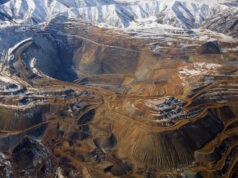
Mining these massive deposits is a colossal undertaking, mostly done through expansive open-pit operations. Once crushed and processed, this iron becomes the foundational ingredient for global steel production, building our modern cities, bridges, and infrastructure.