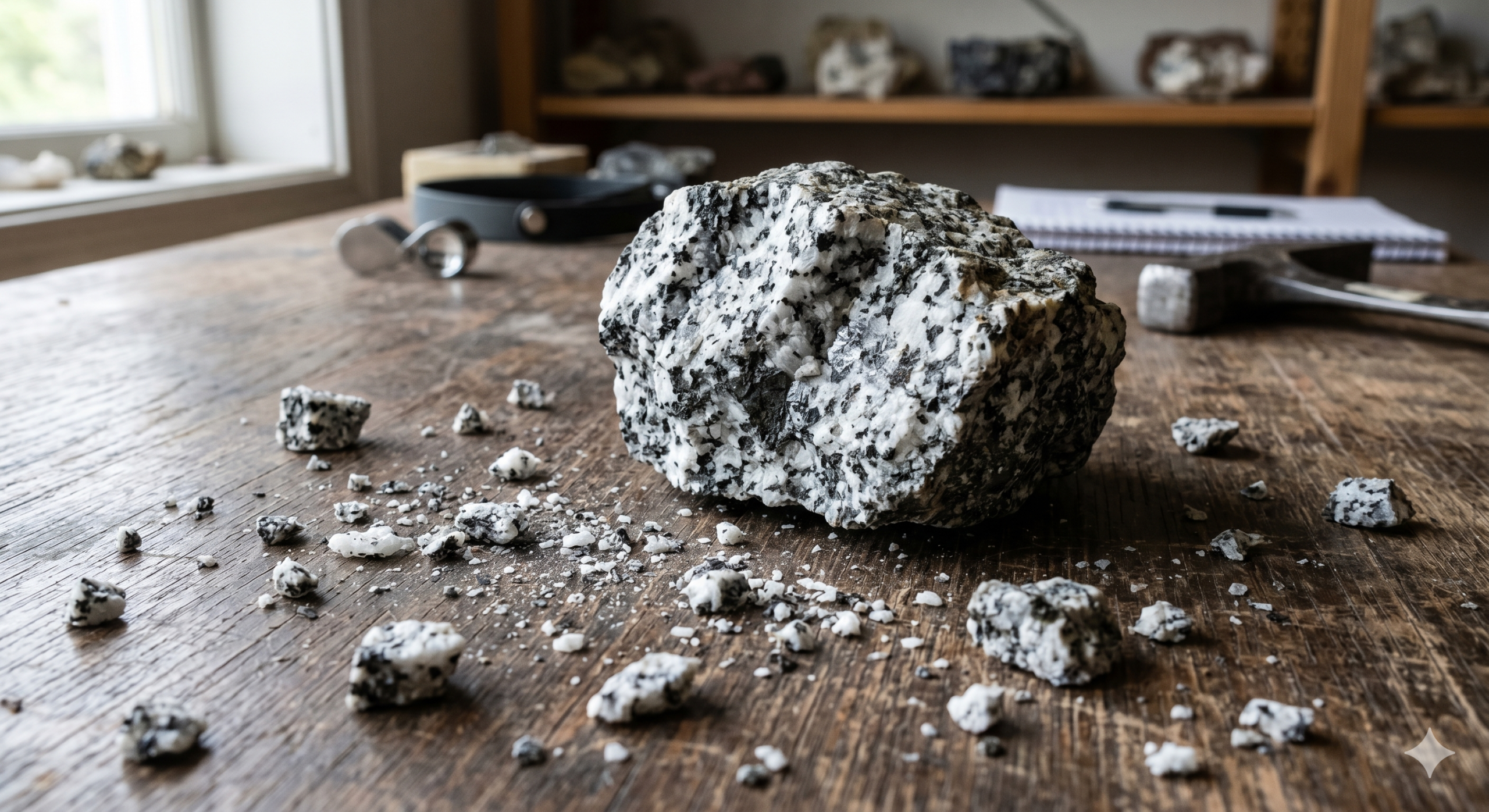
Diorite is a coarse-grained (phaneritic), intermediate intrusive (plutonic) igneous rock. It represents the perfect petrological middle ground between the light-colored, silica-rich granites of the continents and the dark, mafic gabbros of the deep ocean floor. Because of its distinct contrasting mix of white and black minerals, it is affectionately known among geologists as the “salt and pepper” rock.
How Does It Form?

Panel 1: Tectonic Setting (Continental Volcanic Arc)
Diorite formation begins deep within the Earth, typically in specific tectonic environments.
- Subduction Zone: The diagram illustrates an oceanic plate subducting beneath a continental plate. This process causes “Subduction-Zone Melting.”
- Magma Mixing: The crucial step for diorite is the creation of Intermediate Magma. This happens when:
- Mafic Magma: Hot, dense magma derived from the mantle rises.
- Felsic Magma: The rising mafic magma melts the overlying silica-rich continental crust, creating felsic magma.
- When these two distinct magma types (Mafic + Felsic) mix, or when mafic magma partially assimilates continental crust, the result is an intermediate composition magma that will form a “Diorite Pluton.”
Panel 2: Intrusion and Slow Cooling
Once the intermediate magma is formed, it does not erupt to the surface.
- Intrusion: The magma intrudes into the surrounding solid “Country Rock” deep within the crust, forming a large magma body called a pluton.
- Cooling Rate: The text emphasizes “SLOW COOLING DEEP IN CRUST.” Because it is insulated by miles of rock, the magma loses heat very slowly.
- Crystallization Progress: This slow cooling rate allows atoms plenty of time to organize and build large mineral crystals.
Panel 3: Crystallization & Mineral Composition
As the magma cools, specific minerals begin to crystallize based on the intermediate chemical composition.
- Texture: The slow cooling results in an “Interlocking Phaneritic Texture,” meaning the crystals are large enough to be seen easily with the naked eye.
- Mineralogy: Diorite is characterized by a specific mix of light and dark minerals. The diagram highlights:
- Light Minerals: Primarily “Plagioclase Feldspar” (typically striated and light-colored). Notably, diorite contains no quartz or very little quartz (which distinguishes it from granite).
- Dark Minerals: Primarily “Hornblende” (dark, pleochroic) and “Biotite Mica” (brown flakes), with occasional “Augite.” This balanced mix of light plagioclase and dark mafic minerals gives diorite its classic appearance.
Panel 4: Uplift and Exposure
The final stage brings the deeply formed rock to the surface where we can observe it.
The Result: The inset shows a “Diorite Hand Sample,” displaying its visually distinct “Salt-and-Pepper Texture” created by the contrasting light (Plagioclase) and dark (Hornblende, Biotite) minerals.
Tectonic Uplift: Geological forces push the crust upwards over millions of years, building mountains (“Tectonic Uplift”).
Erosion: Simultaneously, wind, water, and ice erode the overlying rock away.
Exposure: Eventually, the deeply buried “Exposed Diorite Pluton (Batholith)” is revealed at the Earth’s surface.
What is Its Mineral Composition?
As an intermediate rock, diorite hosts a balanced mix of both felsic and mafic minerals:
- Plagioclase Feldspar (Andesine): This makes up the “salt” portion of the rock. Unlike the calcium-rich dark plagioclase in gabbro, the plagioclase in diorite is usually white or light gray.
- Hornblende (Amphibole) and Biotite: These are the primary dark mafic minerals that provide the “pepper.” They appear as black, shiny, or dark green crystals.
- Pyroxene (Augite): Sometimes present in minor amounts, bridging the gap toward gabbro.
- Quartz: Diorite typically contains little to no quartz (less than 5%). If the quartz content increases significantly, the rock transitions into a Quartz Diorite or Tonalite.
How to Identify It in the Field (Outcrop and Core)?

Identifying diorite in a core box or at an outcrop is highly reliant on its visual texture:
- The “Salt and Pepper” Look: This is the most diagnostic feature. You will see roughly equal amounts (or slightly more light than dark) of distinct white plagioclase crystals interlocked with black hornblende or biotite.
- Phaneritic Texture: All the essential minerals are large enough to be clearly distinguished with the naked eye or a standard geological hand lens.
- Color Index (Mesocratic): It is intermediate in color. It is noticeably lighter than gabbro but much darker and completely lacking the pinkish potassium feldspars commonly found in granite.
- No Quartz Shine: Unlike granites, when you tilt a piece of diorite in the sunlight, you will generally not see the glassy, irregular gray blebs of quartz.
Economic and Historical Importance
Diorite is an incredibly tough, durable, and hard rock—characteristics that have defined its use throughout human history and modern industry:
- Ancient Monuments and Sculptures: Because it is so difficult to carve but holds fine details beautifully without polishing away, ancient civilizations prized it. The famous statues of Gudea of Lagash from ancient Mesopotamia and numerous Egyptian sculptures were carved from solid diorite.
- Dimension and Facing Stone: Today, it is cut and polished for architectural applications, including building facades, durable countertops, and cobblestones.
- The Porphyry Connection: In economic geology, intermediate intrusive rocks like diorite and granodiorite are the classic host rocks or “heat engines” for world-class Porphyry Copper-Gold deposits. The hydrothermal systems driven by these intermediate plutons are responsible for a significant portion of the world’s copper and gold supply.


… [Trackback]
[…] Read More on on that Topic: allaboutgeology.com/diorite-rock-properties-formation-uses/ […]
… [Trackback]
[…] Info on that Topic: allaboutgeology.com/diorite-rock-properties-formation-uses/ […]
… [Trackback]
[…] Information to that Topic: allaboutgeology.com/diorite-rock-properties-formation-uses/ […]
… [Trackback]
[…] There you can find 62907 more Information on that Topic: allaboutgeology.com/diorite-rock-properties-formation-uses/ […]
… [Trackback]
[…] Information to that Topic: allaboutgeology.com/diorite-rock-properties-formation-uses/ […]
… [Trackback]
[…] Read More Info here on that Topic: allaboutgeology.com/diorite-rock-properties-formation-uses/ […]
… [Trackback]
[…] Here you can find 60058 more Information on that Topic: allaboutgeology.com/diorite-rock-properties-formation-uses/ […]
… [Trackback]
[…] Find More here to that Topic: allaboutgeology.com/diorite-rock-properties-formation-uses/ […]
… [Trackback]
[…] Here you will find 88569 more Information to that Topic: allaboutgeology.com/diorite-rock-properties-formation-uses/ […]
… [Trackback]
[…] Information to that Topic: allaboutgeology.com/diorite-rock-properties-formation-uses/ […]
… [Trackback]
[…] Find More on to that Topic: allaboutgeology.com/diorite-rock-properties-formation-uses/ […]
… [Trackback]
[…] Find More Information here on that Topic: allaboutgeology.com/diorite-rock-properties-formation-uses/ […]
… [Trackback]
[…] There you will find 20683 additional Information on that Topic: allaboutgeology.com/diorite-rock-properties-formation-uses/ […]
… [Trackback]
[…] There you can find 76761 additional Info to that Topic: allaboutgeology.com/diorite-rock-properties-formation-uses/ […]
… [Trackback]
[…] Find More here to that Topic: allaboutgeology.com/diorite-rock-properties-formation-uses/ […]