
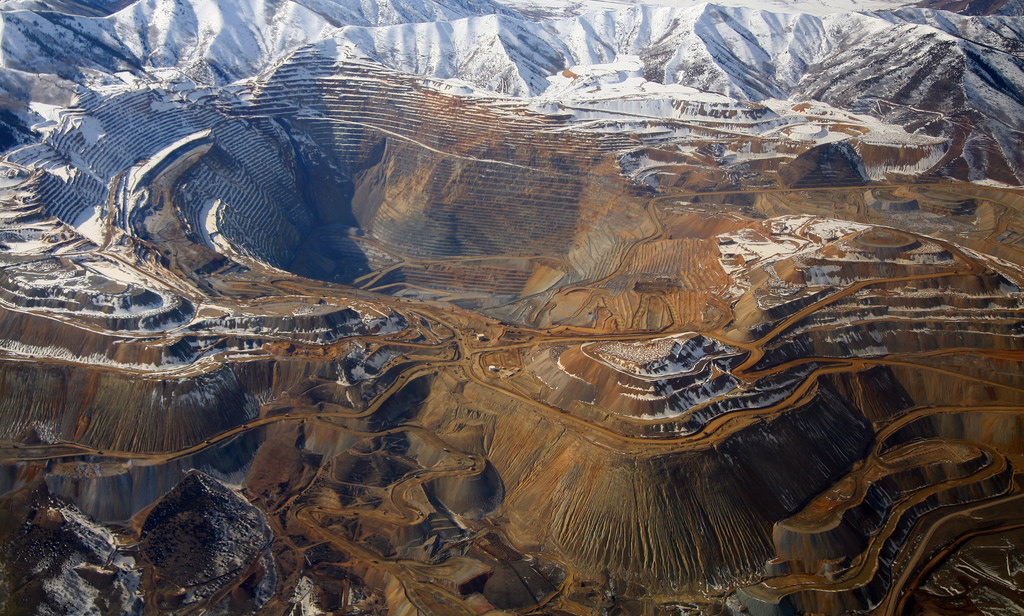
Introduction: The Titans of Global Base Metal Production
Among all mineral systems in the Earth’s crust, porphyry copper deposits are the undisputed heavyweights of global metal supply. They account for approximately 75% of the world’s copper, 50% of molybdenum, and significant inventories of gold, silver, and critical minor metals like rhenium and tellurium.
Characterized by colossal tonnages (ranging from hundreds of millions to several billion tonnes) and moderate grades (typically 0.3% to > 1.5% Cu), world-class giants like Escondida, Chuquicamata, and El Teniente in Chile, Bingham Canyon in the USA, Oyu Tolgoi in Mongolia, and Grasberg in Indonesia represent the apex of magmatic-hydrothermal efficiency.
While classical exploration models frequently rely on simple concentric bullseye diagrams, modern economic geology reveals that giant porphyry copper deposits are highly asymmetric, multi-episodic systems. They are driven by deep trans-crustal magma reservoirs, delicate vapor-brine phase separation, intricate structural dilation jogs, and distinctive vein parageneses.
This comprehensive masterclass dissects the fundamental architecture, cutting-edge geochemical vectoring tools, and lesser-known literature insights that define world-class porphyry copper deposits.
1. The Magmatic-Hydrothermal Engine and Fluid Immiscibility
A fundamental insight from high-temperature experimental petrology (e.g., Audetat, Heinrich, Bodnar) is that porphyry copper deposits are not formed by ordinary hydrothermal liquids. They are born from the catastrophic physical separation of exsolved supercritical magmatic volatiles.
Step 1: Deep Magmatic Staging (> 4–8 km depth)
Exsolution of supercritical magmatic fluids (~700°C, low-salinity H2O-NaCl-CO2-S) from a deep, trans-crustal magma reservoir.
Step 2: Hydrothermal Ascent & Decompression (1.5–3.5 km depth)
Fluids ascend into the porphyry cupola across the lithostatic-hydrostatic boundary, undergoing abrupt decompression.
Step 3: Retrograde Boiling & Phase Separation
The supercritical fluid unmixes into two immiscible phases:
- Dense Hypersaline Brine (35–70 wt.% NaCl equiv.): Trapped in the potassic core, depositing molybdenum and early copper.
- Low-Density Vapor Phase: Rapidly ascends toward shallow levels carrying hydrated gases (SO2, H2S, HCl) and vapor-partitioned copper and gold.
The Copper-Vapor Partitioning Revelation (Lesser-Known Fact)
For decades, standard textbooks taught that base metals are exclusively concentrated into the heavy hypersaline brine as chloride complexes (such as CuCl2⁻). However, laser ablation ICP-MS analyses of fluid inclusions have shattered this paradigm:
- While Molybdenum (Mo) partitions almost strictly into the dense liquid brine, Copper (Cu) and Gold (Au) exhibit a striking affinity for the low-density vapor phase as sulfur-bearing complexes (such as Cu-S-H and Au-S-H complexes).
- In high-sulfur systems, volatile vapor plumes can strip and transport up to 50–70% of the total copper budget upward toward shallow levels, feeding high-sulfidation epithermal systems and shallow high-grade copper blankets while leaving molybdenum in the deeper core.
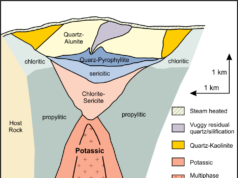
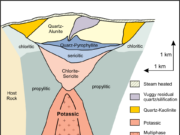
2. Advanced Alteration Architecture: Beyond the Lowell & Guilbert Model

The classic Lowell & Guilbert (1970) concentric shell model remains an excellent conceptual starting point, but exploring for modern blind porphyry copper deposits demands an understanding of time-transgressive, overprinting alteration facies:
Potassic Core (Central Zone): Biotite, K-feldspar, anhydrite, bornite, and chalcopyrite formed by high-temperature magmatic brines (> 450°C).
Phyllic Shell (Upward & Outward Collapse): Quartz, sericite, and massive pyrite halos (QSP) driven by acidic fluid cooling (250°C–350°C).
Sodic-Calcic Roots (Deep & Lateral Flanks): Actinolite, albite, epidote, and magnetite generated by circulating basinal fluids that leach metals from wall rocks.
Distal Propylitic Halo (Regional Margin): Epidote, chlorite, calcite, and albite forming a green rock envelope extending 2 to 10 kilometers outward.

1. The Potassic Core (High-T Magmatic Brine Facies)
- Temperature & Fluid: 450°C to > 600°C; hyper-saline magmatic brines.
- Mineral Assemblage: Secondary hydro-biotite (shreddy texture replacing magmatic hornblende), secondary potassium feldspar (K-feldspar halos lining quartz stockworks), anhydrite, and magnetite.
- Ore Sulfides: Primary chalcopyrite and bornite, with low total sulfide volume (< 2–3 vol.%). The bornite-rich core represents the absolute epicenter of high-grade copper-gold mineralization in giant porphyry copper deposits.
2. Sodic-Calcic Alteration (The Leaching Footprint)
Frequently omitted in simplified models, sodic-calcic alteration (actinolite-albite-epidote-magnetite) occurs in the deep roots and lateral margins of the intrusion (e.g., Yerington district, Candelaria). Driven by heated external basinal or connate waters, this hot fluid actively leaches copper and iron out of wall rocks and funnels it into the central magmatic hydrothermal plume.
3. The Phyllic Shell (Quartz-Sericite-Pyrite / QSP)
- Temperature & Fluid: 250°C to 350°C; low-pH, acidic condensate fluids.
- Mechanism: As late-stage magmatic fluids cool, dissolved SO2 disproportionates into sulfuric acid (H2SO4) and hydrogen sulfide (H2S). This acidic fluid unleashes severe hydrolytic attack, converting earlier potassic K-feldspar and biotite into sericite (fine-grained white mica), quartz, and massive pyrite halos (5–15 vol.% pyrite).
- Ore Impact: Phyllic alteration often remobilizes earlier potassic copper, stripping bornite and re-precipitating it as coarse chalcopyrite, tennantite, or pyrite-digenite assemblages along structural margins.
4. Advanced Argillic and the Lithocap
Directly above the porphyry stock, magmatic vapors condense into groundwater to produce an extensive, barren-looking carapace of quartz, alunite, pyrophyllite, and dickite extending several kilometers across the paleosurface.
5. The Distal Propylitic Halo (The “Green Rock” Environment)
Forms a vast, subtle, regional alteration envelope (chlorite, epidote, calcite, albite) spanning 2 to 10 kilometers outward from the deposit center.
3. The A-B-D Vein Paragenesis: Deciphering Hydrothermal Timing

To determine whether drill core is intersecting the top, center, or dying tail of porphyry copper deposits, geologists rely on the definitive vein classification developed by Gustafson & Hunt (1975) and refined by Sillitoe (2010):
| Vein Type | Morphology & Characteristics | Mineralogy | Alteration Selvage | Formation Temperature |
| EDM Veins | Early Dark Micaceous; irregular, thin, discontinuous | Biotite, sericite, minor chalcopyrite | Strong biotite-sericite halo | > 550°C (Early Potassic) |
| A-Veins | Sinuous, wavy, vermicular, non-planar; formed in ductile-brittle transition | Granular quartz, bornite, chalcopyrite, anhydrite | None (blends smoothly into K-feldspar wall rock) | 500°C–600°C (Potassic Core) |
| B-Veins | Planar, continuous fracture-fill; central suture common | Granular to comb quartz with distinct molybdenite bands | Absent or weak narrow K-feldspar selvage | 400°C–500°C (Mo Deposition) |
| C-Veins | Semi-massive sulfide stringers and veinlets | Pure chalcopyrite ± pyrite | Narrow sericite or chlorite halo | 350°C–400°C (Transition) |
| D-Veins | Planar, sharp, late-stage structural fault veins | Massive coarse pyrite, quartz, minor sphalerite/galena | Wide, prominent bleached QSP (sericite) halos | 250°C–350°C (Phyllic Collapse) |
Exploration Rule of Thumb: A drill hole intersecting abundant, wide, sericite-bordered D-veins cutting across earlier, deformed A-veins indicates the system suffered a deep hydrolytic overprint, which can either upgrade or disperse primary copper grades.
4. Green Rock Vectoring: Epidote and Chlorite Chemistry (The AMIRA Breakthrough)

When exploring frontier terranes, geologists often encounter thousands of meters of nondescript “green rocks” (propylitic alteration) without visible copper sulfides. Breakthrough research spearheaded by the CODES / AMIRA P888 and P1060 projects (Cooke, Wilkinson, et al.) established that trace elements trapped in epidote and chlorite provide quantitative distance vectors pointing straight toward the hidden porphyry core:
Epidote Trace Element Chemistry
Because the epidote crystal lattice substitutes minor trace metals based on temperature and oxidation gradients:
- Proximal Zone (< 500 m from Potassic Core): Epidote is strongly enriched in Titanium (Ti), Vanadium (V), Cobalt (Co), and Nickel (Ni).
- Intermediate Zone (500 m – 1.5 km): Epidote concentrates Lead (Pb), Zinc (Zn), and Manganese (Mn).
- Distal Margin (> 2–4 km away): Epidote exhibits extreme anomalies of highly mobile volatile elements: Arsenic (As), Antimony (Sb), Bismuth (Bi), and Thallium (Tl).
- Vector Tool: Plotting the ratio of
(As + Sb) / (Ti + V)in epidote reveals a vector that increases exponentially away from the orebody, allowing geologists to pinpoint the direction of the deposit from miles away.
Chlorite Geothermometry
The magnesium-iron substitution and titanium content in propylitic chlorite track ambient fluid temperatures:
- High titanium (> 1000 ppm Ti) and high Mg/(Mg+Fe) ratios in chlorite identify high-temperature cores, even when copper assays read near-zero background levels.
5. Zircon Chemistry: Testing Magma Fertility Before Drilling
One of the greatest financial risks in mining exploration is drilling a barren intrusive complex that looks identical to a mineralized porphyry stock. Modern exploration geochemistry utilizes zircon trace-element fertility indicators to evaluate prospective plutons before collar planning:
- The Ce4+/Ce3+ Ratio (Oxidation State):Copper is an intensely chalcophile element. If a magma chamber is reduced, sulfur saturates early as sulfide, sequestering copper in deep, inaccessible cumulate zones. In contrast, highly oxidized magmas (fO2 > Delta-FMQ + 2) stabilize sulfur as sulfate (SO4²⁻), preventing early sulfide saturation and keeping copper dissolved in the melt until final volatile release. Zircons crystallized from these fertile, oxidized magmas exhibit high Ce4+/Ce3+ ratios (> 100–300).
- Europium Anomalies (Eu/Eu > 0.4):*Magmatic water suppresses plagioclase crystallization while promoting hornblende fractionation. Fertile porphyry copper deposits require hydrous magmas (> 4–6 wt.% H2O). A high Eu/Eu* ratio in zircon confirms that plagioclase was suppressed, indicating a water-rich, fertile intrusive event.
6. Supergene Leached Cappings and Grade Blankets
In arid, uplifting terranes (such as the Atacama Desert of Chile or the American Southwest), weathering processes transform sub-economic primary hypogene ores into world-class, ultra-high-grade supergene enrichment blankets:
1. Leached Cap (Above Paleowater Table): Infiltrating meteoric water oxidizes primary pyrite, generating acidic ferric sulfate fluids that dissolve primary chalcopyrite and leach copper downward.
2. The Paleowater Table Boundary: Descending acidic copper-rich solutions hit reducing, neutralizing groundwater conditions.
3. Supergene Enrichment Blanket (High-Grade Target): Dissolved copper precipitates as secondary chalcocite (Cu2S) and covellite (CuS), elevating primary grades from 0.4% Cu up to 1.5%–3.0% Cu.
Decoding Limonites in the Leached Capping (Lesser-Known Field Pointer)
Before drilling a barren, bleached outcrop, mapping the specific limonite mineralogy in the leached cap tells you what primary sulfides existed before weathering:
- Jarosite (Pale Yellow-Orange, Acidic): Indicates a very high pyrite-to-chalcopyrite ratio (> 5:1). Strong acid generation thoroughly flushed copper downward, creating a massive, deep secondary chalcocite blanket beneath.
- Goethite (Dark Brown to Ochre): Indicates an intermediate pyrite-to-chalcopyrite ratio (1:1 to 3:1). Represents mixed leaching conditions.
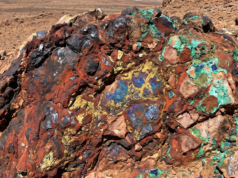
- Hematite (Brick-Red / Maroon, “Live Limonite”): Indicates low pyrite and bornite-rich primary ore (pyrite:chalcopyrite < 1:1). Because little acid was generated, copper could not travel far; it precipitated virtually in-situ as chrysocolla, malachite, or exotic copper oxide ore.
7. Structural Dilatation and 3D Modeling Best Practices
In modern 3D implicit modeling packages like Leapfrog Geo, modeling porphyry copper deposits requires strict geological domaining:
- Tectonic Trapping in Dilatational Jogs: Giant deposits rarely form under pure isotropic compression. They intrude during transient extensional or transtensional releases along regional strike-slip fault corridors, forming pencil-like, vertically elongated cylindrical stocks.
- Vein Density Modeling: Do not interpolate raw copper grades across lithological boundaries without an structural trend. Modeling A-vein intensity counters (veins per meter) defines the true high-temperature cupola of the intrusion, providing a robust boundary shell that prevents artificial volume inflation.
- Contact Fault Truncation: Late-stage D-veins and post-mineral normal faults routinely offset high-grade potassic cores. Always establish discrete structural domains before running radial basis function (RBF) grade estimates.
Key Exploration Takeaways for Geologists
- Follow the Bornite Core: The highest-grade copper-gold shells in porphyry copper deposits invariably sit in the core where bornite coexists with K-feldspar and shreddy hydrothermal biotite.
- Read the Propylitic Halo: Utilize LA-ICP-MS trace element ratios (As+Sb)/(Ti+V) in epidote to vector toward concealed intrusions from kilometers away.
- Screen Magma Fertility: Analyze zircons for high Ce4+/Ce3+ and Eu/Eu* ratios to ensure the target pluton exsolved from an oxidized, water-rich trans-crustal magma reservoir before drilling deep holes.

[…] Porphyry Copper Deposits: The Magmatic-Hydrothermal Giants of Economic Geology […]
[…] Porphyry Copper Deposits: The Magmatic-Hydrothermal Giants of Economic Geology […]