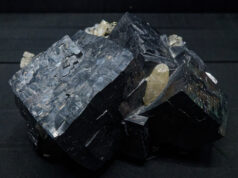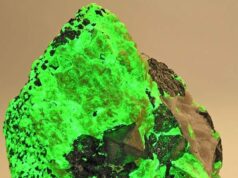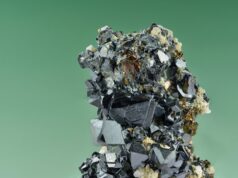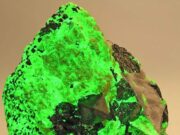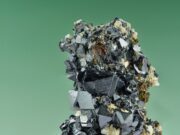
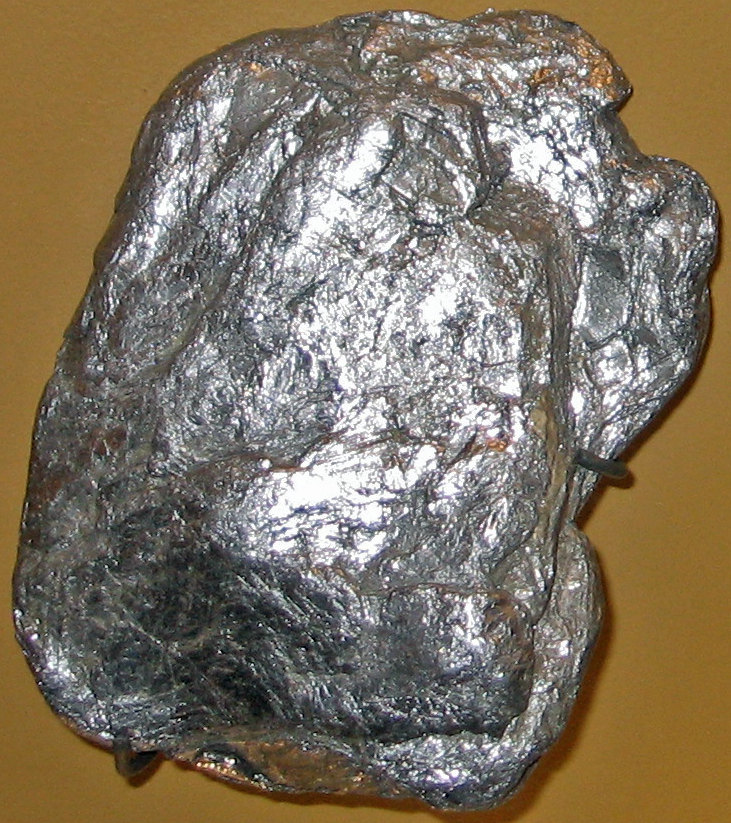
The Molybdenite mineral (molybdenum disulfide, MoS₂) is the primary global ore of molybdenum and the exclusive commercial host for rhenium (Re)—one of the rarest and highest-melting-point strategic metals in the Earth’s crust. Recognizable by its bright bluish-silver metallic luster, extreme softness (Mohs 1.0–1.5), and flexible hexagonal sheets that mimic graphite, this layered transition-metal dichalcogenide bridges classic magmatic-hydrothermal ore geology with cutting-edge 2D nanotechnology.
In economic geology, the Molybdenite mineral is a diagnostic vector phase within porphyry copper-molybdenum deposits, Climax-type porphyry molybdenum stockworks, and contact metasomatic skarn deposits. Moreover, because radioactive rhenium-187 (¹⁸⁷Re) substitutes directly for molybdenum in its crystal lattice and decays to osmium-187 (¹⁸⁷Os), molybdenite serves as the premier sulfide chronometer for dating hydrothermal mineralization events directly.
This comprehensive geological guide examines the layered crystallography, 2H versus 3R polytypes, physical and optical diagnostic properties, rhenium enrichment chemistry, porphyry vein paragenesis, and field identification tests of the Molybdenite mineral.
1. Crystallography and Layered Structure of Molybdenite Mineral

The Molybdenite mineral crystallizes primarily in the hexagonal crystal system (dihexagonal dipyramidal class, space group P6₃/mmc), while a subordinate trigonal polytype (space group R3m) also occurs in specific hydrothermal regimes. Its atomic architecture consists of two-dimensional S–Mo–S “sandwich” layers, where a planar hexagonal sheet of molybdenum cations (Mo⁴⁺) is covalently bonded between two hexagonal sheets of sulfur anions (S²⁻) in trigonal prismatic coordination.
Chemical Formula: MoS₂ (Stoichiometric: 59.94% Mo, 40.06% S)
Crystal System: Hexagonal (2H Polytype, P6₃/mmc) & Trigonal (3R Polytype, R3m)
Unit Cell Parameters (2H): a = 3.161 Å, c = 12.295 Å, Z = 2
Bonding Architecture: Strong Covalent S–Mo–S Layers | Weak van der Waals Interlayer Bonds
Cleavage: Perfect, Effortless Basal Cleavage in 1 direction {0001}
Key Trace Substitutions: Re⁴⁺ (Rhenium), W⁴⁺ (Tungsten), Se²⁻, Te²⁻
While covalent Mo–S bonds within each three-atom-thick sheet are exceptionally strong, adjacent sulfur sheets across the interlayer gap are held together solely by weak van der Waals forces. According to crystallographic records in the Mindat Mineralogy Database, this profound bonding anisotropy explains why the Molybdenite mineral exhibits effortless basal cleavage along {0001}, a greasy feel, and world-class dry lubricant performance under extreme industrial pressures and temperatures.
2H (Hexagonal) vs. 3R (Rhombohedral) Polytypes:
- 2H-MoS₂ Polytype: The dominant crustal form (~80% of natural occurrences), featuring a two-layer stacking sequence per unit cell with hexagonal symmetry.
- 3R-MoS₂ Polytype: Features a three-layer rhombohedral stacking sequence. The 3R polytype frequently crystallizes during lower-temperature or rapid-disequilibrium hydrothermal stages and is notably capable of accommodating higher concentrations of trace impurities, including rhenium, titanium, and tin.
2. Physical and Optical Diagnostic Properties
Logging the Molybdenite mineral in porphyry drill core and polished sections requires attention to its platy habit, extreme softness, and pronounced optical anisotropy under reflected light:
| Diagnostic Property | Hand Specimen & Physical Expression | Reflected Light Microscopy |
|---|---|---|
| Color & Luster | Bright bluish-silver to lead-gray; vivid metallic luster that remains untarnished in air. | Extreme reflection pleochroism (birereflectance): bright white (O-ray) to dark gray (E-ray). |
| Crystal Habit | Hexagonal tabular plates, foliated rosettes, scaly aggregates, or ultra-fine “moly paint” slickensides. | Bent, kinked, and delaminated basal laths displaying undulose extinction under stress. |
| Cleavage & Tenacity | Perfect basal cleavage {0001}; individual laminae are flexible and sectile but not elastic. | Distinct basal cleavage traces parallel to the long dimension of flaky crystals. |
| Hardness | Mohs 1.0 – 1.5 (easily scratched by a human fingernail; leaves a metallic mark on paper). | Very low polishing hardness; prone to smearing unless polished with diamond suspension. |
| Specific Gravity | 4.62 – 4.73 g/cm³ (more than twice as dense as graphite, which is 2.09 – 2.23 g/cm³). | N/A |
| Streak | Bluish-gray on unglazed porcelain; turns pale greenish-gray when rubbed on glazed porcelain. | Extreme anisotropy under crossed polars with pinkish-white to dark violet polarization colors. |
3. Rhenium Enrichment and Re-Os Geochronology in Molybdenite
Beyond molybdenum, the Molybdenite mineral is the world’s primary commercial source of rhenium (Re). Because tetravalent rhenium (Re⁴⁺, ionic radius 0.63 Å) has an almost identical ionic radius and electronegativity to tetravalent molybdenum (Mo⁴⁺, ionic radius 0.65 Å), rhenium substitutes seamlessly into the Mo site without requiring coupled charge compensation.
     [ Magmatic-Hydrothermal Fluid Evolution (350°C – 550°C) ]
                                 │
                                 ▼
         Isovalent Lattice Substitution in S–Mo–S Sheets:
               Mo⁴⁺ (0.65 Å)  ◄────►  Re⁴⁺ (0.63 Å)
             (Zero Common Osmium Incorporated at t = 0)
                                 │
                                 ▼
         Radioactive Beta Decay Inside Closed MoS₂ Lattice:
           ¹⁸⁷Re  ────►  ¹⁸⁷Os + β⁻ + ν̄  (λ = 1.666 × 10⁻¹¹ yr⁻¹)
                                 │
                                 ▼
     ════════ PRECISION Re-Os SULFIDE GEOCHRONOMETER ════════
Why Rhenium Grade Varies by Deposit Type:
- Porphyry Cu–Mo Systems (High Rhenium): Molybdenite recovered as a byproduct from island-arc and continental-margin Cu–Mo porphyries (e.g., El Teniente and Chuquicamata in Chile; Bingham Canyon in Utah; Bagdad in Arizona) is exceptionally rich in rhenium, typically containing 200 to 2,000+ ppm Re (locally exceeding 1 wt% Re, bridging toward the rare end-member rheniite, ReS₂). Mantle-derived mafic magma inputs and low total Mo/Cu ratios concentrate rhenium into the limited volume of precipitating MoS₂.
- Climax-Type Porphyry Mo Systems (Low Rhenium): In contrast, primary molybdenum-only porphyries associated with evolved, fluorine-rich continental rift rhyolites (e.g., Climax and Henderson in Colorado) contain abundant MoS₂ that dilutes the available rhenium budget, yielding low concentrations of only 1 to 20 ppm Re.
- The Re-Os Chronometer: Because the Molybdenite mineral incorporates high concentrations of parent ¹⁸⁷Re while completely excluding daughter osmium (Os) during crystallization, virtually 100% of measured ¹⁸⁷Os inside a crystal is radiogenic. This makes NTIMS (Negative Thermal Ionization Mass Spectrometry) Re-Os analysis of molybdenite the gold standard for directly dating sulfide ore formation, unaffected by younger low-temperature thermal overprints.
4. Major Ore Deposit Associations of Molybdenite Mineral
The Molybdenite mineral precipitates predominantly in high-temperature (300°C–600°C) magmatic-hydrothermal environments genetically linked to intermediate-to-felsic calc-alkaline and alkaline intrusions:
A. Porphyry Copper-Molybdenum Deposits (B-Veins and Fractures)

In classic porphyry Cu–Mo systems, molybdenite occupies a distinct paragenetic and spatial position. Following early high-temperature potassic A-veins (quartz + K-feldspar + chalcopyrite + bornite), cooling fluids at the brittle-ductile transition (~400°C–500°C) generate planar, continuous B-veins. These veins feature sugary granular quartz with characteristic dark bands of fine-grained Molybdenite mineral lining the vein walls or central suture lines. During late post-mineral faulting, ductile molybdenite is frequently smeared along fracture planes as shiny, bluish-gray slickensides termed “moly paint” by core loggers.
B. Climax-Type and Endako-Type Porphyry Molybdenum Deposits
Primary molybdenum deposits are subdivided into two end-members:
- Climax-Type (Rift-Related, High-Fluorine): Hosted in A-typegranite-rhyolite domes (e.g., Climax, Henderson, and Mount Emmons in Colorado; Questa in New Mexico). Multi-stage, radial and concentric quartz–molybdenite–fluorite–topaz stockwork shells drape directly over the apices of sequentially intruded porphyritic stocks, grading 0.15% to 0.45% MoS₂.
- Endako-Type (Arc-Related, Low-Fluorine): Hosted in continental-arc calc-alkaline quartz monzonites and granodiorites (e.g., Endako and Kitsault in British Columbia; Thompson Creek in Idaho), characterized by ribbon-textured quartz-molybdenite veins with lower grades (0.05%–0.15% MoS₂) and weak fluorine anomalies.
C. Tungsten-Molybdenum Skarns and Greisens
Where felsic plutons intrude carbonate wallrocks, prograde calcic skarns (andradite-grossular garnet + hedenbergite pyroxene) and retrograde epidote-amphibole-quartz assemblages host coarse rosettes of the Molybdenite mineral coexisting with scheelite (CaWO₄), chalcopyrite, bismuthinite, and pyrrhotite (e.g., King Island in Tasmania; Pine Creek in California).
5. Supergene Oxidation and Geochemical Mobility

In near-surface weathering environments, the Molybdenite mineral is relatively resistant to oxidation compared to pyrite or chalcopyrite. When exposed to acidic, oxidizing meteoric waters, MoS₂ slowly alters in situ to secondary hexavalent molybdenum (Mo⁶⁺) oxide and molybdate phases:
- Ferrimolybdite [Fe³⁺₂(MoO₄)₃·nH₂O] & Molybdite (MoO₃): Bright canary-yellow, fibrous, or earthy crusts coating residual silver-gray molybdenite flakes inside leached porphyry cappings.
- Powellite (CaMoO₄) & Wulfenite (PbMoO₄): In calcium- or lead-bearing oxidation zones, molybdate anions react to form creamy-white fluorescent powellite or striking orange-red tabular crystals of wulfenite.
- Exploration Geochemistry Vectoring (pH Control): Unlike copper and zinc cations (Cu²⁺, Zn²⁺)—which are mobile in acidic waters (pH < 5) and precipitate at alkaline pH—molybdenum travels in groundwater as the oxyanion molybdate (MoO₄²⁻). Under acidic conditions (pH < 5), molybdate adsorbs strongly onto ferric oxyhydroxides (goethite/hematite) and remains immobile inside the leached gossan cap. This makes soil and rock-chip Mo anomalies (>10–50 ppm Mo) a premiere stationary geochemical pathfinder sitting directly over buried porphyry centers!
6. Field Identification: Molybdenite vs. Graphite and Galena
In the field and core shack, geologists frequently encounter two minerals that superficially resemble the Molybdenite mineral—graphite (C) and fine-grained galena (PbS). Four rapid tests separate them definitively:
- The Glazed Porcelain Streak Test (Molybdenite vs. Graphite): Both minerals have Mohs hardness of 1–1.5, basal cleavage, and a greasy feel. However, when rubbed across a glazed white porcelain surface (such as the rim of a coffee mug or a smooth tile), molybdenite leaves a diagnostic olive-green to greenish-gray streak, whereas graphite leaves a dull black to dark charcoal-gray streak.
- Color Tint & Luster: Held at an angle to sunlight, fresh Molybdenite mineral folia exhibit a bright, metallic bluish-silver hue, whereas graphite appears duller, submetallic steel-gray to black.
- Specific Gravity Contrast: Molybdenite (SG ~4.7 g/cm³) is more than twice as dense as graphite (SG ~2.2 g/cm³); rich specimens feel noticeably heavy in the hand.
- Molybdenite vs. Galena: Galena is harder (Mohs 2.5), much denser (SG 7.58 g/cm³), brittle rather than flexible, and breaks into 3-directional 90° cubes rather than 1-directional flexible hexagonal sheets.
7. Metallurgy, Industrial Demand, and 2D Semiconductor Applications
According to global production data published by the U.S. Geological Survey (USGS), over 80% of mined molybdenum is consumed in metallurgical applications—producing high-strength low-alloy (HSLA) steels, corrosion-resistant austenitic stainless steels, nickel-based superalloys, and high-temperature drill pipes.
Because the basal {0001} faces of the Molybdenite mineral are naturally hydrophobic (water-repellent), crushed MoS₂ floats effortlessly in froth flotation cells using simple nonpolar hydrocarbon oils (kerosene or fuel oil), while sodium hydrosulfide (NaSH) or Nokes reagent is added to depress copper and iron sulfides. During subsequent multi-hearth oxidative roasting at 600°C–700°C (converting MoS₂ concentrate into technical molybdenum trioxide, MoO₃), volatile rhenium heptoxide (Re₂O₇) sublimates into the flue gas and is scrubbed out as ammonium perrhenate (NH₄ReO₄) to supply the aerospace superalloy industry.
Summary & Key Takeaways
- Strategic Dual Commodity: The Molybdenite mineral (MoS₂) is the primary global source of molybdenum and the exclusive commercial reservoir for strategic rhenium.
- Layered Anisotropy: Covalent S–Mo–S sheets bonded by weak van der Waals forces produce Mohs 1.0–1.5 softness, 1-directional basal cleavage, and extreme dry-lubricant performance.
- Porphyry & Chronology Hallmark: Concentrates in porphyry B-veins and Climax-type stockworks, serving as economic geology’s most reliable Re-Os radiometric clock.
- Field Diagnostics: Distinguished from graphite by its bluish-silver metallic luster, higher density (4.7 g/cm³), and greenish-gray streak on glazed porcelain.
Frequently Asked Questions (FAQ)
How can you tell Molybdenite apart from Graphite in drill core?
First, inspect the color under bright light: the Molybdenite mineral displays a distinctly bluish-silver metallic sheen, whereas graphite is duller steel-gray to black. Second, rub a flake on glazed porcelain (or shiny paper): molybdenite leaves a subtle greenish-gray streak after rubbing, while graphite leaves a pure black-gray smudge. In portable XRF (pXRF) core scanning, molybdenite immediately yields an unmistakable high Mo-Kα peak.
What is “moly paint” in porphyry copper exploration?
“Moly paint” is the field exploration term for paper-thin, mirror-bright coatings of smeared Molybdenite mineral along post-mineral or syn-mineral fault fractures and slickensides. Because MoS₂ has a hardness of 1.0 and acts as a natural solid lubricant, even minor tectonic slip along a quartz-molybdenite B-vein smears the sulfide across fracture surfaces, creating the visual illusion of higher molybdenum grade than the actual bulk rock assay.
Why is Molybdenite important for next-generation electronics?
When exfoliated down to a single three-atom-thick S–Mo–S monolayer, MoS₂ transitions from an indirect bandgap (1.23 eV) to a direct bandgap semiconductor (1.8 eV)—unlike graphene, which lacks a bandgap. This allows two-dimensional Molybdenite nanosheets to function as ultra-thin field-effect transistors (FETs), flexible photodetectors, and hydrogen evolution electrocatalysts.