1. Introduction: The Thermodynamic Engines of Global Metal Wealth
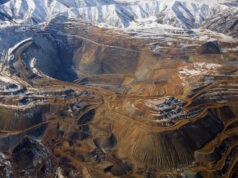
Hydrothermal ore deposits are mineral concentrations formed by the circulation of superheated, metal-bearing aqueous solutions (100°C to >500°C) through fractures and permeable zones in the Earth’s crust. They account for over 70% of global base metal and primary gold production, precipitating ores through fluid cooling, boiling, and wall-rock reactions.

Across the Earth’s continental and oceanic crust, hydrothermal systems serve as the ultimate thermodynamic engines of mineral concentration. From the massive porphyry copper-gold belts of the circum-Pacific to the multi-million-ounce orogenic gold corridors of Archean cratons, hydrothermal ore deposits account for more than 70% of the world’s copper, lead, zinc, and silver, alongside the vast majority of primary gold.
In its literal sense, hydrothermal refers simply to hot water (hydro + therme). In an economic geology context, however, hydrothermal fluids are far from ordinary water: they are superheated, pressurized, chemically aggressive, multi-component aqueous solutions. Packed with dissolved volatile species (H₂S, SO₂, CO₂, HCl, HF) and high concentrations of dissolved alkali and heavy metal ions, these crustal brines can leach dispersed background metals from cubic kilometers of rock, transport them over structural pathways spanning tens of kilometers, and focus them into narrow, high-grade ore bodies.
To discover and delineate these deposits beneath cover, an exploration geologist must look beyond individual hand samples and understand the entire hydrothermal continuum—from fluid genesis and metal complexation to structural conduits, boiling horizons, and metasomatic alteration halos.
2. Fluid Provenance: Four Distinct Reservoirs of Hydrothermal Solutions
Hydrothermal brines originate from four distinct geological reservoirs, often interacting and mixing over the lifespan of a single mineralizing event:
- Magmatic Fluids (Juvenile Fluids):As hydrous, volatile-rich intermediate-to-felsic magmas ascend into the shallow crust (typically 1 to 5 km depth) and cool, anhydrous silicate minerals (feldspars, quartz) crystallize first. This process drives progressive volatile saturation (second boiling). When internal fluid overpressure exceeds lithostatic confining pressure, metal-rich, hyper-saline supercritical brines exsolve from the magma. These magmatic-hydrothermal solutions carry the bulk of copper, molybdenum, gold, and tin in porphyry, skarn, and high-sulfidation epithermal systems.
- Meteoric Waters:Surface-derived precipitation and shallow groundwater that circulate deep into the upper crust via hydrostatic pressure gradients and convective cells driven by magmatic heat engines. Meteoric fluids are typically oxygenated and dilute, but upon heating and mixing with ascending magmatic vapors, they trigger rapid cooling, pH shifts, and ore precipitation in epithermal and geothermal environments.
- Connate / Basinal Brines:Ancient seawater and pore fluids trapped within sedimentary basins during deposition. Over millions of years of burial, sediment compaction, and geothermal heating, these fluids evolve into dense, highly saline Na-Ca-Cl brines. As they migrate along regional basin-bounding faults, they scavenge lead and zinc, forming classic Mississippi Valley-Type (MVT) and Sedimentary Exhalative (SEDEX) deposits.
- Metamorphic Fluids:Generated during regional collisional tectonics and prograde metamorphism. As sedimentary and volcanic packages undergo greenschist-to-amphibolite facies dehydration, hydrous minerals (chlorite, muscovite, amphibole) break down, releasing low-salinity, neutral-to-alkaline, CO₂-rich fluids. These fluids mobilize gold as bisulfide complexes, forming world-class orogenic gold veins in deep ductile shear zones.
3. Physicochemical Mechanisms: Mobilization, Complexation, and Transport

Metals do not travel through the Earth’s crust as free elemental atoms or simple suspended particles. At crustal temperatures (100°C to >600°C) and pressures, base and precious metals are kept in solution through chemical coordination with inorganic ligands.
The two dominant ligand complexes in hydrothermal geology are:
- Chloride Complexes (Cl⁻):Chloride is the principal transporting agent for base metals (Cu, Pb, Zn, Fe, Mn) as well as high-temperature silver and tin. Under high-salinity, acidic, and high-temperature conditions (>300°C), metals form species such as CuCl₂⁻, FeCl₂, ZnCl₄²⁻, and PbCl₃⁻. The solubility of chloride complexes drops precipitously as the fluid cools or is diluted by meteoric water.
- Bisulfide Complexes (HS⁻ / H₂S):Under neutral-to-weakly acidic pH, moderate temperatures (150°C–350°C), and reduced conditions, gold and silver are predominantly transported as bisulfide complexes, most notably Au(HS)₂⁻ and Ag(HS)₂⁻. Unlike copper chloride complexes, gold bisulfide complexes remain exceptionally stable down to 200°C, explaining why gold can travel much further away from a magmatic heat source into epithermal and distal-disseminated settings.
4. Deposition and Trapping: What Triggers Ore Precipitation?
A fluid can carry gigatons of metal across the crust, but without an efficient physical or chemical trap, no mineable deposit forms. Precipitation requires a destabilization of the metal-ligand complex:
- Boiling and Phase Separation (Fluid Immiscibility):When an ascending, fluid-saturated hydrostatic column experiences a sudden pressure drop (e.g., fault rupture), the fluid boils. Volatile gases (H₂S, CO₂, SO₂) fractionate instantly into the vapor phase. The loss of H₂S destabilizes Au(HS)₂⁻, driving violent, rapid gold precipitation and leaving behind diagnostic banded crustiform quartz, amethyst, and adularia.
- Fluid Mixing and Dilution:When hot, acidic, saline magmatic-hydrothermal brines encounter cooler, oxygenated, dilute meteoric groundwater, rapid drops in temperature and chloride activity destabilize base-metal chloride complexes, causing chalcopyrite, sphalerite, and galena to drop out of solution.
- Wall-Rock Sulfidation and Neutralization:When an iron-rich host rock (such as a basalt, banded iron formation, or gabbro) reacts with a sulfur-bearing hydrothermal fluid, iron in the wall-rock strips sulfur from the fluid to form pyrite (FeS₂). This sudden removal of reduced sulfur breaks apart the gold bisulfide complex, precipitating native gold along vein selvages. Similarly, acidic fluids interacting with reactive carbonate lithologies (limestones, dolomites) experience immediate neutralization, triggering skarn and MVT deposition.
5. Structural Architecture: Conduits, Permeability, and Fault-Valve Action
Hydrothermal systems are fundamentally governed by structural geology. Solid crystalline rock possesses virtually zero primary permeability; hence, fluids require dynamic structural pathways.
- The Fault-Valve Mechanism (Sibson Model):In seismogenic shear zones, impermeable fault gouge acts as a transient seal, trapping high-pressure hydrothermal fluids beneath it. As fluid pressure exceeds lithostatic overburden, the fault slips, generating sudden hydraulic fractures and pressure drops that draw fluid into the dilational jog. Mineral precipitation instantly seals the fracture, repeating the cycle hundreds of times to produce multi-stage, ribboned laminated quartz veins.
- Dilational Jogs, Strike-Slip Duplexes, and Breccia Pipes:Regional bends along strike-slip faults create localized zones of crustal extension (pull-apart basins or dilational jogs), which focus fluid ascent. In volcanic edifices, explosive gas decompression shatters host rocks into pipe-like breccias, creating open void spaces characterized by cockade and crustiform infill.
6. The Modernized Lindgren Classification: Depth-Temperature Facies

Waldemar Lindgren’s 1913 classification remains the foundational framework for mapping hydrothermal ore deposits, updated today with modern plate tectonic and fluid-inclusion data:
A. Hypothermal Deposits (>3 km Depth | 300°C to 500°C+)
- Setting: Deep plutonic roots, ductile metamorphic regimes, and immediate magmatic contact aureoles.
- Fluid Regime: Predominantly high-salinity magmatic brines; lithostatic pressures.
- Characteristic Minerals: Wolframite, cassiterite, molybdenite, scheelite, arsenopyrite, coarse gold, tourmaline, topaz, fluorite, high-temperature garnets.
- Deposit Types: Sn-W Greisens, Porphyry Cu-Mo roots, Magmatic Skarns.
B. Mesothermal Deposits (1.5 km to 3.5 km Depth | 200°C to 350°C)
- Setting: Compressional-to-transpressional orogenic belts, major regional suture zones, and intermediate subduction arc settings.
- Fluid Regime: Moderate to low salinity, CO₂-rich metamorphic and magmatic fluids; transitional hydrostatic-lithostatic pressure.
- Characteristic Minerals: Chalcopyrite, sphalerite, galena, pyrite, tetrahedrite, native gold, ankerite, siderite, sericite.
- Deposit Types: Orogenic Gold systems, VMS sub-seafloor stockwork zones, intermediate Cu-Pb-Zn vein systems.
C. Epithermal Deposits (<1.5 km Depth | 50°C to 200°C)
- Setting: Subaerial volcanic arcs, calderas, and extensional back-arc rifts.
- Fluid Regime: Dominantly hydrostatic pressures; intense mixing between magmatic vapor plumes and meteoric aquifers; pervasive boiling horizons.
- Characteristic Minerals: Electrum, argentite, acanthite, pyrargyrite, cinnabar, stibnite, realgar, orpiment, adularia, chalcedony.
- Deposit Types: High-Sulfidation (HS), Intermediate-Sulfidation (IS), and Low-Sulfidation (LS) Epithermal Au-Ag systems.
7. Hydrothermal Alteration Zoning: Vectors to the Core
Because hydrothermal fluids are in chemical disequilibrium with the host rocks they traverse, they drive extensive metasomatic alteration halos. Recognizing these alteration assemblages in the field provides a direct vector toward the high-grade core:
| Alteration Zone | Key Mineral Assemblage | Fluid Characteristics | Target Association / Vector |
| Potassic | K-feldspar, Hydrothermal Biotite, Magnetite, ± Anhydrite | High temperature (>350°C–550°C), neutral-to-alkaline, high K⁺/H⁺ | Heart of Porphyry Cu-Au-Mo deposits; proximal core indicator |
| Phyllic (Sericitic) | Quartz, Sericite (Illite/Muscovite), Pyrite (“QSP”) | Moderate-to-high temp (200°C–350°C), acidic, destructive of feldspars | Forms pervasive halos around potassic zones; strong IP chargeability anomaly |
| Advanced Argillic | Pyrophyllite, Alunite, Dickite, Diaspore, Vuggy Silica | Extremely acidic (pH < 2), high-temperature acid-leached fluid | Hosts High-Sulfidation Epithermal Au-Ag; directly overlies porphyry systems |
| Intermediate Argillic | Kaolinite, Illite, Smectite, Montmorillonite | Moderate-to-low temp (100°C–250°C), moderately acidic | Outer perimeter of phyllic zones and shallow epithermal blankets |
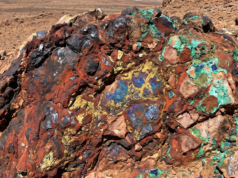
| Propylitic | Chlorite, Epidote, Calcite, Albite, ± Pyrite | Low-to-moderate temp (150°C–300°C), neutral-to-alkaline, H₂O-rich | Regional outer footprint (kilometers scale); green mineral halo |
| Silicification | Quartz, Chalcedony, Opaline Silica, Jasperoid | Variable temp, intense fluid throughput, silica dumping | Structural conduits, paleosurface sinters, and hydrothermal feeder vents |
8. Integrated Exploration Methodology
Targeting blind or buried hydrothermal systems requires layering complementary geological, geochemical, and geophysical datasets:
- Short-Wave Infrared (SWIR) Spectroscopy:Handheld spectrometers (e.g., ASD TerraSpec) allow geologists to rapidly map white mica composition (paragonite vs. muscovite vs. phengite via the 2200 nm absorption feature) and chlorite crystallinity, vectoring directly toward fluid upflow centers.
- Pathfinder Geochemistry:Volatile trace elements (As, Sb, Hg, Tl, Bi, Te) display far broader dispersion halos than gold or copper. High As-Sb-Hg signatures highlight the shallow preserved roofs of intact epithermal systems, whereas elevated Bi-Te-Mo points to high-temperature deep roots.
- Induced Polarization (IP) & Resistivity Surveys:Pervasive disseminated sulfide networks (such as phyllic pyrite halos) generate massive chargeability highs, while dense quartz stockworks and silicified cap rocks manifest as high-resistivity zones.
- Airborne Magnetics:Magnetics excels at detecting hydrothermal alteration. Pervasive destruction of magnetite by sulfur-bearing fluids produces distinct regional “magnetic quiet” lows, while potassic cores with secondary hydrothermal magnetite stand out as positive magnetic bullseyes.
9. Conclusion: Reading Crustal Fossil Systems
Hydrothermal ore deposits are the preserved geochemical blueprints of ancient fluid circulation. By synthesizing the Lindgren temperature-depth model with structural mechanics, alteration mineralogy, and modern spectral vectoring tools, exploration teams can decipher where a target sits within the crustal column—transforming surface alteration anomalies into decisive drilling discoveries.