The Geology of Earth’s Rarest Color-Changing Gem
When it comes to rare gemstones, diamonds and rubies dominate the market. However, for a structural geologist or a serious mineral collector, true rarity is found in geological anomalies—minerals that require such a specific, improbable combination of heat, pressure, and trace elements that they only form in one specific location on Earth.
Zultanite (the trademarked name for gem-quality Diaspore) is precisely that.
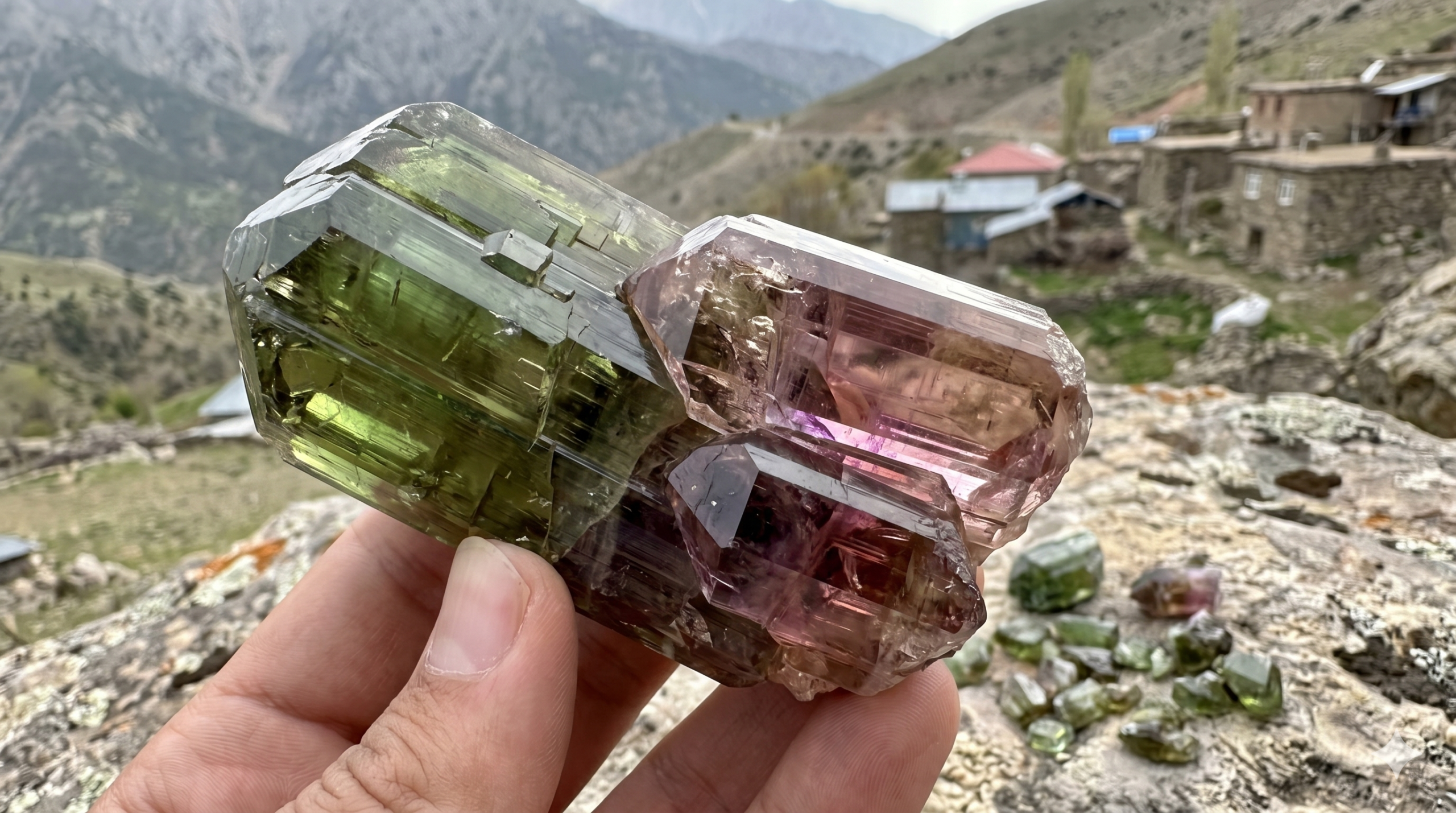
Mined exclusively from a single high-altitude deposit in the Anatolian mountains of Turkey, this astonishing mineral is highly prized for its extreme pleochroism and natural color-changing ability. Here is the geological breakdown of how this extraordinary stone is formed, mined, and processed.
1. What is Diaspore? The Mineralogical Foundation
Before it is faceted into a gemstone, Zultanite is known to geologists as Diaspore—an aluminum oxide hydroxide mineral with the chemical formula AlO(OH).
Diaspore itself is not exceptionally rare. It is one of the three major mineral components of bauxite (along with gibbsite and boehmite), which is the world’s primary ore of aluminum. However, 99.9% of the world’s diaspore forms as massive, opaque, earthy aggregates.
For diaspore to crystallize into large, transparent, gem-quality crystals, the geological environment must undergo a radical transformation.
2. The Geological Setting: The Menderes Massif

The only place in the world where these transparent crystals are found is the İlbir Mountains of Muğla, located in southwestern Turkey. This area is part of the Menderes Massif, a massive metamorphic complex.
The formation of Zultanite required a perfect geological storm:
- The Protolith (Parent Rock): Millions of years ago, typical bauxite deposits formed in limestone cavities near the surface.
- Regional Metamorphism: Tectonic forces buried these bauxite deposits deep underground. They were subjected to intense regional metamorphism (high heat and pressure).
- Crystallization: The heat and pressure forced the opaque, earthy bauxite to recrystallize. Water was partially driven off, and the aluminum oxide re-formed into large, distinct, orthorhombic diaspore crystals housed within fractures in the surrounding metabauxite and marble host rocks.
3. The Optical Magic: Pleochroism and Color Change
What makes Zultanite highly commercial is its remarkable optical properties. It is strongly pleochroic, meaning it shows different colors when viewed from different angles.
More importantly, it exhibits a distinct color-change effect depending on the light source. This is primarily driven by trace amounts of Manganese (Mn) substituting for aluminum in the crystal lattice.
- Daylight (Fluorescent Light): The stone absorbs certain wavelengths, appearing as a vivid kiwi green to yellowish-green.
- Incandescent Light (Candlelight/Indoor): The optical absorption shifts, and the stone flashes rich tones of champagne, pink, and raspberry purples.
4. The Mining Challenge: Perfect Cleavage
From a mining and lapidary (gem-cutting) perspective, Zultanite is an absolute nightmare.
Diaspore possesses perfect cleavage in one direction. In mineralogy, cleavage is the tendency of a crystal to break cleanly along specific structural planes of weakness. Because of this perfect cleavage, the raw crystals are incredibly fragile against mechanical shock.
- Extraction: Explosives cannot be used in the Zultanite mine, as the shockwaves would shatter the crystals in the host rock. Extraction is done entirely by hand and careful chiseling.
- Faceting: When cutters attempt to facet the stone, the friction and vibration often cause it to split perfectly in half.
Due to these geological constraints, the yield from rough crystal to finished gem is roughly 2% to 3%. You have to mine and process a massive amount of metabauxite host rock to produce a single, flawless, one-carat Zultanite.
Conclusion
Zultanite is a prime example of how metamorphism can turn a common industrial ore into a world-class gemstone. For exploration geologists, it serves as a reminder that the world’s most fascinating minerals often hide within the structural complexities of ancient tectonic events.