
Native Minerals: The Pure Elements of the Earth’s Crust
In the vast realm of mineralogy, most minerals are complex compounds—elements bonding with oxygen, sulfur, or silica to achieve stability. However, a small, exclusive group of minerals defies this trend. Native minerals occur in nature as pure, uncombined elements.
For the exploration geologist, native minerals represent the extremes of economic geology. They include the ultimate prizes of exploration, like native gold and diamonds, as well as critical indicators of extreme geological environments.
Native minerals are generally divided into three categories: Metals, Semi-metals, and Non-metals. Here is your essential field and exploration guide to the most significant native elements.
1. The Native Metals: Gold, Silver, and Copper

These metallic elements possess classic metallic bonding, resulting in high specific gravity, malleability, and excellent electrical conductivity.
- Native Gold (Au): The ultimate exploration target. Native gold is incredibly dense (SG ~19.3), soft, and completely resistant to weathering or chemical breakdown. It occurs in primary hydrothermal veins (epithermal and orogenic systems) or as secondary placer deposits in riverbeds.
- Exploration Implication: In resource modeling, native gold is notorious for the “Nugget Effect.” Because it clusters as pure metallic flakes or nuggets rather than being evenly disseminated, assay data can show extreme variance. Strict top-cutting (capping) of assay grades is required in software like Datamine or Leapfrog to prevent overestimating the total resource.
- Native Silver (Ag): Often found in association with gold (electrum) or in the oxidized zones of lead-zinc-silver deposits. It is slightly harder than gold and readily tarnishes to a black color (silver sulfide) when exposed to air.
- Native Copper (Cu): While most copper is extracted from sulfides (like chalcopyrite), native copper can form massive deposits in specific environments, such as the famous Keweenaw Peninsula basalts. It often forms irregular, branching (dendritic) masses in the oxidized zones of structurally-controlled copper sulfide projects, providing a spectacular visual vector in the core shed.
2. The Semi-Metals: The Volatile Pathfinders
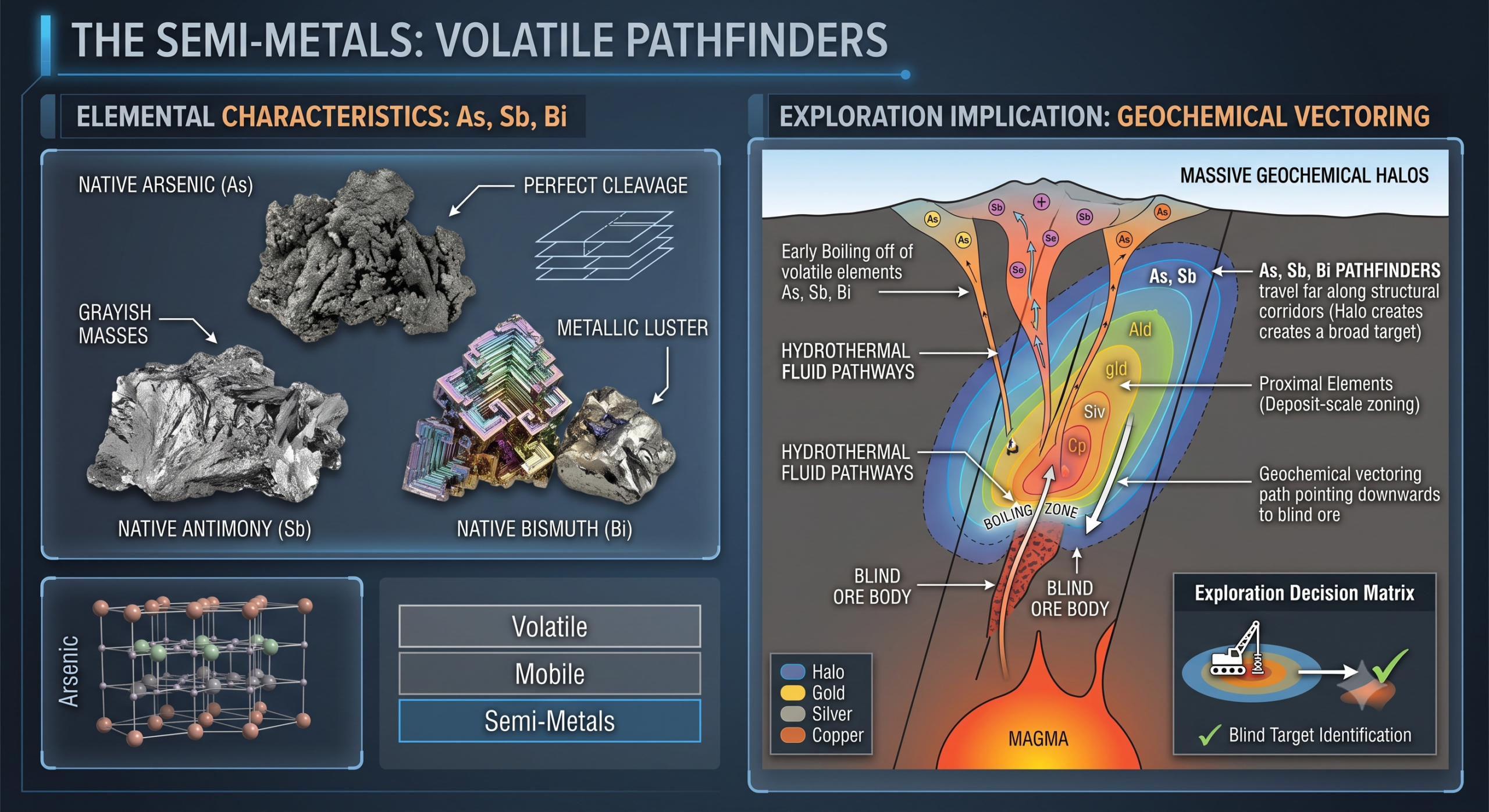
These elements bridge the gap between metals and non-metals. They are highly volatile and mobile in hydrothermal fluids.
- Arsenic (As), Antimony (Sb), and Bismuth (Bi): While they can occur in their native states (often as dull, grayish masses with perfect cleavage), they are rarely mined for their pure form.
- Exploration Implication: As we discussed in geochemical vectoring, these elements are the ultimate pathfinders. They boil off early in hydrothermal systems and travel far along structural corridors, creating the massive geochemical “halos” that point downwards to blind ore bodies.
3. The Non-Metals: Sulfur and the Carbon Polymorphs

These elements form under unique conditions ranging from the Earth’s surface to its deep mantle.
- Native Sulfur (S): Immediately recognizable by its striking resinous yellow color and distinct odor. It is highly brittle and acts as an electrical insulator. Native sulfur precipitates directly from volcanic gases (fumaroles) and is a common feature in the advanced argillic alteration zones of high-sulfidation epithermal systems.
- Diamond and Graphite (C): The classic example of polymorphism. Both are composed of 100% pure carbon, yet they could not be more different. Graphite forms under standard crustal temperatures and pressures, resulting in a soft, flaky mineral used as a lubricant. Diamond forms under extreme pressure deeper than 150 kilometers in the Earth’s mantle and is brought to the surface by explosive kimberlite pipes. It is the hardest known natural substance.
The Modeling Implication
When logging core and preparing database imports, recognizing the physical state of the metal is crucial. If your copper or gold is native rather than bound in a sulfide lattice, the metallurgical recovery process changes dramatically. Crushing circuits and recovery curves must be adjusted, and your 3D geological domains must accurately separate the zones of native accumulation from the refractory sulfide ores.