Foliated Metamorphic Rocks
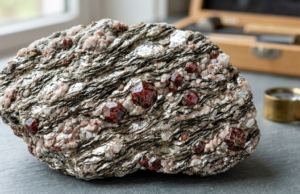
In the dynamic environment of the Earth’s crust, rocks are rarely left in peace. When tectonic forces subject pre-existing rocks to intense heat and directed pressure (differential stress), the minerals within them recrystallize and align perpendicularly to the direction of maximum stress. This parallel alignment of platy or elongated minerals is known as foliation.
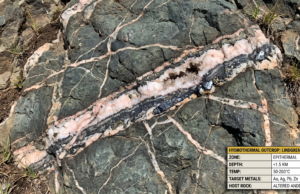
For an exploration geologist, foliated metamorphic rocks are much more than just a textural classification. These structural fabrics dictate rock mechanics during drilling, create pervasive anisotropy that must be accounted for in 3D block modeling, and most importantly, act as primary conduits for hydrothermal fluids in shear-hosted ore deposits.
Here is the ultimate field guide to the sequence of foliated metamorphic rocks, representing the progression of increasing metamorphic grade.
1. Slate: The First Stage of Metamorphism
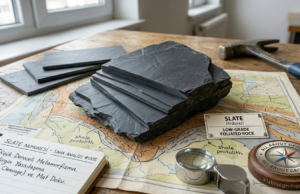
Slate is a fine-grained, low-grade metamorphic rock typically formed from the metamorphism of shale or mudstone.
- Fabric: It exhibits a very strong type of foliation called slaty cleavage. The microscopic clay and mica minerals align so perfectly that the rock breaks along flat, parallel planes.
- Field Recognition: Slate is dull in appearance (lacking a shiny luster) and makes a distinct “clinking” sound when struck with a rock hammer. Because of its perfect cleavage, it is widely used as a roofing and flooring material.
2. Phyllite: The Silky Sheen
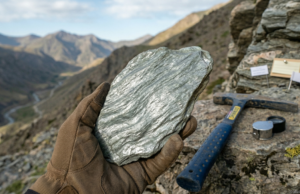
As temperature and pressure increase, the microscopic mica minerals in a slate begin to grow larger, transitioning the rock into a phyllite.
- Fabric: The foliation in phyllite is often wavy or corrugated, a texture known as crenulation cleavage.
- Field Recognition: You cannot clearly see individual mica flakes with the naked eye, but they are large enough to give the rock a distinct, reflective, silky sheen (often silvery, greenish, or reddish).
3. Schist: The Glittering Host Rock
Schist represents medium to high-grade metamorphism. By this stage, the platy minerals have grown large enough to be easily visible to the naked eye.
- Fabric: The rock displays schistosity, characterized by the pervasive, parallel alignment of coarse-grained mica (muscovite, biotite) or elongated minerals like hornblende.
- Field Recognition: Schists are highly reflective and scaly. They are also famous for hosting porphyroblasts—large, distinct crystals such as deep red garnets or brown staurolite crosses that grow within the finer foliated matrix. In exploration, chlorite schists and sericite schists are frequently encountered as the highly altered host rocks in structurally-controlled shear-zone systems.
4. Gneiss: The High-Grade Banding
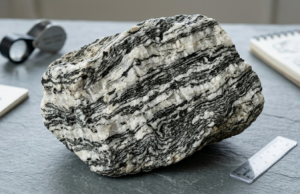
Gneiss (pronounced “nice”) is the result of high-grade regional metamorphism, where temperatures are high enough to cause minerals to segregate into distinct layers, but not quite high enough to melt the rock entirely.
- Fabric: It is characterized by gneissic banding—alternating dark (mafic, typically biotite or amphibole) and light (felsic, typically quartz and feldspar) bands.
- Field Recognition: Unlike schist, gneiss does not easily split along its foliation planes. It is a massive, incredibly competent rock. The convoluted, folded banding often records the extreme ductile deformation the rock underwent deep within the crust.
5. Mylonite: The Fault Zone Indicator
While the slate-to-gneiss sequence represents regional metamorphism, mylonites form in very specific structural settings: deep, ductile shear zones.
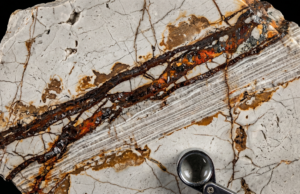
- Fabric & Recognition: Formed by dynamic metamorphism, mylonites are created when rocks are subjected to extreme shearing forces under high temperatures. The original minerals are plastically deformed, stretched, and dynamically recrystallized into a fine-grained, highly foliated, and lineated rock.
- Exploration Significance: For economic geologists, mapping mylonite zones is critical. These major crustal faults often serve as the primary plumbing systems for massive, structurally-controlled gold and copper sulfide mineralization.