Non-Foliated Metamorphic Rocks
Non-Foliated Metamorphic Rocks: Massive Fabrics and Contact Zones
While foliated rocks record the intense, directed pressures of tectonic collisions, non-foliated metamorphic rocks tell a different story. These massive, directionless rocks typically form under conditions where heat is the dominant metamorphic agent (contact metamorphism) or where the parent rock (protolith) is composed of minerals that simply do not align under pressure, such as pure quartz or calcite.
For exploration geologists, encountering non-foliated rocks means dealing with highly competent lithologies, distinct weathering profiles, and unique metasomatic fluid traps that often host world-class ore deposits.
Here is the essential field guide to the most common non-foliated metamorphic rocks and their structural implications.
1. Quartzite: The Topographical Titan
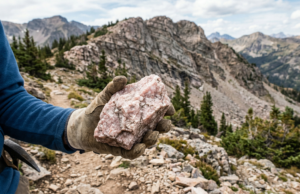
Quartzite is the product of metamorphosed quartz-rich sandstone. Under extreme heat and pressure, the original sand grains and silica cement completely fuse together into an interlocking mosaic of quartz crystals.
Field Recognition: Quartzite is exceptionally hard (Mohs hardness of 7) and breaks with a conchoidal fracture that cuts straight through the original sand grains, rather than around them.
Exploration Significance: Because it is incredibly resistant to chemical and physical weathering, quartzite often forms the highest, most rugged ridges in a survey area. When generating Digital Elevation Models (DEMs) from drone photogrammetry, these sharp topographical highs are immediately apparent. In drilling, quartzite is notoriously difficult, rapidly wearing down diamond bits.
2. Marble: The Recrystallized Carbonate
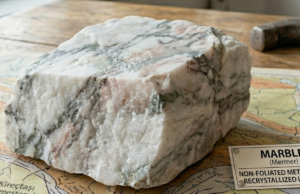
Marble forms when limestone or dolostone is subjected to metamorphism. The microscopic calcite or dolomite grains recrystallize into a much coarser, interlocking mass.
Field Recognition: Visually, marble can range from pure white to heavily veined and colorful depending on impurities. It lacks foliation, is relatively soft (Mohs hardness of 3), and will vigorously fizz when a drop of dilute hydrochloric acid is applied.Exploration Significance: While pure marble is economically valuable as a dimension stone, in mineral exploration, these carbonate packages act as highly reactive sponges for acidic hydrothermal fluids, leading us to our next critical rock type.
3. Skarn (Tactite): The Ore-Bearing Metasomatite
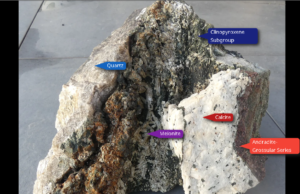
Strictly speaking, skarn is a metasomatic rock, meaning its chemistry was fundamentally altered by the introduction of hydrothermal fluids. When a hot, silica- and metal-rich intrusion intersects a reactive carbonate rock (like limestone or marble), massive chemical exchange occurs.
Field Recognition: Skarns are typically dense, massive, and characterized by calc-silicate minerals such as grossular garnet (often green to brown) and diopside.Exploration Significance: Skarns are primary targets for shallow, structurally-controlled copper sulfide systems. They frequently host massive chalcopyrite and pyrite at depth. When these sulfide zones are unroofed and oxidized at the surface, they display spectacular green malachite and blue azurite staining, serving as a glaring visual vector for field geologists.
4. Hornfels: The Baked Aureole
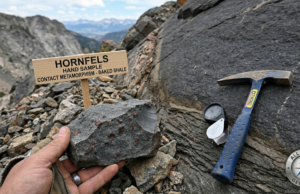
Hornfels is the classic product of pure contact metamorphism. When a magma chamber intrudes into shallow crustal rocks (typically mudstones or shales), the immense heat “bakes” the surrounding country rock without melting it.
Field Recognition: Hornfels is dark, fine-grained, exceptionally dense, and massive. It breaks with a sharp, splintery fracture and sounds almost metallic when struck with a rock hammer.
Exploration Significance: Identifying hornfels in the field means you are standing in the contact aureole of an intrusion. In porphyry copper systems, the massive, impermeable nature of hornfels can act as a structural cap, trapping mineralizing fluids beneath it and causing intense sulfide precipitation in the underlying fractured zones.