What is Conglomerate Rock?
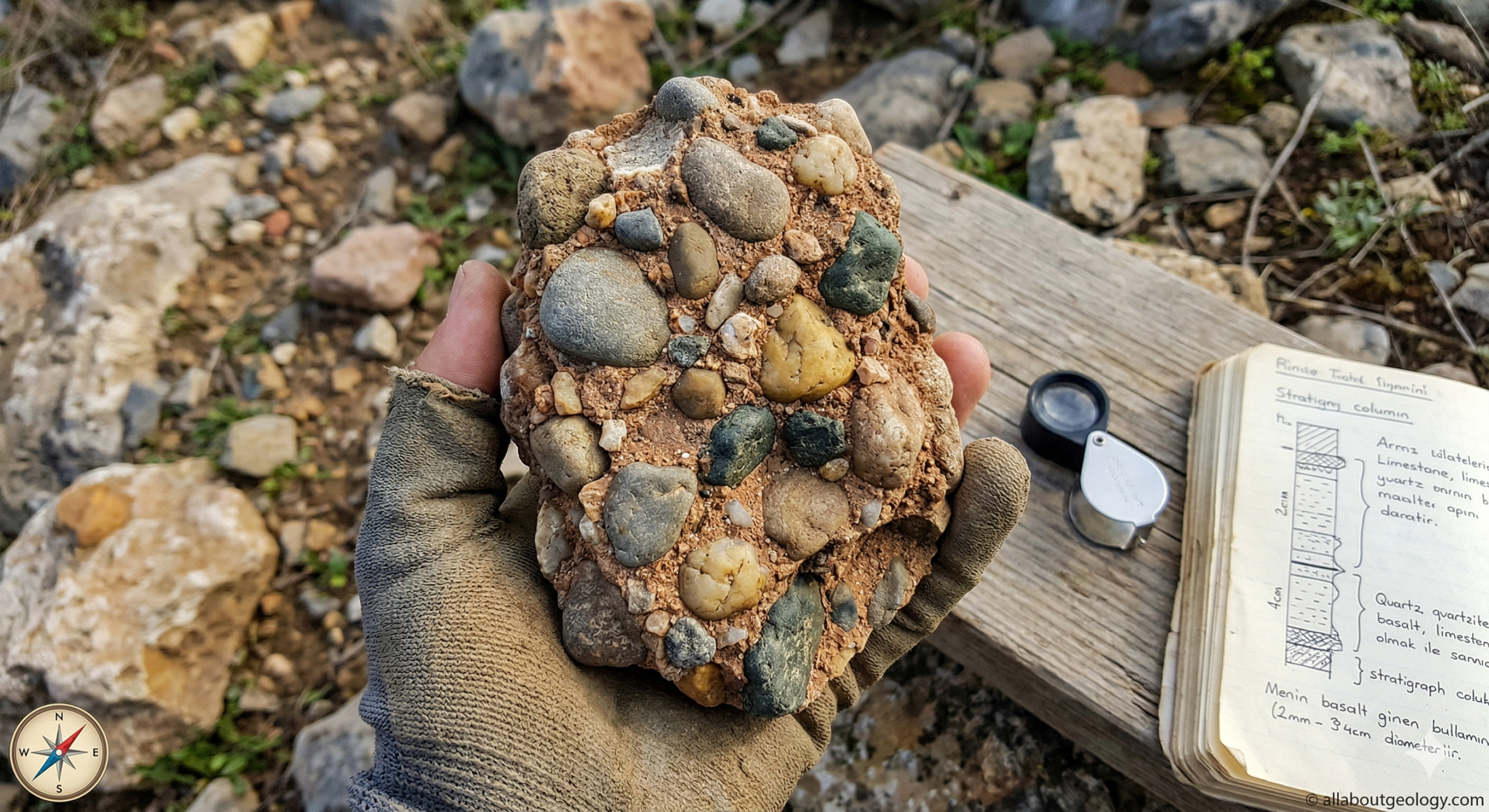
Conglomerate is a widely recognized, coarse-grained clastic sedimentary rock. It is essentially nature’s concrete, characterized by large, rounded to sub-rounded gravel (clasts larger than 2 mm in diameter) bound together by a finer-grained matrix. In the classification of sedimentary rocks, conglomerates represent extreme, high-energy depositional environments where only strong water currents or massive forces can transport such heavy material.
How Does It Form? (The Sedimentary Process)

Conglomerates are formed through a sequence of weathering, high-energy transport, deposition, and lithification. Because it takes significant power to move large rocks, conglomerates typically form in dynamic environments like fast-flowing braided rivers, steep alluvial fans, or high-energy beach coastlines pounded by strong waves.
The formation process follows these steps:
- Transport and Rounding: Powerful water currents carry broken pieces of rock. As these fragments tumble along riverbeds or shorelines over long distances, their sharp edges are continuously ground down, making them rounded.
- Deposition: When the water’s energy drops (e.g., a river entering a flatter plain), the heaviest rounded gravels drop out of the suspension and accumulate.
- Lithification: Over millions of years, these gravel beds are buried. Finer sediments (sand and mud) fill the gaps, and mineral-rich groundwater flows through, depositing cements that bind the entire mass into solid rock.
Physical and Mineralogical Properties of Conglomerate
A conglomerate’s physical appearance is chaotic but highly informative. Its internal structure tells exploration geologists exactly how the rock was deposited and where it came from.
Clast vs. Matrix Relationship (Texture)
The most defining physical trait of a conglomerate is how the large clasts interact with the finer matrix around them:
- Clast-Supported (Orthoconglomerate): The large, rounded gravel pieces are touching one another, bearing the weight of the rock, while the matrix simply fills the small voids. This indicates sustained, turbulent water flow (like a river) that washed away most of the fine mud.
- Matrix-Supported (Paraconglomerate): The large clasts “float” isolated within a sea of fine mud or sand without touching each other. This is the fingerprint of a catastrophic, gravity-driven event dumping everything at once, such as a glacial till or a submarine debris flow.
Main Mineral Composition
Unlike chemical rocks (like limestone), conglomerates do not have a single chemical formula. Their composition is divided into three parts:
- The Clasts (Gravel): These can be composed of any durable rock type. If all clasts are the same rock (e.g., pure quartz pebbles), it is called monomictic. If it is a chaotic mix of granite, basalt, and quartz, it is polymictic. Quartz is the most common clast because it is incredibly hard and survives long transport.
- The Matrix: Typically consists of fine-grained quartz sand, silt, or clay.
- The Cement: The chemical “glue” holding it together, most commonly composed of silica (quartz), calcium carbonate (calcite), or iron oxide (hematite).
What is the Difference Between Conglomerate and Breccia?
Distinguishing between conglomerate and breccia is one of the most fundamental concepts in sedimentary geology. Both are coarse-grained clastic rocks with fragments larger than 2 mm, but their transport histories are entirely different:
| Feature | Conglomerate | Breccia |
| Clast Shape | Rounded to sub-rounded. | Angular and sharp. |
| Transport Distance | Long distance. The clasts tumbled in water for a long time, eroding their sharp edges. | Short distance. The rock was broken and deposited almost immediately (e.g., faulting, landslides). |
| Depositional Environment | Braided rivers, alluvial fans, high-energy beaches. | Fault zones (tectonic breccia), volcanic vents, or base of steep cliffs (talus). |
If the gravel looks like smooth river stones, it is a conglomerate. If the fragments look like freshly shattered glass or broken tiles, it is a breccia.
Common Uses
Due to its variable composition and the presence of softer matrix materials, conglomerate does not polish well and is rarely used as high-end architectural stone. However, it has significant practical and economic uses:
- Economic Ore Hosts (Paleoplacers): For resource geologists, ancient conglomerates are massive targets. High-energy rivers that formed conglomerates also concentrated heavy, durable minerals like Gold (Au) and Uranium between the cobbles. The Witwatersrand conglomerates in South Africa have produced over 40% of all the gold ever mined.
- Construction Aggregate: When crushed, conglomerates provide excellent gravel and aggregate for road base, fill, and concrete production.
- Aquifers: Because the spaces between the large clasts can be highly porous and permeable (if not fully cemented), conglomerates often serve as excellent underground reservoirs for water or hydrocarbons.