
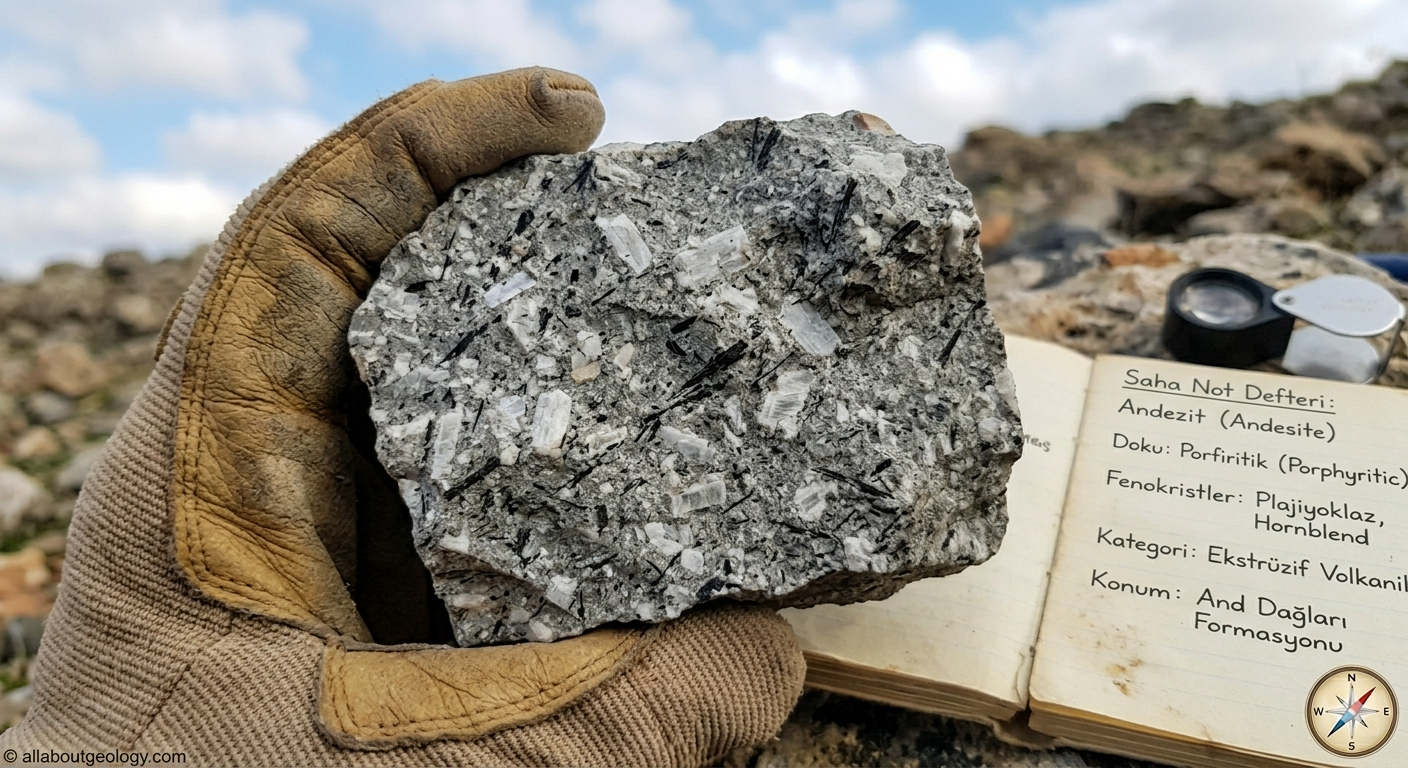
What is Andesite?
Andesite is a fascinating extrusive igneous rock. Unlike intrusive rocks that cool slowly deep underground, andesite forms when magma erupts onto the Earth’s surface as lava and cools rapidly. It is classified as an “intermediate” volcanic rock, meaning its silica content (between 52% and 63%) falls right in the middle, perfectly bridging the gap between heavy, dark basalt and light, silica-rich rhyolite.
Because it is the primary rock type forming the spectacular stratovolcanoes along the Pacific Ocean, it was famously named after the towering Andes Mountains of South America.
The Mineral Composition: A Perfect Intermediate
The intermediate chemistry of this volcanic rock dictates its mineral makeup and its typically light-to-dark gray color. A standard hand sample primarily consists of:
- Plagioclase Feldspar: This is the dominant mineral, giving the rock its lighter gray matrix.
- Amphibole (Hornblende) & Pyroxene: These ferromagnesian (iron and magnesium-rich) minerals provide the dark, contrasting speckles scattered throughout the stone.
- Biotite Mica: Occasionally present, adding tiny, reflective black flakes. (Note: Quartz is either absent or present in very minor amounts).
Porphyritic Texture: The “Chocolate Chip Cookie” of Rocks
One of the most distinguishing features of andesite is its porphyritic texture. This means the rock contains two distinct sizes of crystals, revealing a complex, two-stage cooling history.
Deep beneath the volcano, the magma begins to cool slowly, allowing large, visible crystals (called phenocrysts)—usually rectangular plagioclase or blocky hornblende—to form. Before the rock can completely solidify, a volcanic eruption blasts the mixture to the surface. The remaining liquid lava then cools almost instantly, forming a fine-grained, microscopic background matrix (called groundmass). The final result looks incredibly similar to a chocolate chip cookie: large, distinct chunks suspended in a smooth, uniform dough.
Where Does Andesite Form? The Tectonic Connection

Andesite formation typically occurs at subduction zones, where an oceanic tectonic plate slides beneath a continental or another oceanic plate. Here’s a description of how this process unfolds and what a diagram would depict in English:
- Plate Collision: One tectonic plate (usually the denser, water-rich oceanic plate) collides with and subducts under another (lighter continental plate or island arc).
- Melting: As the subducting plate descends into the hot mantle, it releases water. This water significantly lowers the melting point of the overlying mantle rock, causing partial melting and creating magma.
- Rise & Interaction: The newly formed magma is less dense than the surrounding rock and begins to rise. As it passes through the thick continental crust, it can melt and mix with continental rocks, increasing its silica content and changing its composition from mafic (like basalt) towards intermediate (like andesite).
- Eruption: This intermediate, relatively viscous magma eventually erupts onto the surface through stratovolcanoes, characteristic of subduction zones. The rapid cooling of the lava on the surface forms the fine-grained andesite rock.
A typical figure would show a cross-section diagram with:
- The descending oceanic lithosphere (marked with arrows).
- The trench on the ocean floor.
- The overriding continental lithosphere (marked).
- Labels for the subducting plate, asthenosphere, and mantle wedge.
- A depiction of magma generation (melting region) above the descending slab.
- Magma chambers within the continental crust showing interaction.
- A stratovolcano on the surface, with labels for the volcano and potentially andesite lava flows.”
Historical and Modern Uses
While it may not hold the economic hydrocarbon value of sedimentary rocks, this extrusive rock is incredibly durable and slip-resistant.
- Ancient Architecture: The Romans and various South American empires extensively used it to construct enduring monuments, temples, and road networks.
- Modern Construction: Today, crushed andesite is a highly valued aggregate in road construction, railroad ballast, and high-quality concrete mixtures due to its immense compressive strength and resistance to weathering.

[…] or Andesite: Sometimes, fine-grained volcanic rocks can also act as the protolith, resulting in a dark, […]