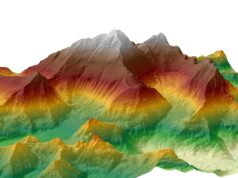
In exploration geology and airborne magnetic surveys, some of the most distinct and intense positive anomalies are generated by ultramafic rocks, specifically serpentinites. The secret behind those massive red and pink “bullseye” zones on the map is not the original magnetism of the rock, but the hydrothermal evolution it underwent over time.
But how does a peridotite with originally weak magnetic properties turn into a massive source of magnetic anomaly? The answer lies in the “chemical engine” driven by the serpentinization process.
The Initial State of Ultramafic Rocks
The parent rocks of serpentinites (peridotite, dunite, harzburgite) are rich in olivine and pyroxene, which are among the first minerals to crystallize from magma. Although pure olivine and pyroxene contain iron (Fe), they do not exhibit high magnetic susceptibility. The iron is locked securely within the silicate crystal lattice. Therefore, a fresh, unaltered dunite or peridotite body does not create a massive geophysical magnetic anomaly on its own.
The Serpentinization Reaction: Water Meets Rock
At mid-ocean ridges, ophiolitic thrust zones, or deep fault systems, seawater or hydrothermal fluids infiltrate these ultramafic rocks. Olivine and pyroxene cannot remain stable in this new environment of lower temperatures and abundant water, triggering the famous alteration process known as serpentinization.
The fundamental reaction is: Olivine + Water -> Serpentine + Brucite + MAGNETITE + Hydrogen Gas
Here is the general chemical formula representing this transformation (using iron-bearing olivine):
30(Mg₁.₈Fe₀.₂)SiO₄ + 41H₂O → 15Mg₃Si₂O₅(OH)₄ + 9Mg(OH)₂ + 2Fe₃O₄ + 2H₂
The Birth of Secondary Magnetite
This is the absolute key to the magnetic anomaly. The trapped iron (the fayalite component) within the olivine structure does not fit into the crystal lattice of the newly formed serpentine minerals (such as chrysotile, antigorite, or lizardite). The system forcibly expels this “excess iron.”
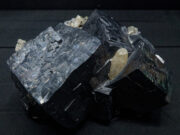
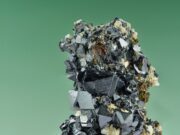
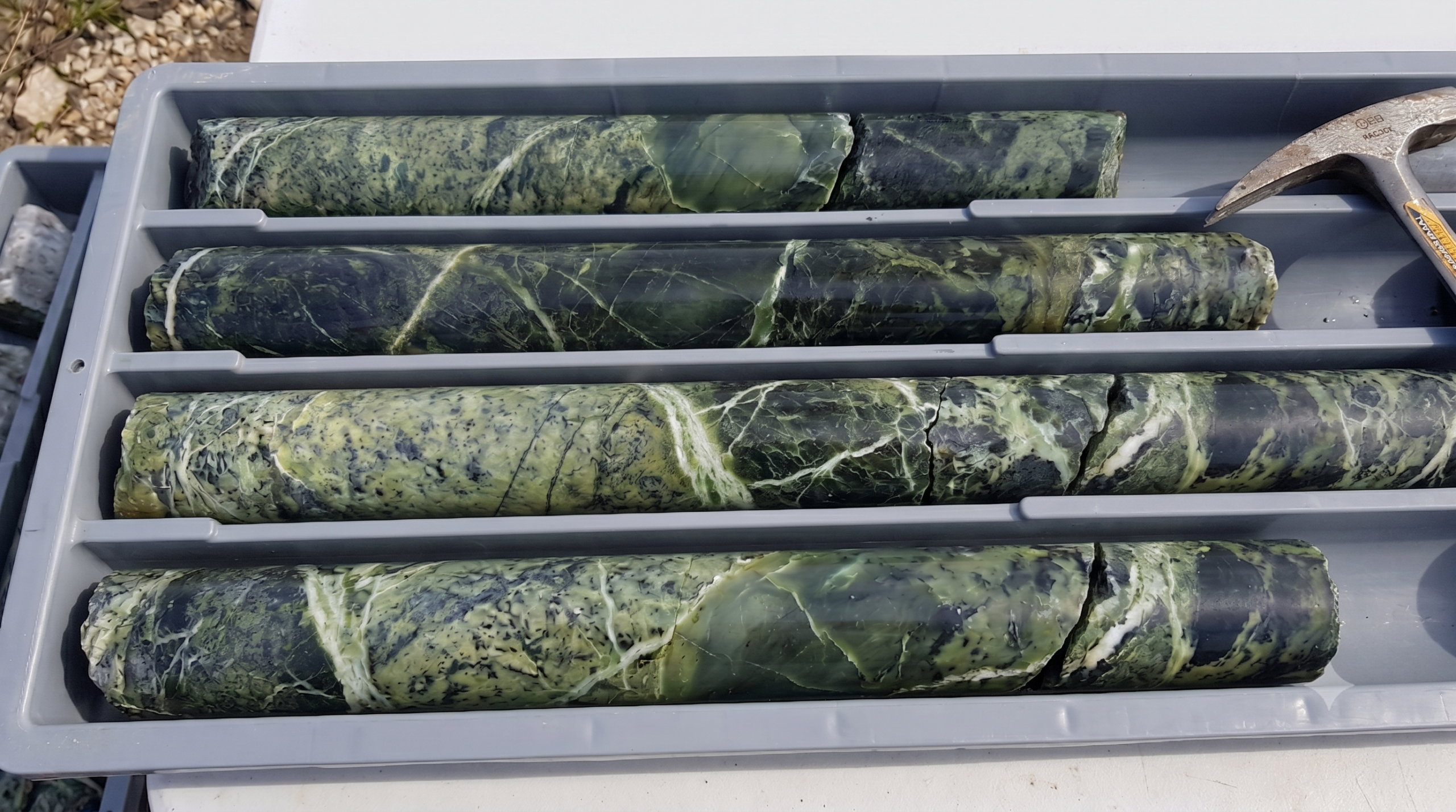
This expelled iron oxidizes to form brand-new, free crystals of secondary magnetite (Fe3O4). The fine black dust or veinlets we observe on serpentinites under the microscope or while logging drill core are exactly these secondary magnetites.
The Geophysical Result: Intense Magnetic Susceptibility

While a fresh ultramafic rock contains almost no free magnetite, the serpentinization process generates new magnetite crystals that can make up between 2% and 10% of the rock’s total volume.
Magnetite is the most magnetic mineral in nature. Spread homogeneously or concentrated in mesh-like veinlets throughout the rock, these secondary magnetites instantly multiply the rock’s magnetic susceptibility by thousands of times. A geophysical drone or plane flying over the surface detects this dense magnetite accumulation, drawing those intense, high-amplitude positive anomalies we target on our maps.
In summary: Serpentinites produce magnetic anomalies because the alteration process expels the hidden iron within olivine, transforming it into free magnetite—the world’s strongest natural magnet.
In the next part of this series, we will explore how to read these magnetite anomalies on airborne magnetic maps, understand Reduction to the Pole (RTP), and use this data to build exploration strategies.