Serpentinite: The Green Transformation of the Oceanic Crust
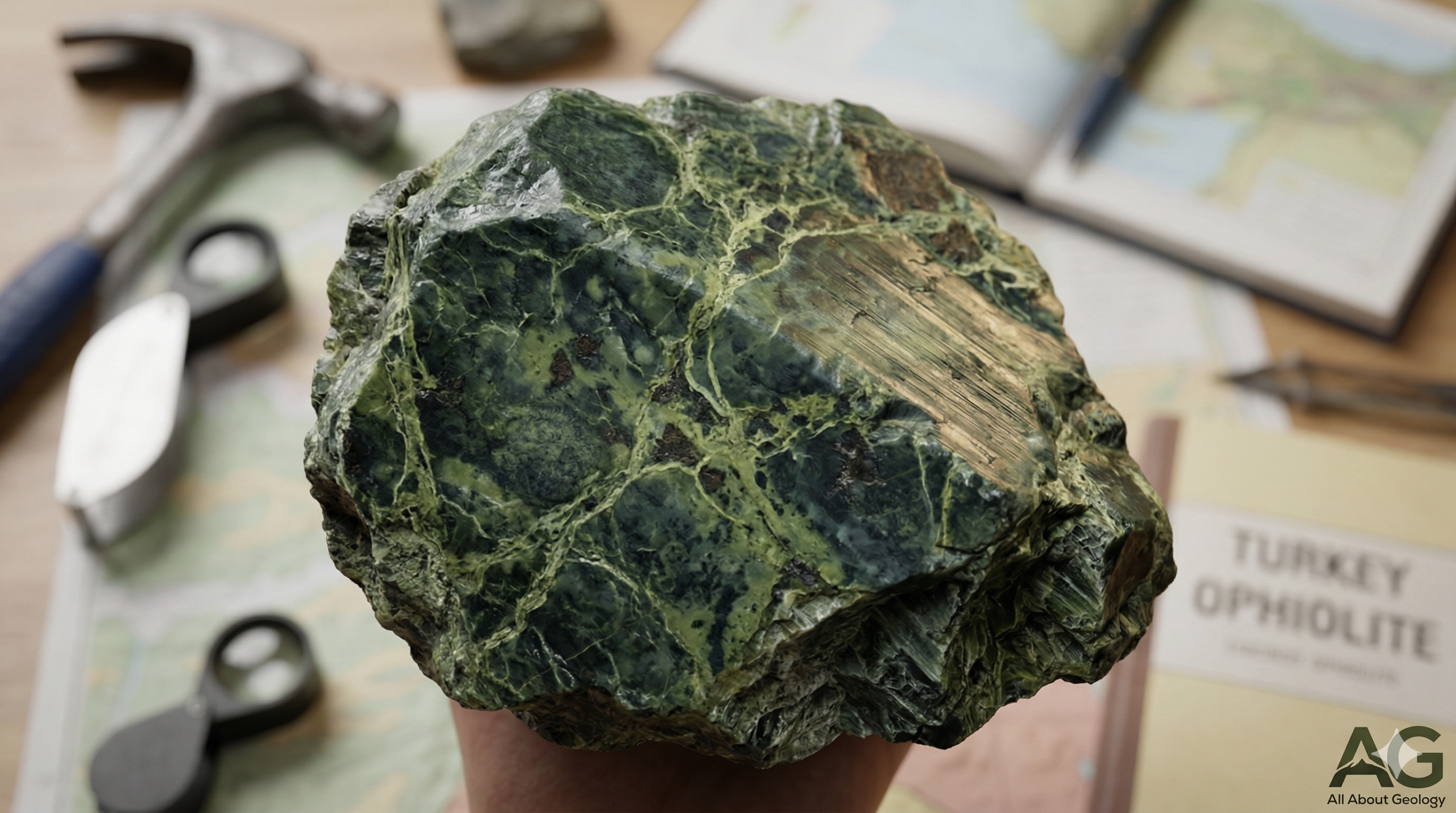
In the realm of geology, few rocks possess a transformation story as dramatic as serpentinite. It is not simply formed through standard volcanic or sedimentary processes; rather, it emerges when ultramafic rocks (like peridotite and dunite) deep within the Earth’s crust meet water, taking on an entirely new identity. Named for its mottled, greenish, and slick surface that resembles snakeskin, serpentinite stands as one of the greatest testaments to the Earth’s tectonic and hydrothermal power.
1. Genesis and the Serpentinization Process
The origins of serpentinite lie deep within the fracture systems of the ocean floor and subduction zones. When seawater infiltrates olivine- and pyroxene-rich rocks in the upper mantle, it triggers “serpentinization”—a highly effective, low-temperature (< 400 °C) hydrothermal metamorphism. This reaction is highly exothermic (releasing massive amounts of heat) and increases the rock’s volume by 30% to 40%. This immense volumetric expansion literally fractures the surrounding rocks and pushes the oceanic crust upward

2. Mineralogy, Structure, and Textures

Serpentinite is not a single mineral, but a family of minerals. The bulk of the rock is composed of antigorite, lizardite, and the fibrous chrysotile (white asbestos). When handled in the field, it has a distinct waxy or soapy feel. During the alteration process, the released iron oxidizes into magnetite. This not only gives serpentinite its characteristic dark green and black veined appearance but also endows it with a strong magnetic signature.
3. Exploration, Engineering, and 3D Modeling
For an exploration geologist, working in serpentinite terrains is both a massive opportunity and a serious engineering test. Thanks to its high magnetite content, it immediately stands out as a massive anomaly during high-resolution magnetic surveys conducted with drones like the Mavic 2 Pro. It acts as a primary host rock for significant nickel, cobalt, and chromium (chromite) deposits.
However, drilling in these zones is notoriously difficult due to the highly fractured, sheared, and slick nature of the rock, which often results in poor core recovery. When structural data, magnetic maps, and drillhole logs are imported into software like Leapfrog, Datamine, or MapInfo, the 3D modeling of these complex alteration zones and their hosted ore bodies must be executed with high precision to effectively guide the exploration program.
4. Iconic Global Examples
- Troodos Ophiolite (Cyprus): The classic textbook example where oceanic crust and serpentinization processes are best observed globally.
- Semail Ophiolite (Oman): One of the largest and most complete sections of oceanic crust exposed on the Earth’s surface.
- Kızıldağ / Hatay (Turkey): Iconic serpentinite massifs known for their massive ultramafic sequences and rich chromite deposits.