Thick mudstone and shale sequences seen on geological maps or in core boxes are often dismissed as “uneconomic, boring cover rocks.” However, for exploration geologists, the reality is entirely different. The process of mudstone compaction in a sedimentary basin acts as a massive, billion-ton underground press, serving as the primary hydrothermal pump that creates the world’s largest Lead (Pb) and Zinc (Zn) deposits..
In this article, we will examine step-by-step the massive compaction created by lithostatic pressure and how this mechanism drives the formation of world-class ore bodies known as SEDEX (Sedimentary Exhalative) and MVT (Mississippi Valley Type) deposits.
Part 1: The Engine of the System – Lithostatic Pressure and Compaction

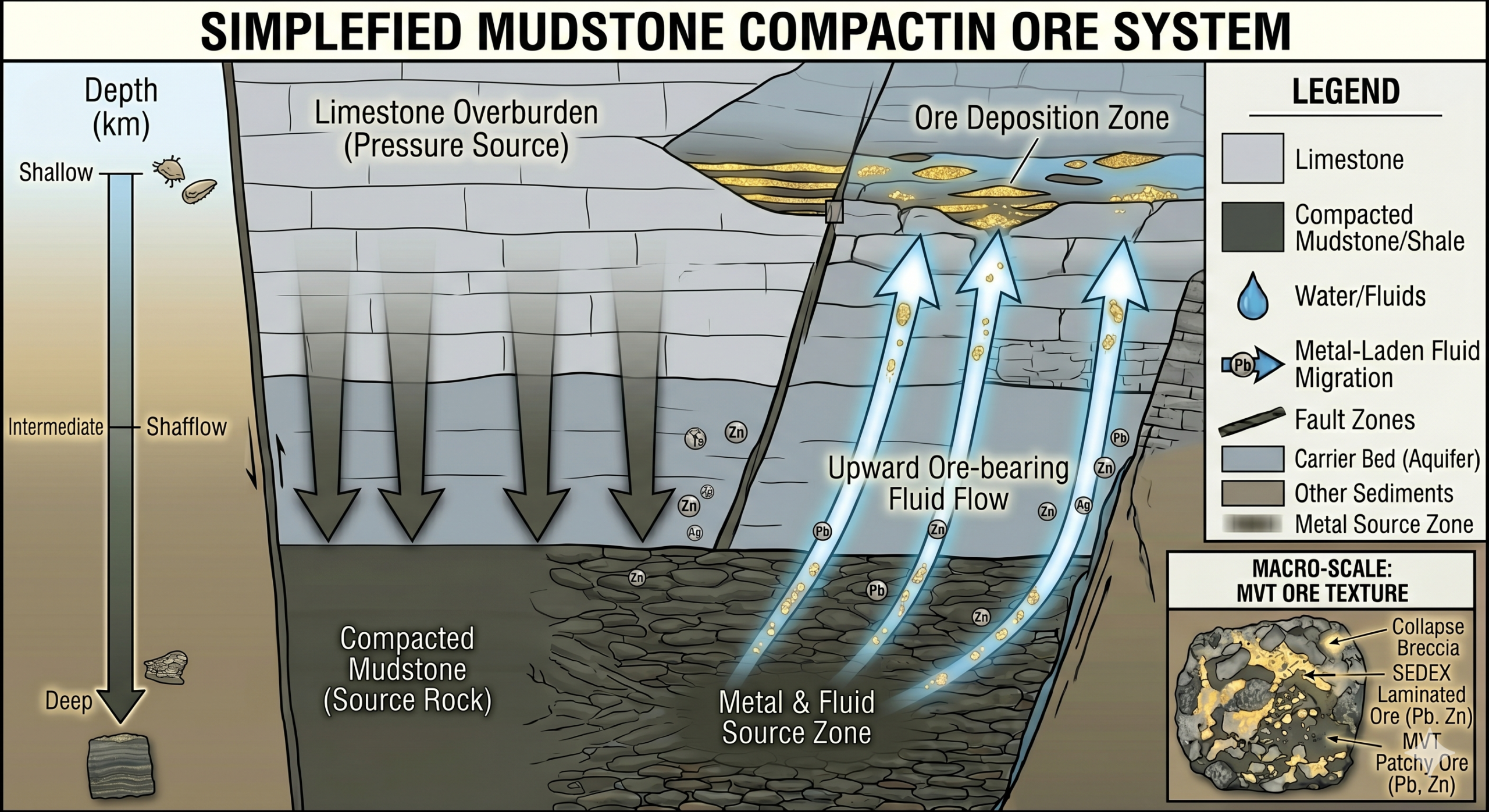
The fundamental mechanism underlying the classical genetic model of both deposit types is the Compaction process. You can think of this process as a massive hydraulic press operating deep underground:
- A Watery Beginning: A newly deposited layer of clay and mud on an ocean or lake floor contains about 60% to 80% seawater by volume. At this stage, the system is nothing more than a wet sea of mud.
- Lithostatic Pressure (Rock Load): Over millions of years, thousands of meters of new sediments (sands, limestones, gravels) continue to accumulate on top of this mud layer. Every meter of sediment deposited adds tremendous weight to the underlying mud. In geology, this all-encompassing rock weight is called Lithostatic Pressure.
- The Press Effect (Compaction): Crushed under millions of tons of lithostatic pressure, the mud layer begins to yield. As the rock grains interlock, the 80% seawater trapped between them is expelled outward (upward and laterally) with immense force. The wet mud has now lost its volume, transforming into a hard mudstone or shale.
Part 2: Fluid Transformation and Metal Enrichment

The water violently expelled from the mudstone is no longer ordinary seawater. While being compressed under lithostatic pressure deep within the basin, it has also been heated by the geothermal gradient (100°C – 250°C), transforming into a highly saline, aggressive fluid known as a basinal brine.
These hot, chloride-rich waters act as a solvent. They effectively “wash” and dissolve trace amounts (ppm levels) of metals like lead, zinc, and silver scattered within the matrix of the compacting mudstones and surrounding clastic rocks, absorbing them into their own solution. We now have millions of cubic meters of highly overpressured, metal-laden hydrothermal fluid.
(Academic Note: Mudstone compaction is the most classic and fundamental model for mobilizing basinal fluids. However, modern geology recognizes that to sustain massive fluid flow over millions of years, other fluid drive mechanisms—such as topographically driven flow, thermal convection, and tectonic squeezing—also operate alongside compaction.)
Part 3: Fluid Escape and Geological Targets (SEDEX and MVT)

Desperately trying to escape the lithostatic pressure, these aggressive, metal-laden fluids begin to migrate upwards, using deep basin-margin faults or permeable sandstone layers (aquifers) as fluid highways. Where these fluids arrive and precipitate determines the type of the deposit:
SEDEX (Sedimentary Exhalative) Deposits
These form when the pressurized basinal brines are discharged directly onto the seafloor (exhalation) via deep faults. They are massive systems hosting over 50% of the world’s zinc reserves (e.g., Red Dog, Alaska).
- The hot, metal-laden brines experience a thermodynamic shock the moment they encounter the cold, anoxic (sulfur-rich) waters of the seafloor.
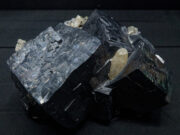
- The sphalerite (ZnS) and galena (PbS) carried in the fluid precipitate onto the seafloor, almost like an underwater snowstorm.
- The ore is perfectly concordant with the host mudstone and is deposited in millimetric bands/laminations (Stratiform).
MVT (Mississippi Valley Type) Deposits
If these squeezed fluids fail to reach the seafloor and are instead trapped in a shallow limestone or dolomite trap underground, MVT deposits emerge.
- The acidic and metal-bearing fluids seep into cave voids, fault fractures, and collapse breccias within the limestone.
- The limestone neutralizes the acid, causing the metals to precipitate directly into these open spaces as patches (epigenetically). Unlike SEDEX, MVT deposits are not bedded; they exhibit void-filling, brecciated textures.
Part 4: Exploration Criteria (SEDEX vs. MVT)
When you intercept a zinc-lead anomaly in the field, you should look at these fundamental differences to understand the character of your target:
| Feature | SEDEX | MVT |
| Host Rock | Mudstone, Shale, Siltstone (Clastics) | Limestone, Dolomite (Carbonates) |
| Ore Geometry | Bedded, Laminated, Stratiform | Void-filling, Brecciated, Discordant |
| Timing of Formation | Precipitates at the same time as the host rock (Syngenetic) | Infiltrates long after the host rock is formed (Epigenetic) |
| Temperature and Depth | Hotter (150-250°C), deeper systems. | Cooler (50-150°C), shallow platforms. |
In summary; The geological evolution of a sedimentary basin operates like a colossal underground refinery. The relentless compaction of mudstones under lithostatic pressure gathers scattered metals from the Earth’s crust and concentrates them into specific geological traps as SEDEX or MVT deposits.