
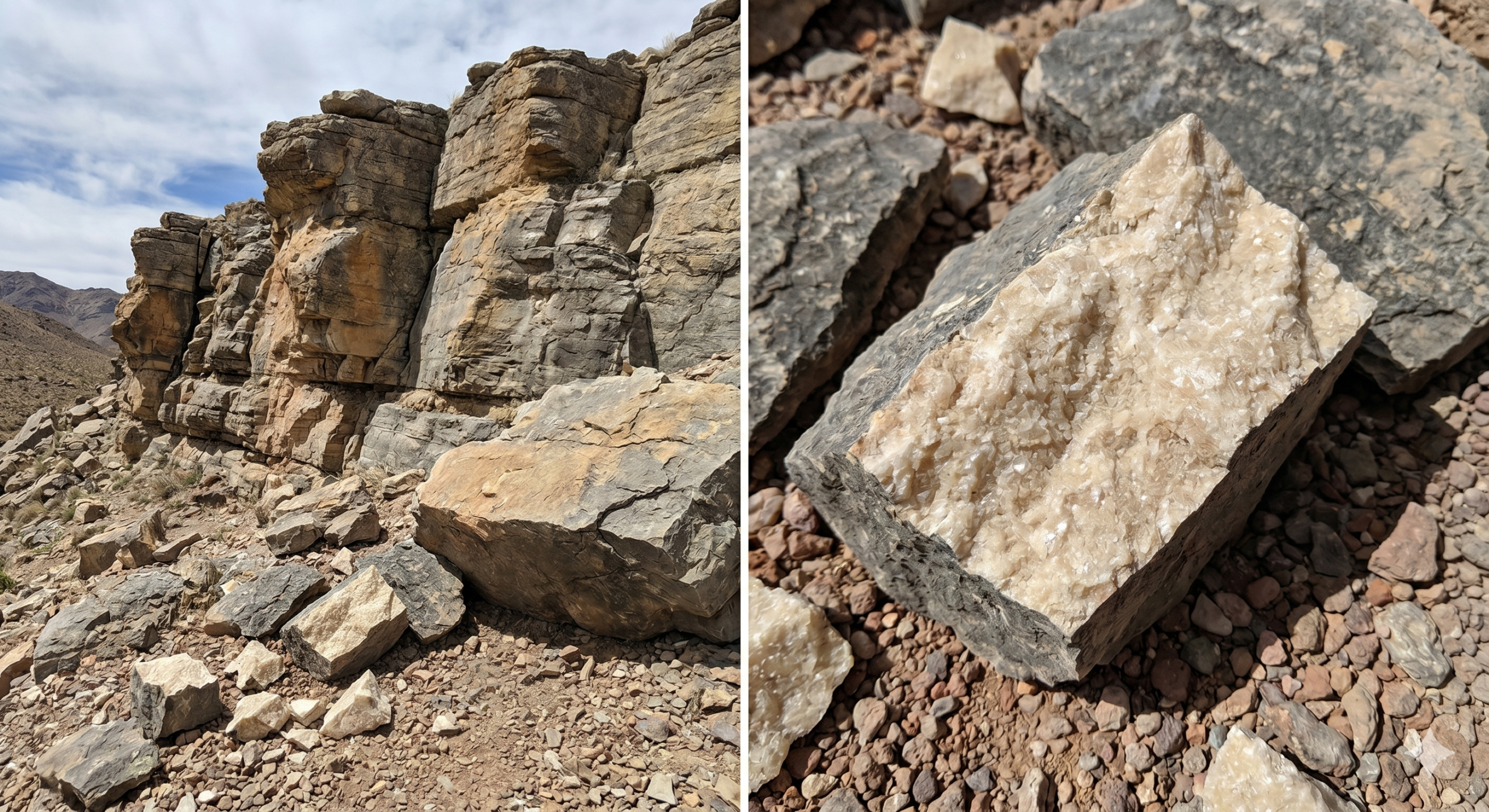
The Complete Guide to Its Properties, Formation, and Economic Significance
In the realm of earth sciences, the term “dolomite” is uniquely dual-purpose: it refers both to a specific carbonate mineral and to a sedimentary rock composed predominantly of that mineral (also known as dolostone). Named in honor of the French mineralogist Déodat Gratet de Dolomieu, this fascinating geological material is far more than just a common rock.
From understanding the diagenetic history of sedimentary basins to mapping complex 3D alteration halos in mineral exploration, dolomite plays a central role in both academic research and economic geology. In this comprehensive guide, we will explore the physical characteristics, the complex formation mechanisms, and the strategic industrial importance of dolomite.
Physical and Chemical Properties of the Dolomite Mineral
At its core, the dolomite mineral is an anhydrous carbonate of calcium and magnesium, with the ideal chemical formula CaMg(CO₃)₂. While it shares a structural resemblance to calcite, the substitution of magnesium ions introduces distinct physical and crystallographic characteristics.
- Color: Typically white, gray, cream, or off-white. It can exhibit a pinkish hue if trace amounts of manganese are present, or brown/yellowish tints when iron substitutes within the crystal lattice (trending toward ankerite).
- Hardness (Mohs Scale): 3.5 to 4.0 (Making it notably harder than pure calcite, which is 3.0).
- Specific Gravity: 2.8 to 2.9 g/cm3
- Crystal System: Trigonal. In nature, it frequently occurs as rhombohedral crystals with distinct, curved faces (saddle dolomite), or as massive, granular aggregates.
- Cleavage: Perfect rhombohedral cleavage in three directions.
- Luster: Vitreous to pearly.
Field Identification: Calcite vs. Dolomite
For field geologists logging drill core or mapping outcrops, distinguishing between limestone (calcite) and dolostone (dolomite) is a daily necessity. Due to their visual similarities, macroscopic identification can be ambiguous.
The most reliable and practical field test is the 10% dilute Hydrochloric Acid (HCl) test.
When cold, dilute HCl is applied to calcite, it reacts instantly and vigorously, producing a highly visible effervescence (fizzing). In contrast, dolomite will show a very weak or virtually non-existent reaction with cold acid on a fresh surface. However, if the dolomite is scratched into a fine powder to increase the surface area, or if the acid is heated, a distinct effervescence will occur.
The Dolomitization Process: How Does Dolostone Form?

Unlike limestone, which frequently precipitates directly from marine environments or forms from the accumulation of biogenic debris, primary dolomite precipitation in modern marine environments is exceptionally rare. The vast majority of dolostone in the geological record forms through a secondary diagenetic process known as dolomitization.
Dolomitization occurs when magnesium-rich fluids (such as hypersaline brines or modified seawater) percolate through pre-existing calcium carbonate (limestone) muds or rocks. During this fluid-rock interaction, magnesium ions replace a portion of the calcium ions:
2CaCO₃ + Mg²⁺ ⇌ CaMg(CO₃)₂ + Ca²⁺
Because the magnesium ion is significantly smaller than the calcium ion, this crystallographic replacement results in a volume reduction of approximately 13%. This shrinkage is geologically paramount: it creates extensive secondary porosity and permeability within the rock mass (often forming vuggy textures), transforming dense limestones into excellent fluid reservoirs.
Economic Geology: Dolomite as a Host Rock and Exploration Vector
The importance of dolomite in economic geology cannot be overstated. Its unique physical properties and chemical stability make it a critical focal point in mineral exploration, particularly for base metal deposits.
Host for MVT and SEDEX Deposits
The secondary porosity generated during dolomitization turns the rock into an ideal structural trap and reservoir for migrating hydrothermal fluids. The world’s most significant lead-zinc (Pb-Zn) reserves, including Mississippi Valley-Type (MVT) and Sedimentary Exhalative (SEDEX) deposits, are predominantly hosted within dolomitized sequences. The vugs and highly permeable fault zones within the dolostone provide the necessary open space for the precipitation of economic sulfide minerals like sphalerite and galena.
Alteration Halos and Geochemical Vectors
In various ore-forming systems, including orogenic gold and Volcanogenic Massive Sulfide (VMS) deposits, the interaction between hot, mineralizing fluids and the surrounding host rocks creates widespread alteration halos. Carbonate alteration, specifically the formation of ferroan dolomite and ankerite, serves as a crucial geochemical vector.
By utilizing multi-element geochemical analyses, exploration geologists can trace the intensity of dolomitic alteration. Integrating this multi-element data into 3D geological modeling software (such as Leapfrog Geo or Datamine) allows for the precise correlation of structural controls and helps vector toward the high-grade core of the orebody.
Industrial Applications of Dolomite
Beyond its role in ore genesis, dolomite is directly extracted and utilized across numerous global industries:
- Construction and Infrastructure: Crushed dolostone is heavily used as an aggregate in concrete and asphalt due to its high hardness and durability.
- Metallurgy: In the iron and steel industry, calcined dolomite is utilized as a fluxing agent to remove impurities (slag formation) and as a raw material for manufacturing refractory bricks that line high-temperature furnaces.
- Agriculture: Pulverized dolomite (aglime) is an essential soil conditioner. It neutralizes soil acidity (pH) and provides vital magnesium and calcium nutrients for crop growth.
- Glass and Ceramics: The addition of dolomite to glass melts introduces calcium and magnesium, which significantly improves the durability, thermal shock resistance, and optical clarity of the final glass product.
Summary
Whether you are conducting a drone survey over a carbonate sequence, logging a 600-meter drill hole, or running an implicit 3D model of a complex vein system, dolomite is a lithology that consistently commands attention. Understanding its properties and formation processes unlocks vital clues about diagenetic history, hydrothermal fluid pathways, and the potential for economic mineralization.
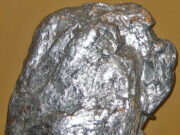
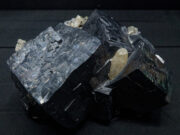
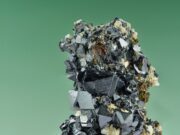


[…] District, Pine Point, Viburnum Trend), epigenetic basinal brines at 80°C–150°C replace dolostones and limestones. Sphalerite occurs as coarse, banded, botryoidal (“schalenblende”) […]
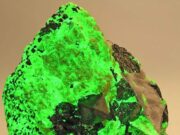
[…] deposit, hosting over 20 million tonnes of high-grade ore (~18% Zn). Hosted within Neoproterozoic dolomitic carbonates of the Vazante Group, willemite occurs in major fault-breccia shear zones. Hydrothermal fluids […]