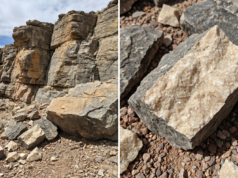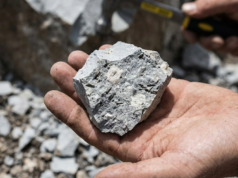
Rhyolite is a light-colored, fine-grained (aphanitic), felsic extrusive (volcanic) igneous rock. If basalt is the dark, fast-flowing lava of the ocean floor, rhyolite is the explosive, highly viscous, silica-rich lava of the continents. Petrologically, it is the exact volcanic equivalent of granite. When granitic magma erupts onto the surface rather than cooling slowly underground, it becomes rhyolite.
How Does It Form?

1. Magma Generation (Partial Melting):
Rhyolitic magma is primarily generated in the deep continental crust. The heat often comes from massive, underlying mafic magmas (like basalt) rising from the mantle, which partially melts the silica-rich continental rock. Because felsic minerals (like quartz and alkali feldspar) melt at lower temperatures, the resulting magma is heavily enriched in silica SiO2 > 69%).
2. The Problem of Viscosity:
The most critical factor in rhyolite formation is its extreme viscosity. Silica molecules link together in complex, sticky chains even while still liquid. This makes the magma incredibly thick and slow-moving. Unlike fluid basalt, which flows easily, rhyolitic magma struggles to reach the surface.
3. Ascent and Gas Entrapment:
As the thick magma slowly rises through the crust, pressure decreases. Volcanic gases (primarily water vapor and carbon dioxide) try to expand, but the sticky magma traps them, building immense internal pressure.
4. Surface Eruption (The Extrusive Phase):
When the magma finally breaches the surface, the result depends entirely on the trapped gas pressure:
- Explosive Eruption: If the gas pressure is too high, the magma shatters violently, creating catastrophic ash falls, pyroclastic flows, and highly vesicular pumice.
- Lava Domes & Thick Flows: If the magma has lost some of its gas (degassed), it oozes out like thick toothpaste. Because it is too stiff to flow far, it piles up around the vent to form steep-sided lava domes or very thick, short lava flows.
5. Rapid Cooling (Aphanitic Texture):
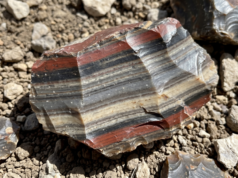
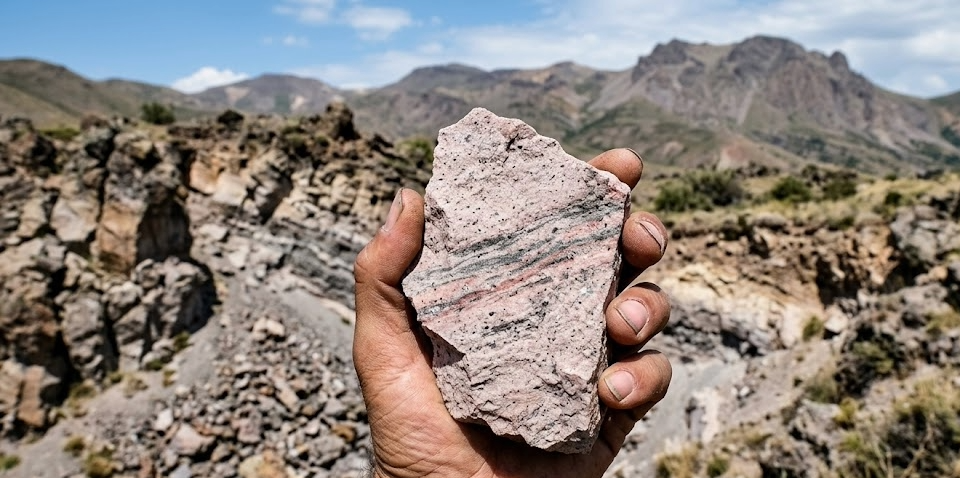
Whether it erupts explosively or as a thick dome, the material is suddenly exposed to the cool atmosphere. It chills rapidly, preventing atoms from forming large crystal structures. The result is the fine-grained (aphanitic), light-colored volcanic rock we call rhyolite, often preserving “flow banding” created as the stiff lava dragged against itself during extrusion.
What is Its Mineral Composition?
As a felsic rock, rhyolite is rich in silica and aluminum, and very poor in iron and magnesium. Its essential mineral composition includes:
- Quartz: The dominant mineral, often appearing as small, glassy, greyish grains.
- Alkali Feldspar (Sanidine or Orthoclase): Gives the rock its typical light pink, pale reddish, or white hues.
- Plagioclase Feldspar (Sodium-rich): Present in smaller amounts, usually white or clear.
- Mafic Minerals (Biotite or Hornblende): Very sparse, appearing as tiny black specks (less than 10-15% of the total volume).
How to Identify It in the Field (Outcrop and Core)?
Identifying rhyolite in a core box or mapping it in the field involves looking for distinct felsic volcanic textures:
- Light Color Index (Leucocratic): It typically presents in pale shades of pink, grey, light brown, or white.
- Porphyritic Texture: While the groundmass is fine-grained, rhyolites almost always contain larger, visible crystals (phenocrysts). Finding rounded, glassy “quartz eyes” or blocky pink feldspar crystals suspended in the fine matrix is a classic diagnostic feature.
- Flow Banding: Because the lava is so thick and pasty, it often preserves flow lines as it moves. You will frequently see distinct, parallel bands of slightly different colors or textures running through the rock.
- Associated Glass: It is very common to find rhyolite grading into glassy phases, closely associated with obsidian or highly vesicular pumice within the same volcanic sequence.
Economic Importance (Epithermal Systems and VMS)
While not traditionally used as a basic construction aggregate due to its variable composition and glassy nature, rhyolite is an incredibly important rock for exploration geologists:
- Epithermal Gold and Silver Deposits: Rhyolitic volcanic centers and their associated calderas are the classic host environments for high-grade epithermal Au-Ag veins. The heat from the rhyolitic domes drives the hydrothermal fluids that deposit precious metals in the fractured rocks above.
- Kuroko-Type VMS Deposits: While basalt hosts standard VMS deposits, submarine felsic volcanism (rhyolite and dacite domes) is the engine behind Kuroko-type Volcanogenic Massive Sulfide deposits, which are exceptionally rich in zinc, lead, copper, and often precious metals.
- Lithium and Uranium: Highly evolved rhyolites and their associated volcanic ashes (tuffs) are significant source rocks for sediment-hosted lithium and uranium deposits.
- Gemstones: Vugs (cavities) in rhyolite, formed by trapped gases, are famous for hosting magnificent gemstone crystals, including red beryl, topaz (like at Topaz Mountain, Utah), and opal.