In geology, breccia is not just a single rock type; it is the textural signature of a violent, high-energy event. Unlike a conglomerate, where rocks have been gently rounded by river currents over thousands of years, the rock fragments (clasts) in a breccia are sharp, highly angular, and chaotic.
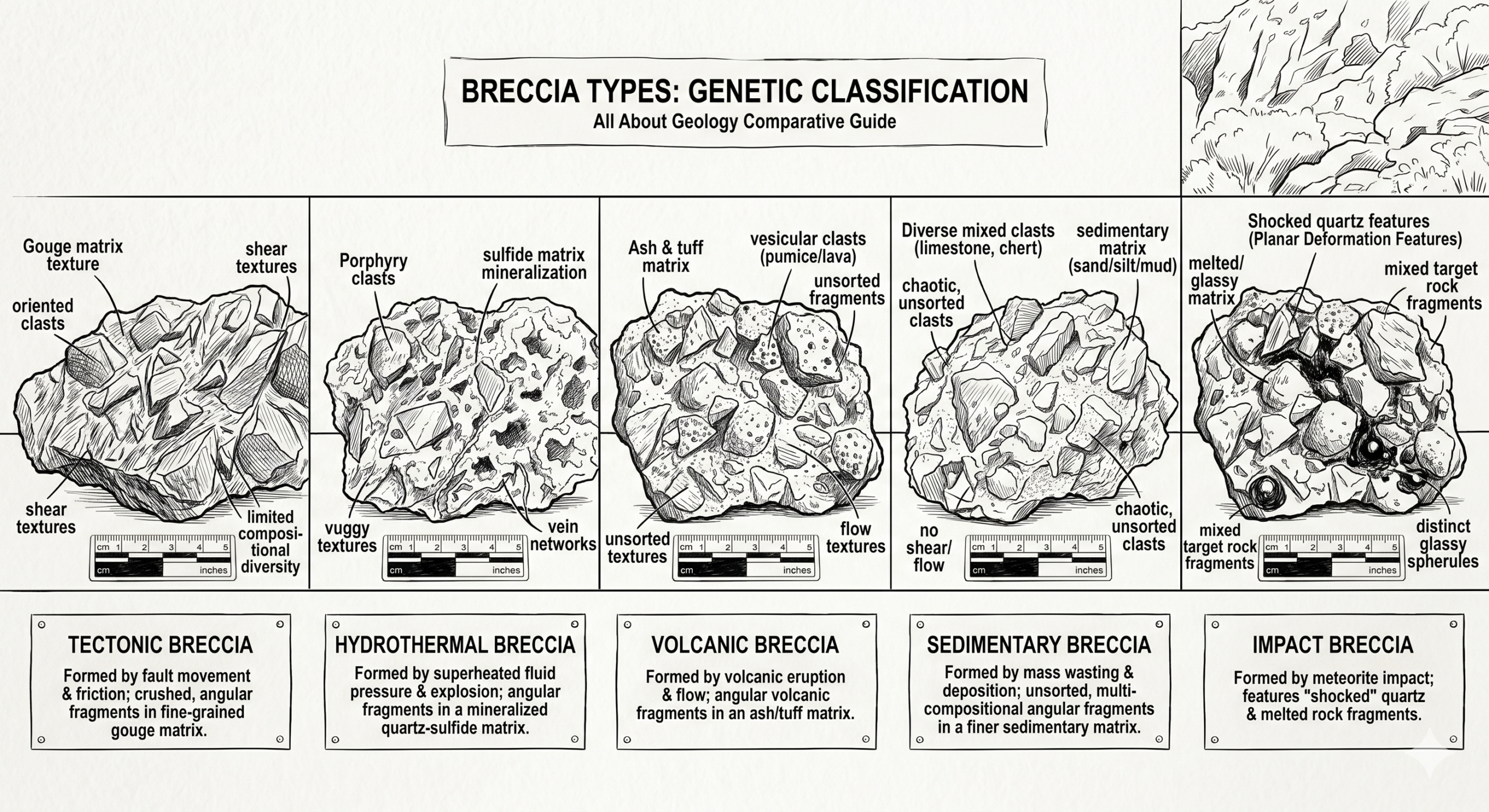
When a geologist sees a breccia in a core box or an outcrop, they know that immense energy was suddenly released here—shattering the host rock before a new matrix cemented the broken pieces back together. Based on their genetic origin (how they formed), breccias are classified into 5 main types:
1. Tectonic (Fault) Breccia

- How it Forms: Tectonic breccia is created by the immense friction and grinding forces between two massive rock blocks sliding past each other along a fault zone.
- Field Appearance: It typically presents as angular wall-rock fragments suspended in a fine-grained, pulverized clay-like paste known as “fault gouge.”
- Geological Importance: For structural geologists and explorers, fault breccias are primary indicators for mapping major structural weaknesses, shear zones, and crustal displacements.
2. Hydrothermal Breccia (The “Million Dollar” Rock)

- How it Forms: This is the Holy Grail for mining geologists. It forms through hydraulic fracturing when superheated, highly pressurized magmatic fluids (loaded with dissolved metals and gases) overcome the confining pressure of the overlying rock and violently explode.
- Field Appearance: The shattered host rock fragments are cemented together by a matrix of precipitated hydrothermal minerals. This matrix is often pure quartz, calcite, or, most importantly, sulfide minerals like pyrite, chalcopyrite, and sphalerite.
- Geological Importance: Hydrothermal breccias are the beating heart of world-class Porphyry Copper-Gold and Epithermal deposit systems. Because the matrix itself carries the ore, these breccia pipes are primary high-grade drilling targets.
3. Volcanic (Pyroclastic / Autoclastic) Breccia

- How it Forms: This type is born from volcanic activity. It can form explosively when lava is blown apart in the air and falls back to earth, or slowly (autobrecciation) when a highly viscous lava flow (like dacite or rhyolite) continuously breaks its own solidified outer crust as it moves forward.
- Field Appearance: Angular volcanic clasts (sometimes glassy or vesicular like pumice) embedded in a matrix of volcanic ash or tuff. Agglomerates fall under this broad family.
4. Sedimentary Breccia

- How it Forms: Formed by mass-wasting events where gravity is the main driver. Debris avalanches from steep mountain slopes, submarine canyon collapses, or karst (cave) roof collapses create massive piles of rubble. Because the rocks are buried and cemented before water can transport and round them, they remain angular.
- Field Appearance: Poorly sorted, angular fragments of similar rock types (e.g., all limestone or all sandstone clasts) cemented by a sedimentary matrix. Talus and scree deposits are modern examples.
5. Impact Breccia (Impactite)

- How it Forms: The rarest and most extreme type of breccia. It is created when an extraterrestrial meteorite strikes the Earth’s surface at hypersonic speeds, instantly vaporizing, melting, and shattering the target rock.
- Field Appearance: A chaotic, highly deformed rock that uniquely contains “shocked quartz” crystals and teardrops of impact glass (tektites). The Ries Crater in Germany is a classic locality.