
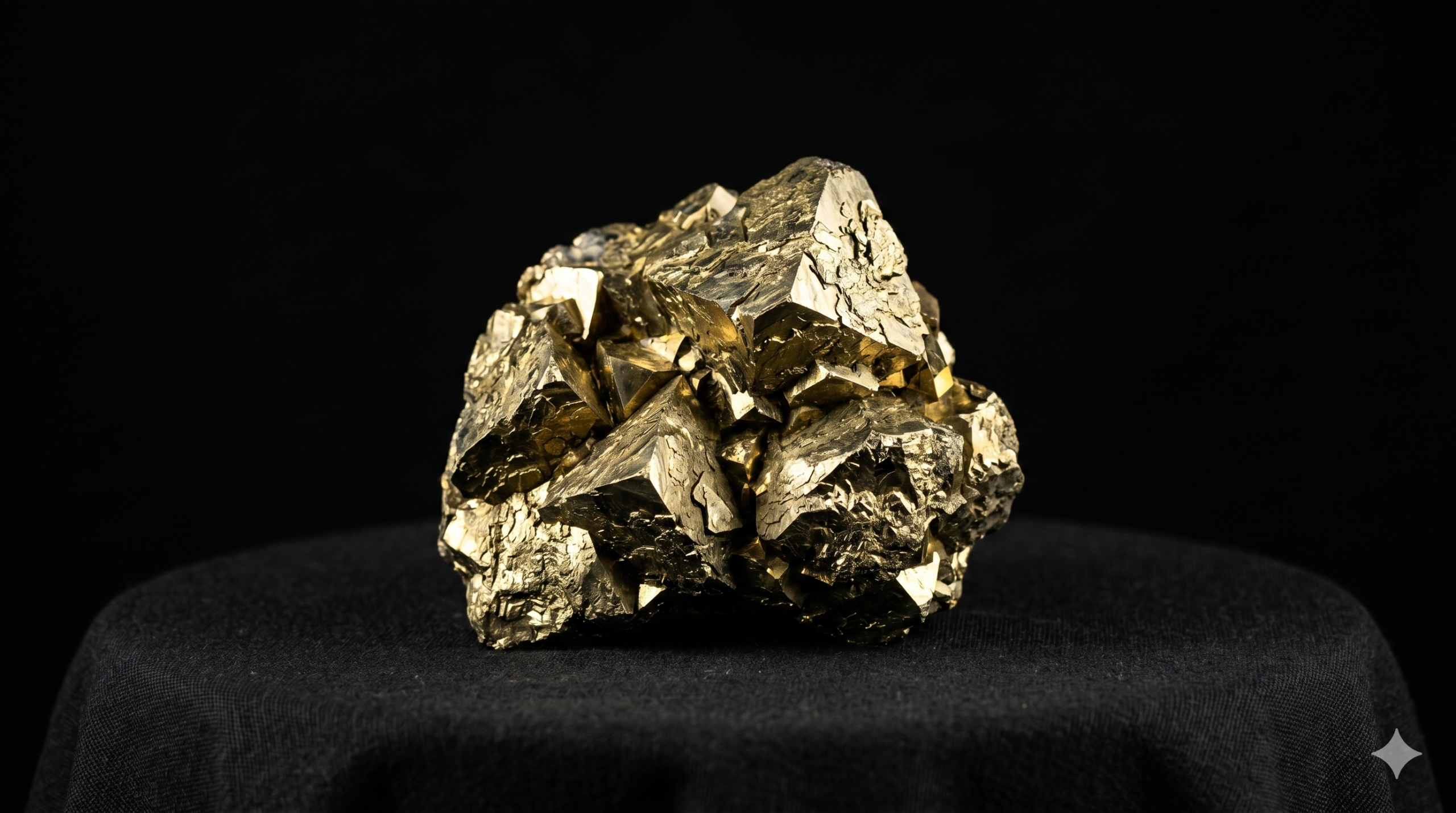
What is Chalcopyrite? The World’s Most Important Copper Ore
Chalcopyrite is the most abundant copper ore mineral and the primary source of copper production worldwide. While it is often confused with “Fool’s Gold” (pyrite) during field exploration, this brilliant brass-yellow mineral is indispensable not only for geologists but for the entire global industrial economy.
Before diving into the detailed exploration strategies and metallurgical processes, let’s quickly review the crystallographic and physical identity of this critical mineral:
Chalcopyrite Mineral Properties
| Property | Geological Data | Description |
| Chemical Formula | CuFeS2 | Copper Iron Sulfide (34.5% Cu, 30.5% Fe, 35.0% S) |
| Mineral Group | Sulfides | Chalcopyrite sub-group. |
| Crystal System | Tetragonal | Usually massive or sphenoidal (wedge-like) crystals. |
| Hardness (Mohs) | 3.5 – 4.0 | Much softer than pyrite (6-6.5); easily scratched by a knife. |
| Specific Gravity | 4.1 – 4.3 g/cm³ | Average weight for a metallic sulfide. |
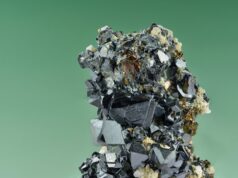
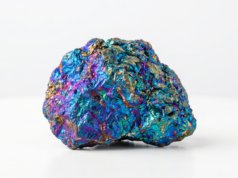
| Color | Brass-yellow | Often tarnishes to iridescent purples, blues, and greens. |
| Streak | Greenish-black | The color of its powder on a streak plate. |
| Fracture / Tenacity | Conchoidal to uneven | Brittle; it powders when struck, unlike malleable gold. |
What is Chalcopyrite and Which Group Does it Belong To?
Chalcopyrite is a prominent member of the sulfide mineral group, formed by the combination of copper, iron, and sulfur. Its name is derived from the Greek words “chalkos” (copper) and “pyrites” (striking fire).
Although it shares similar colors with pyrite, chalcopyrite has a deeper, brass-yellow tone. In the field, the easiest way to distinguish it from gold or pyrite is by testing its tenacity: true gold bends and flattens when struck with a rock hammer, whereas chalcopyrite is brittle and easily crushes into powder.
Important Ore Deposits for Chalcopyrite
When a mining exploration program targets copper, chalcopyrite is almost always the primary focus. This mineral forms massive economic deposits in several distinct geological environments:
- Porphyry Copper Deposits: The vast majority of the world’s chalcopyrite is mined from these magmatic-hydrothermal systems. Although they are low-grade (typically 0.4% – 1% Cu), they boast billions of tons of ore.
- Volcanogenic Massive Sulfides (VMS) and SEDEX: Forming around ancient submarine hydrothermal vents or in sedimentary basins, chalcopyrite is found here alongside sphalerite and galena in massive sulfide lenses.
- Orogenic Systems: In structurally controlled hydrothermal veins placed in shear zones, chalcopyrite is a crucial part of the sulfide paragenesis, often accompanying gold mineralization.
- Skarn Deposits: These form in contact metamorphic zones where hot magmatic fluids react with carbonate rocks (limestone), resulting in concentrated lenses of massive chalcopyrite.
Chalcopyrite in Core Logging and Alteration Zones
Tracking chalcopyrite while logging drill cores is a direct indicator of proximity to the center of a hydrothermal system. In porphyry systems, for instance, it is the primary ore mineral in the potassic alteration zone alongside biotite and K-feldspar. Moving outward into the phyllic zone, it accompanies sericite-quartz-pyrite veinlets. Observing an increasing frequency of sulfide veinlets within chlorite or sericite alteration halos is a strong physical indicator that the main ore body is near.
34-Element Assay Interpretation and Geochemical Correlation
When the 34-element assay data from drill cores is analyzed, the presence of chalcopyrite exhibits strong positive correlations with specific elements. Depending on the nature of the system, increasing copper (Cu) grades often parallel surges in molybdenum (Mo), gold (Au), or silver (Ag). To correlate multiple underground veins in complex structural environments, geologists rely not just on visible mineralogy, but heavily on these geochemical signatures and pathfinder elements.
3D Modeling of Underground Veins
In advanced exploration projects, proving the spatial continuity of chalcopyrite-bearing veins and multiple breccia zones is the most critical step. Coordinate, lithology, and assay data from drill holes are imported into professional geological software like Leapfrog Geo or Datamine. This allows for the generation of highly accurate 3D vein models. By defining grade shells and isolating fault-displaced zones in 3D space, the exploration team can plan the next drilling phase with pinpoint accuracy.
“Chalcopyrite Disease” Under the Microscope

When examined under a reflected light ore microscope, a fascinating texture often appears: microscopic, star-shaped blebs or droplets of chalcopyrite trapped completely within sphalerite (zinc) crystals. Known as “Chalcopyrite Disease,” this texture forms when copper-rich hydrothermal fluids react with and partially replace early-formed sphalerite. However, this beautiful geological phenomenon poses a significant metallurgical challenge, as it makes the clean separation of copper from zinc extremely difficult during the flotation process.
From Chalcopyrite to Pure Copper: Processing and Metallurgy

Extracting the ore from the earth is only the first step. Removing the iron (Fe) and sulfur (S) from its chemical structure (CuFeS2) to produce pure copper (Cu) is a massive metallurgical undertaking:
- 1. Milling and Flotation: The mined rock is crushed into a fine powder. When mixed with water and special chemicals in aerated tanks (flotation), chalcopyrite particles attach to air bubbles and float to the surface. This “concentrate” achieves a copper grade of about 25-30%.
- 2. Roasting and Smelting: The concentrate is roasted with oxygen in massive furnaces to burn off the sulfur as SO2 gas. The melted iron and copper sulfides settle at the bottom, forming a liquid mixture known as “Copper Matte.”
- 3. Converting (Blister Copper): Silica is added to the copper matte, and air is blown through it. The silica binds with the remaining iron to form “slag.” The remaining liquid cools into Blister Copper (due to a bumpy surface formed by escaping gases), achieving about 98-99% purity.
- 4. Electro-refining: Blister copper plates are immersed in acidic water tanks and subjected to an electrical current. The copper dissolves from the anode and plates onto the cathode as 99.99% pure “Cathode Copper.” Valuable impurities like gold and silver fall to the bottom of the tank as highly profitable “anode slime.”

[…] Coarse-grained pyrite, pyrrhotite, galena, iron-rich (dark) sphalerite, and minor chalcopyrite within an intense siderite-ankerite-quartz alteration pipe (e.g., the Sullivan tourmalinite and […]
[…] Sulfides: Primary chalcopyrite and bornite, with low total sulfide volume (< 2–3 vol.%). The bornite-rich core represents the […]
[…] Crosscutting vein networks, stringers, and disseminations of chalcopyrite, pyrite, quartz, and […]
[…] ubiquitous occurrence of micron-sized blebs, droplets, and worm-like vermicular stringers of chalcopyrite (CuFeS2) oriented along crystallographic planes within host Sphalerite mineral […]
Профессиональный ремонт и диагностика двигателей в Москве — предлагаем капитальный ремонт легковых двигателей с гарантией 2 года [url=https://remont-dvig124.ru]Ремонт двигателей[/url]
Ремонт и диагностика двигателей в Москве являются важными направлениями обслуживания транспортных средств. Это обеспечивает безопасность и надежность эксплуатации автомобиля.Современные сервисы в Москве оснащены профессиональной техникой, что позволяет точно определить проблему. Правильная диагностика — залог эффективного ремонта и долгой службы двигателя.
Капитальный ремонт двигателя включает в себя полную разборку, замену изношенных деталей и сборку. Такой подход обеспечивает восстановление мощности и надежности двигателя.Некоторые сервисы в Москве дают гарантию на капитальный ремонт двигателя до двух лет, что подтверждает их качество и надежность. Это повышает доверие клиентов и гарантирует долгосрочную работу двигателя без поломок.
Обращаясь в специализированные сервисы Москвы, вы получаете качественный ремонт с гарантией и длительным сроком службы двигателя. Такой подход позволяет обеспечить безопасность и комфорт при эксплуатации автомобиля.Средний срок выполнения капитального ремонта — от нескольких дней до недели, в зависимости от сложности работ. В результате заказчик получает надёжный двигатель и спокойствие за его дальнейшую работу.