The Baked Rock of Contact Metamorphism
What is Hornfels?
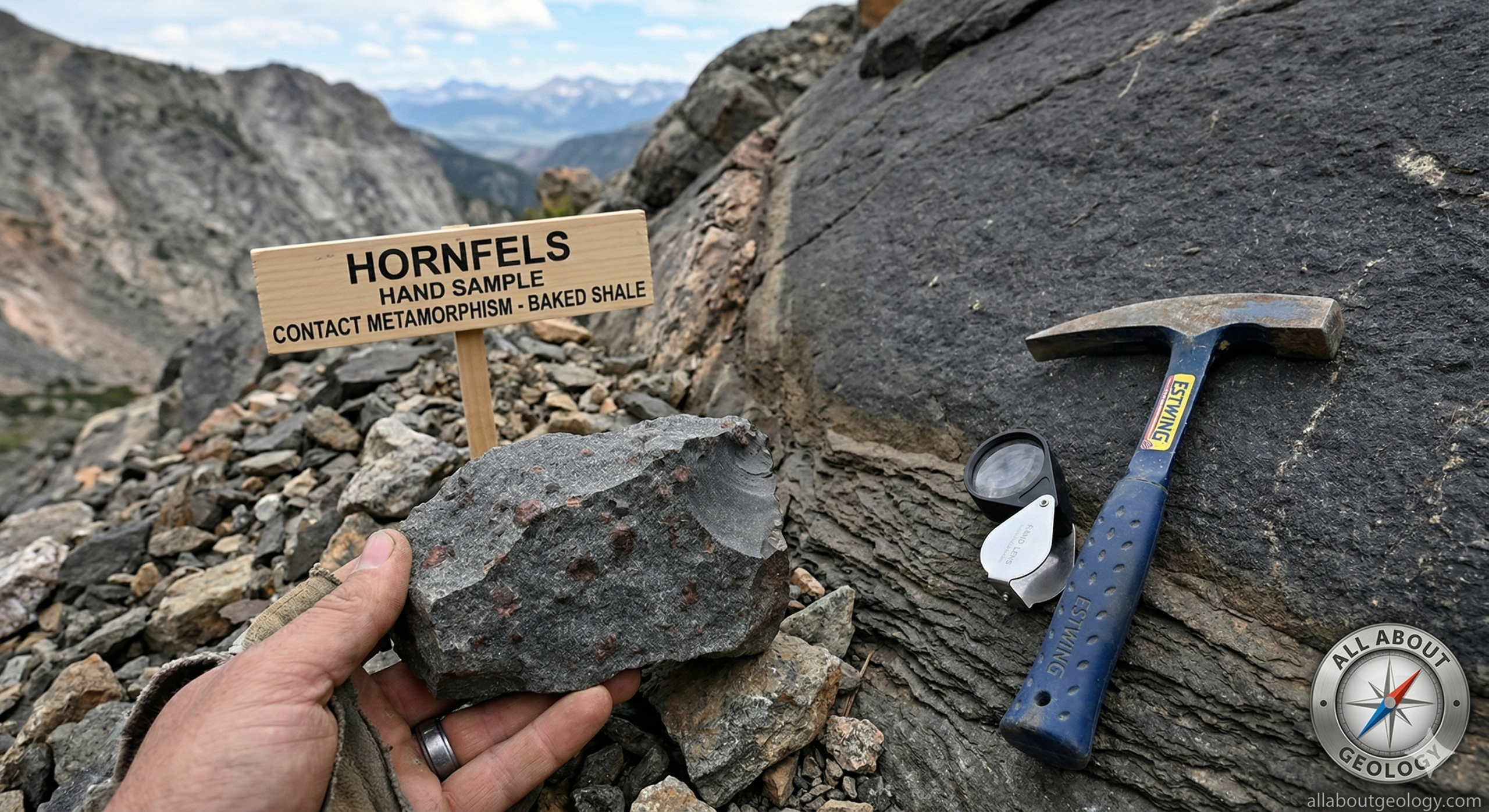
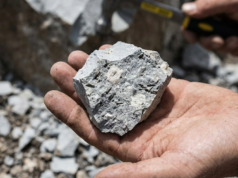
Hornfels is a fine-grained, exceptionally hard, and non-foliated metamorphic rock. Its name derives from the German word “hornfels,” meaning “horn-stone,” which perfectly describes its incredible toughness and dense, flint-like texture that often resembles an animal’s horn. Unlike schist or gneiss, which are forged by immense tectonic pressures, hornfels is born almost entirely of extreme heat.
The Forge: Contact Metamorphism

To truly understand it, you must understand its unique formation process: Contact Metamorphism.
While rocks like slate and phyllite form over vast areas due to tectonic plate collisions (regional metamorphism), it forms very locally. It is created when a body of searing-hot magma (an igneous intrusion like a dike, sill, or batholith) forces its way into cooler, pre-existing crustal rocks.
The extreme heat radiating from the magma literally “bakes” the surrounding country rock. Because this process happens at relatively shallow depths where directed pressure is low, the minerals do not align into layers or bands. This lack of directed pressure is why iy is completely non-foliated. The zone of baked rock surrounding the magma intrusion is known as a metamorphic aureole.
The Protolith: What Gets Baked?
Technically, any rock can be baked into a hornfels if a magma chamber gets close enough. However, the classic, fine-grained hornfels we typically identify in the field is usually formed from fine-grained clastic sedimentary rocks:
- Shale and Mudstone: When these clay-rich rocks are baked, their microscopic clay minerals rapidly recrystallize into a dense mosaic of hard, high-temperature minerals.
- Basalt or Andesite: Sometimes, fine-grained volcanic rocks can also act as the protolith, resulting in a dark, incredibly dense mafic hornfels
Types of Hornfels and Their Mineralogy
Because hornfels is simply the “baked” version of whatever rock the magma touched, its mineral composition varies wildly based on its parent rock (protolith). Geologists generally classify hornfels into three main types:
1. Pelitic (Baked Shale & Mudstone) When magma intrudes into clay-rich sedimentary rocks like shale or mudstone, it creates Pelitic Hornfels. This is the most common type.
- Key Minerals: The extreme heat forces the clay minerals to recrystallize into high-temperature aluminosilicates. You will typically find Andalusite, Cordierite, Biotite mica, and Quartz.
- Visual Trait: Often dark gray or brownish-black, sometimes displaying distinctive “spots” (porphyroblasts) of cordierite or andalusite.
2. Calcareous (Baked Limestone & Dolomite) When magma intrudes into carbonate rocks like limestone or dolostone, a chemical reaction occurs between the heat, silica, and calcium. These are also known as calc-silicate hornfels.
- Key Minerals: The calcite breaks down and recombines to form calcium-rich silicate minerals such as Grossular Garnet (a green/brown garnet), Diopside, Wollastonite, Epidote, and Tremolite.
- Visual Trait: Usually lighter in color, featuring banded or mottled patterns of green, pale brown, and white.
3. Mafic (Baked Basalt & Gabbro) If the magma intrudes into pre-existing basic/mafic igneous rocks (like basalt flows or diabase dikes), Mafic Hornfels is formed.
- Key Minerals: The original minerals recrystallize into a tough, interlocking matrix of Hornblende (amphibole), Plagioclase Feldspar, and Pyroxene.
- Visual Trait: Typically very dark, dense, and massive, making it sometimes difficult to distinguish from the original basalt without a microscope.
Field Identification: Spotting the “Baked” Rock
Because hornfels can look like a featureless, dark gray or black chunk of rock, it can be tricky for amateur geologists to identify. Here are the key field diagnostics:
- Extreme Hardness: Hornfels is surprisingly hard and tough. When struck with a rock hammer, it often gives off a distinct, high-pitched “ringing” sound, unlike the dull thud of its parent rock, shale.
- Conchoidal Fracture: Because of its tightly fused, fine-grained (aphanitic) texture, hornfels often breaks with smooth, curved surfaces, similar to glass, chert, or flint.
- Spotted Texture (Porphyroblasts): While the background matrix is fine-grained, the heat sometimes causes specific new minerals to grow larger than the rest. It is very common to see hornfels with distinct “spots” or crystals of minerals like Andalusite or Cordierite scattered throughout the rock.
The Geologic Story It Tells
Finding it in the field is a massive clue for a geologist. It is the smoking gun that tells you an igneous intrusion—perhaps a massive granite pluton—is hiding very close by, even if the igneous rock itself hasn’t been exposed by erosion yet. It represents the fiery boundary where the deep earth’s molten forces met the cooler, established crust.

[…] Carbonates: Convert into fine-grained, dense calc-silicate rocks known as hornfels or […]