In the first three parts of our series, we explored the textures left behind by boiling hydrothermal fluids and magmatic heat. But there is another, far more violent force that shapes world-class ore deposits: Tectonic Stress.
In structurally controlled systems, such as Orogenic Gold deposits, the rock is not just a passive host; it is an active participant. The crust is squeezed, stretched, shattered, and sheared. For an exploration or resource geologist, recognizing these structural textures in the core shed is critical. If you do not understand the structural fabric, your 3D models and search ellipsoids in Leapfrog Geo or Datamine will fail to capture the high-grade shoots.
Let’s look at the three most critical fingerprints of tectonic stress.
1. The Sudden Shatter: Fault Breccia & “Jigsaw” Texture

When rocks are in the shallow, cooler parts of the crust (the brittle regime), tectonic stress builds up until the rock suddenly fails. This creates a fault zone.
Hydrothermal fluids under extreme pressure are often trapped below these active faults. When the fault ruptures (an earthquake), the pressure drops instantly. This sudden decompression causes the fluids to violently boil (flash), shattering the surrounding rock into angular fragments.
- The Clue: Look for the “Jigsaw Puzzle” texture. The angular rock fragments look like they could fit perfectly back together if the hydrothermal cement (often quartz or sulfides) between them was removed.
- The Meaning: This texture represents “seismic pumping.” It is a prime location for sudden, high-grade gold or base metal precipitation due to the rapid pressure drop.
2. The Deep Flow: Mylonite & Ribbon Quartz

Deeper in the crust, where temperatures and pressures are higher (the ductile regime), rocks do not shatter; they flow like plastic. Active faulting in this zone creates “Shear Zones.”
- The Clue: The core will show intense foliation (layering) and mylonitic textures, where mineral grains are stretched and ground down into microscopic sizes. You will often see “Ribbon Quartz”—long, drawn-out bands of quartz that look like stretched taffy.
- The Meaning: These shear zones are the primary highways for deep-crustal auriferous (gold-bearing) fluids. Free gold absolutely loves to precipitate along these highly strained, stylolitic seams. If you see ribbon quartz with sulfides smeared along the foliation planes, you are in the main fluid conduit.
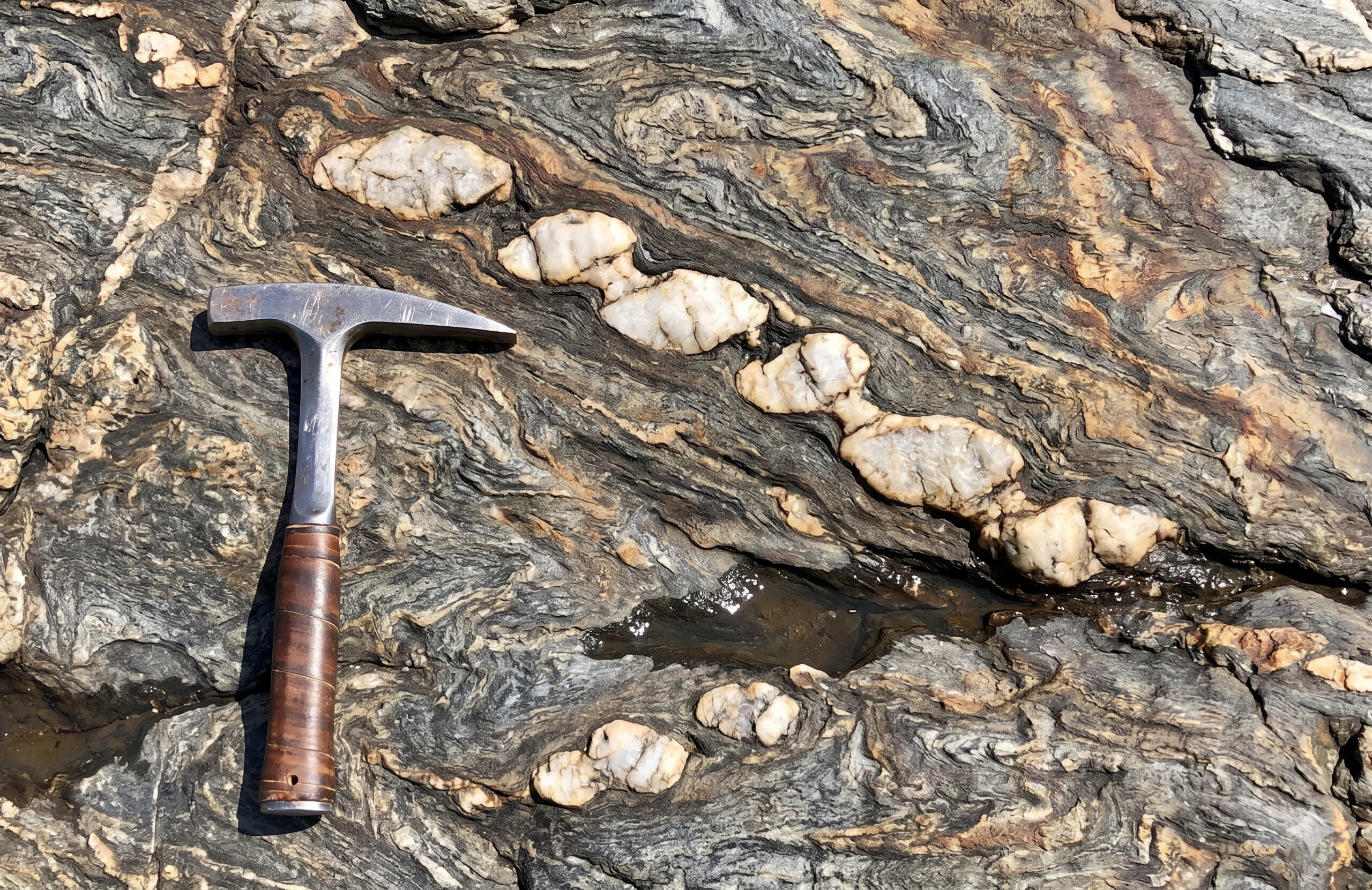
3. The Stretch and Snap: Boudinage (Pinch-and-Swell)

What happens when a hard, brittle layer of rock (like a quartz vein) is encased in a softer, ductile rock (like shale) and the whole system is stretched? The hard vein cannot stretch, so it snaps and separates into sausage-like segments. This is called Boudinage.
- The Clue: In the core or outcrop, you will see a vein that pinches and swells, or breaks into isolated, elongated blocks (boudins).
- The Meaning: The gaps or “necks” between these broken boudins become extreme low-pressure zones. Hydrothermal fluids rush into these necks, precipitating massive amounts of minerals. In 3D modeling, these boudin necks often represent highly localized, vertically plunging “Bonanza Shoots.”
Modeling the Chaos
Understanding these textures is not just academic; it dictates your resource model. You cannot use a simple, isotropic spherical search ellipsoid in a shear-hosted deposit. You must align your variography and interpolants with the structural anisotropy dictated by the mylonitic foliation or the plunge of the boudin necks.
Read the rock. It tells you exactly how it was broken, and more importantly, where it hid the gold.



Thanks for the pubication