
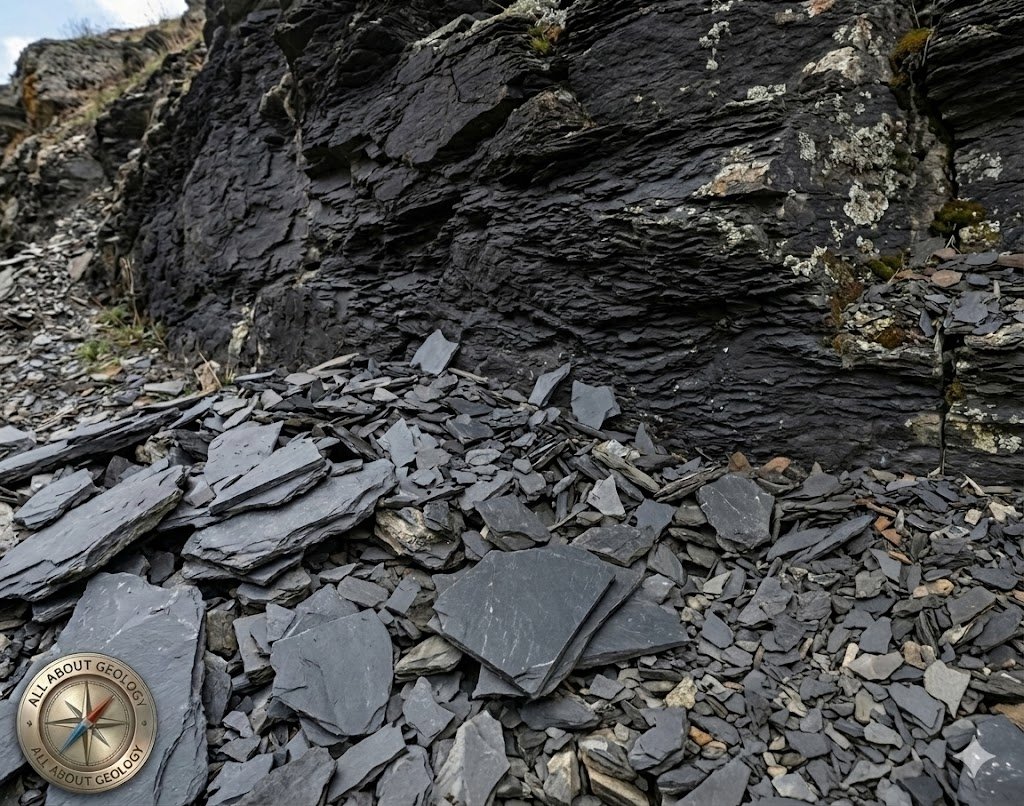
What is Shale?
Shale is the most abundant sedimentary rock on Earth, accounting for roughly 70% of all sedimentary rock in the planet’s crust. It is a fine-grained, clastic sedimentary rock composed primarily of compacted mud—a mixture of microscopic clay minerals and tiny fragments (silt-sized particles) of other minerals, most notably quartz and calcite.
The Formation Process (Deposition and Compaction)
Shale forms in “low-energy” environments where the water is extremely calm, allowing the finest suspended particles to settle slowly to the bottom. These environments include:
- Deep ocean floors
- Quiet lakes and lagoons
- Slow-moving river floodplains
Over millions of years, as these microscopic layers of mud accumulate, the weight of the overlying sediments exerts immense downward pressure. This compaction squeezes out the water and tightly presses the clay minerals together, lithifying the mud into solid rock.
Field Identification and Key Characteristics
For a geologist in the field, distinguishing shale from a generic “mudstone” relies on one critical property:
- Fissility: This is the defining characteristic of shale. Fissility is the rock’s ability to easily split into thin, flat layers (laminations) along the planes of deposition. If a mud-based rock does not possess fissility and breaks into blocky chunks instead, it is classified as mudstone, not shale.
- Grain Size: Shale is aphanitic. The individual grains are far too small to be seen with the naked eye or a standard 10x hand lens.
- Color Variations: The color of shale is a direct indicator of its depositional environment:
- Black Shale: Contains high amounts of unoxidized organic matter, indicating deposition in a highly anoxic (oxygen-depleted) environment, like a stagnant deep-ocean basin.
- Red/Brown Shale: Contains iron oxide (hematite), indicating deposition in an oxygen-rich environment.
- Green Shale: Suggests a low-oxygen environment containing minerals like chlorite or glauconite.
The Protolith: Starting the Metamorphic Engine
In the grand scheme of the rock cycle, shale is incredibly important because it acts as the primary protolith (parent rock) for the foliated metamorphic sequence. When tectonic forces bury shale deep within the crust, subjecting it to intense heat and directed pressure, its clay minerals begin to recrystallize and align.
This transformation follows a strict sequence of increasing metamorphic grade: Shale ➔ Slate ➔ Phyllite ➔ Schist ➔ Gneiss
Economic and Industrial Importance
Beyond its academic importance, shale is a massive economic driver. Black shales are the primary source rocks for the world’s petroleum and natural gas reserves. As the organic matter in the shale is buried and heated, it transforms into hydrocarbons. In modern energy sectors, horizontal drilling and hydraulic fracturing (fracking) are used to extract trapped natural gas directly from impermeable shale formations. Additionally, shale is extensively quarried for the production of cement, bricks, and ceramics.

[…] Shale and Mudstone: When these clay-rich rocks are baked, their microscopic clay minerals rapidly recrystallize into a dense mosaic of hard, high-temperature minerals. […]
[…] Skarnoids: When the host rock isn’t pure limestone but a “dirty” shale or volcanic rock, the result is a “Skarnoid”. These are subtle, fine-grained, and often […]
[…] The Press Effect (Compaction): Crushed under millions of tons of lithostatic pressure, the mud layer begins to yield. As the rock grains interlock, the 80% seawater trapped between them is expelled outward (upward and laterally) with immense force. The wet mud has now lost its volume, transforming into a hard mudstone or shale. […]