Basalt rock is a dark-colored, fine-grained (aphanitic), and mafic extrusive (volcanic) igneous rock. If gabbro is the patient, slowly-cooling giant of the deep crust, basalt is its fast-moving, explosive counterpart on the surface. It is the most abundant bedrock on Earth, making up almost the entire oceanic crust and forming massive continental flood basalt provinces.
How Does It Form?

The formation is divided into two primary numbered stages, followed by specific cooling processes.
Part 1: Deep Underground Origin (The Source)
As shown at the bottom of the diagram within the Upper Mantle and Earth’s Crust, the process begins here:
- Step 1: Partial Melting: The first numbered step (1) states that “PARTIAL MELTING OF MANTLE ROCKS (e.g., peridotite) creates low-silica, high-iron mafic magma.”
- Magma Chamber: This newly created mafic magma collects in a “MAGMA CHAMBER (MAFIC MAGMA)” beneath the crust. Because magma is less dense than the surrounding solid rock, it begins to rise.
Part 2: Ascent and Eruption (The Extrusion)
The arrows indicate “MAGMA RISING” upwards through the crust via “CONDUITS/DIKES”:
- Step 2: Eruption: When the rising magma reaches the “VOLCANIC VENT” on the surface, it erupts. Step 2 in the diagram labels this: “ERUPTION: Mafic magma erupts onto the surface as lava.”
- Lava Flows: Once erupted on the surface, the molten rock is called “LAVA FLOWS,” which spread out over the preexisting landscape.
- Lava Types: The diagram highlights two distinct textures of surface lava flows that result from varying viscosity and gas content:
- PAHOEHOE LAVA FLOW: Shows a smooth, “ropy texture.”
- AA LAVA FLOW: Shows a rough, rubble-like “blocky texture.”
Part 3: Cooling and Texture Formation (Solidification)
As the lava is exposed to the atmosphere at the surface, it cools very quickly, solidifying into “BASALT (EXTRUSIVE IGNEOUS ROCK).” The inset boxes on the right explain the physical and microscopic changes that occur during this quick cooling phase:
- Rapid Cooling & Fine Grain: In the “BASALT TEXTURE & COMPOSITION” inset box, the diagram explains that “RAPID COOLING at the surface prevents large crystal growth.” This results in a “FINE-GRAINED (APHANITIC) TEXTURE” composed of “Small, interlocking crystals (too small to see without magnification).”
- Trapped Gases (Vesicles): Gases that escape from the cooling lava can get trapped. The lower-right microphotograph shows “VESICULAR BASALT,” where holes called “VESICLES” are visible, labeled as “Gas bubbles trapped during cooling.”
Part 4: Special Cooling Structures (Columnar Jointing)
In some instances, particularly within thick lava flows, a unique cooling pattern develops. This is depicted in the top-right inset panel:
Columnar Basalt: The final result is “COLUMNAR JOINTING IN SOLIDIFIED BASALT,” creating striking vertical, typically hexagonal, columns of rock.
Solidification and Contraction: As the thick body of mafic lava cools and solidifies completely, the rock contracts (shrinks).
Join Formation: This contraction causes the rock to fracture in geometric patterns. These are labeled as “COOLING & CONTRACTION JOINTS.”
What is Its Mineral Composition?
Chemically, basalt is identical to gabbro; the only difference is the crystal size driven by the cooling rate. Its essential mineral composition includes:
- Calcium-Rich Plagioclase: Microscopic laths that form the structural, interlocking matrix of the rock.
- Pyroxene (Augite): The dominant dark mineral contributing to the rock’s overall blackish hue.
- Olivine: Often the only mineral that forms large enough crystals (phenocrysts) to be seen without a hand lens, appearing as small, glassy olive-green blebs scattered in the dark matrix.
- Accessory Minerals: Magnetite and ilmenite are commonly dispersed throughout, giving the rock a strong magnetic signature that is crucial for geophysical mapping.
How to Identify It in the Field (Outcrop and Core)?
Identifying basalt in the field or during core logging requires looking for specific volcanic textures rather than large crystals:
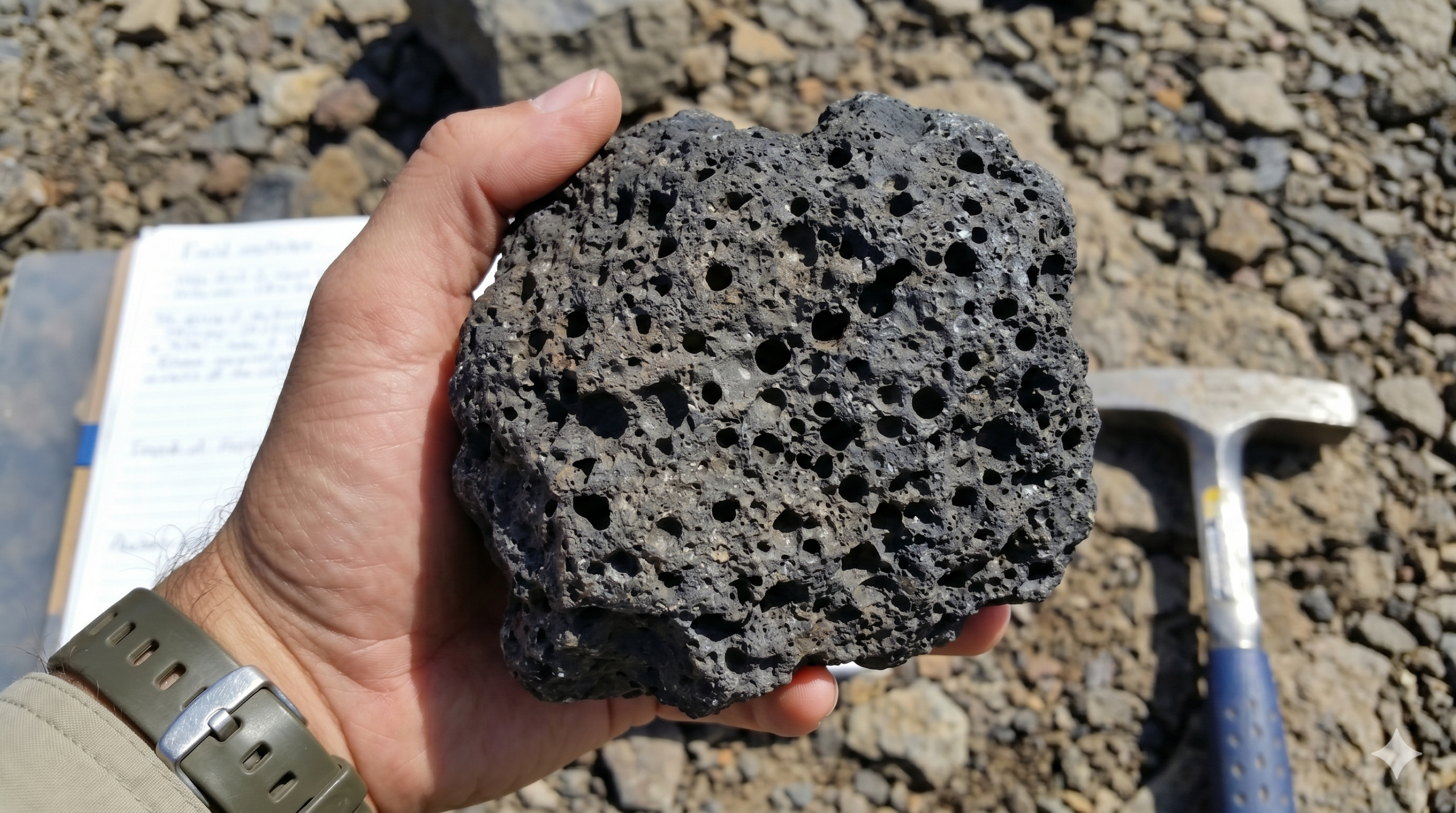
- Fine-Grained (Aphanitic) Texture: The rock looks like a uniform, dark, matte mass. You cannot distinguish individual minerals without a petrographic microscope, except for occasional olivine or pyroxene phenocrysts.
- Vesicular Structure: As magma rises and pressure drops, trapped gases expand and escape, leaving behind spherical or elongated cavities called vesicles.
- Amygdaloidal Texture: In older basalt flows or deeper in a drill core, those gas vesicles often get filled with secondary minerals precipitated by hydrothermal fluids. If you see white calcite, green epidote, or quartz filling the holes, you are looking at an amygdaloidal basalt.
- Color and Density: It is typically very dark grey to black. Like gabbro, it feels unusually heavy for its size due to the high iron and magnesium content.
Economic Importance (The VMS Connection)
Beyond its widespread use as crushed aggregate for asphalt, concrete, and railroad ballast, basalt plays a critical role in economic geology and mineral exploration.
- Volcanogenic Massive Sulfide (VMS) Deposits: Submarine basaltic volcanism drives the massive hydrothermal engines that create sulfide lenses on the seafloor. Basaltic sequences (especially pillow lavas) are prime exploration targets for rich copper, zinc, and lead deposits.
- Native Copper Traps: The highly porous, vesicular tops of basalt flows act as excellent structural traps for migrating hydrothermal fluids, occasionally precipitating native copper directly within the vesicles (as famously seen in the Keweenaw Peninsula).
- Greenstone Belts: Ancient, metamorphosed basalts (greenstones) are some of the most prolific host rocks globally for world-class orogenic gold deposits.