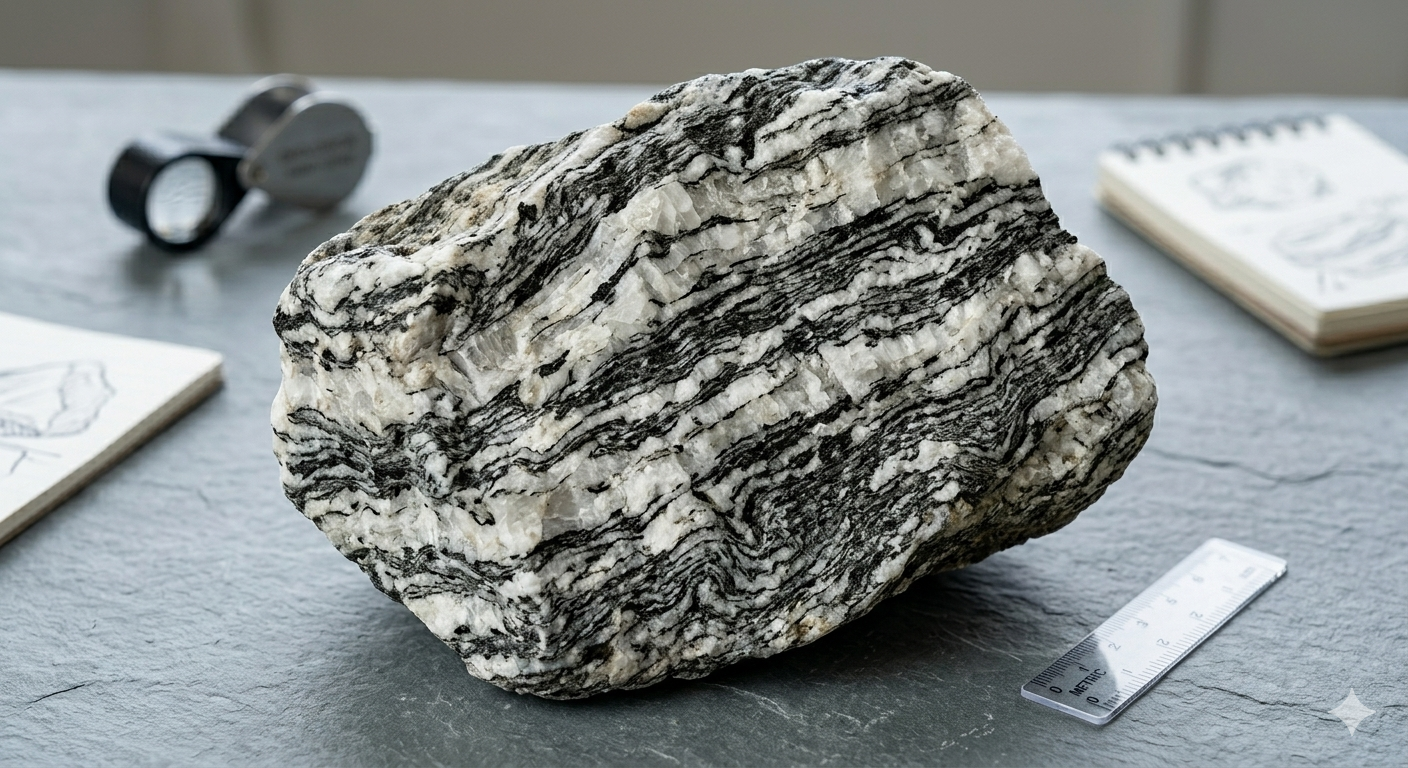
What is Gneiss?
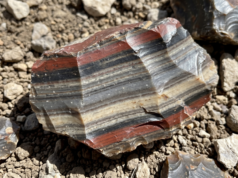
Gneiss (pronounced “nice”) is a highly distinct, high-grade metamorphic rock easily recognized by its beautiful, alternating bands of light and dark minerals. This signature “gneissic banding” is the result of extreme heat and pressure deep within the Earth’s crust, which forces minerals to separate and crystallize into distinct layers, making it one of the most structurally complex and visually striking rocks in the geological record.
Quick Facts:
- Rock Type: Metamorphic
- Sub-Type: Foliated (High-grade)
- Color: Distinctly banded with alternating light (white, pink, light gray) and dark (black, dark green) layers.
- Texture: Coarse-grained; strongly foliated (gneissic banding).
- Origin: High-grade regional metamorphism at convergent plate boundaries.
Mineral Composition of Gneiss
Gneiss is characterized by its compositional banding. Rather than a random mix, the minerals segregate into distinct layers during the intense metamorphic process:
- Light Bands (Felsic): Primarily composed of granular Quartz and Feldspar (both orthoclase and plagioclase). These minerals are more resistant to deformation and form the thicker, lighter-colored stripes.
- Dark Bands (Mafic): Dominated by ferromagnesian minerals such as Biotite (black mica) and Hornblende (amphibole). These platy and elongated minerals align parallel to the directed pressure, creating the dark stripes.
How Does Gneiss Form? (Genesis)

Gneiss forms at the deepest levels of the Earth’s crust under extreme conditions (temperatures often exceeding 600°C and immense directed pressure). It can originate from two main types of parent rocks (protoliths):
- Orthogneiss: Formed from the metamorphism of an igneous rock, most commonly Granite. As the granite is compressed, its randomly oriented minerals are forced into parallel bands.
- Paragneiss: Formed from the progressive, high-grade metamorphism of sedimentary rocks (like shale) or lower-grade metamorphic rocks (like schist). In the sequence of regional metamorphism, the journey is: Shale ➔ Slate ➔ Phyllite ➔ Schist ➔ Gneiss.
Physical Properties and Texture
The most defining physical property of gneiss is its gneissic banding. Unlike schist, which splits easily along its thin mica layers (schistosity), gneiss is a massive, tough rock that does not break easily along its bands. The crystals are coarse and interlocking, making the rock exceptionally hard, durable, and resistant to weathering.
Where is Gneiss Found? (Occurrence)
Gneiss is a foundational rock of the continents. It is widely exposed in the core of ancient mountain ranges and makes up the vast majority of “continental shields” (the oldest, most stable parts of the Earth’s crust). Massive formations of gneiss can be found in the Canadian Shield, the Baltic Shield in Scandinavia, and the core of the Himalayas.
Economic Importance and Uses
Due to its incredible hardness, durability, and appealing banded pattern, gneiss is a highly valued economic rock:
- Dimension Stone: It is extensively quarried and cut into slabs for architectural uses, including high-end countertops, flooring, and building facing. (In the commercial stone trade, it is often simply sold as “Granite”).
- Construction Material: Crushed gneiss is used as a tough aggregate in road construction, concrete, and landscaping.