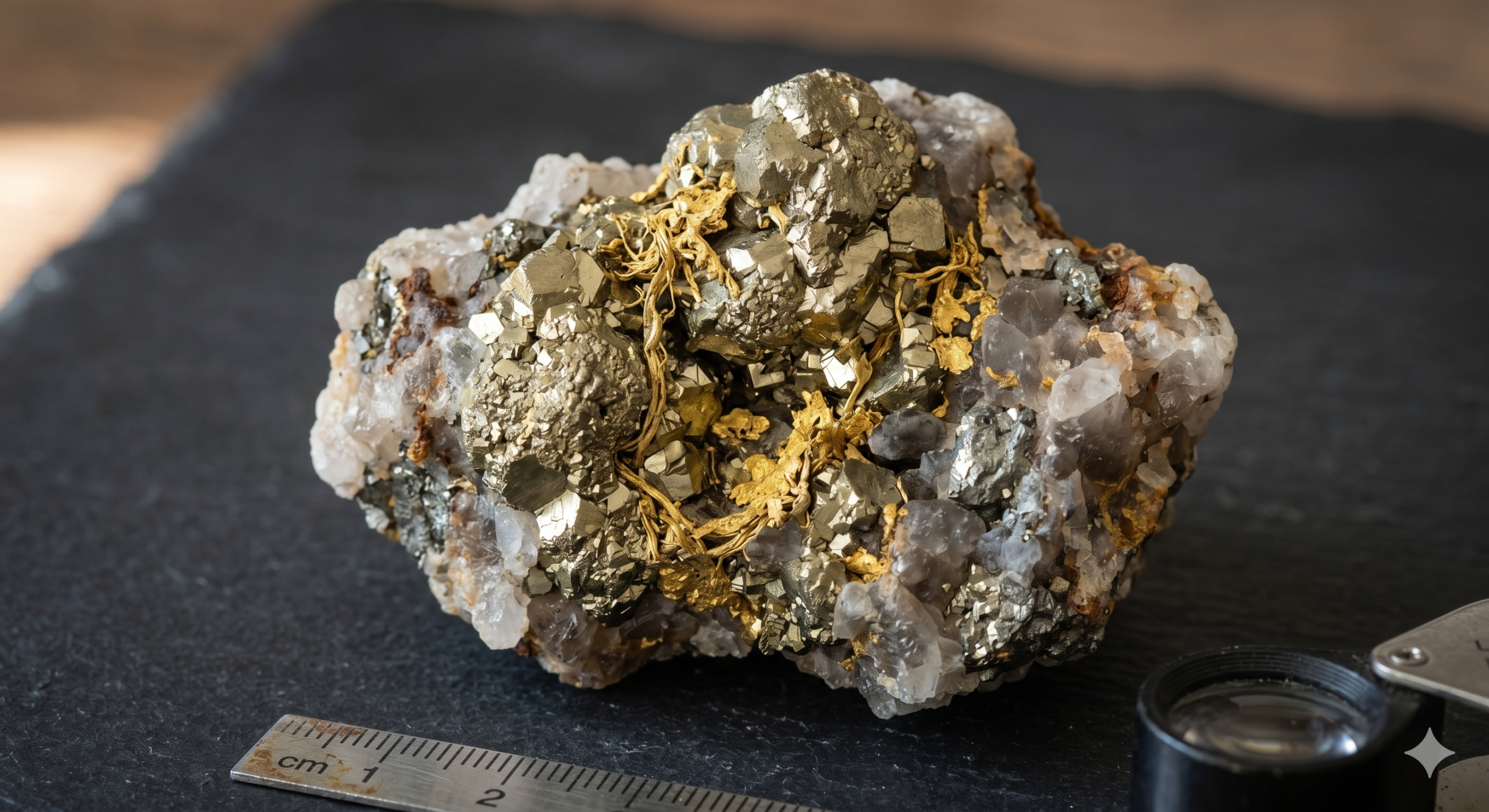
Every beginner in geology quickly learns about Pyrite (FeS₂). With its brassy-yellow color and metallic luster, it has tricked prospectors for centuries, earning it the infamous nickname: “Fool’s Gold.” The golden rule taught in introductory classes is simple: If you hit it with a hammer and it shatters, or if it leaves a blackish-green streak on a ceramic plate, it’s just pyrite, not gold. But in professional economic geology, the story is not that simple. Sometimes, the real fool is the one who throws the pyrite away. Welcome to the complex world of Barren Pyrite versus Gold-Bearing (Auriferous) Pyrite.
1. Barren Pyrite: The Classic “Fool’s Gold”

Barren pyrite is exactly what it sounds like: iron sulfide with no economic value. It is one of the most common and widespread sulfide minerals on Earth.
- How it Forms: Barren pyrite can form in almost any geological environment. You will find it in sedimentary rocks like black shales (where it forms from decaying organic matter in oxygen-poor mud), in coal beds, and in standard metamorphic rocks.
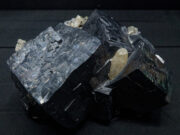
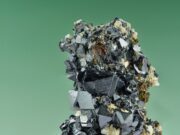
- The Look: Barren pyrite often forms absolutely beautiful, perfect cubic crystals, or striking radiating clusters (like “pyrite suns”). Because it grows in environments without precious metals in the fluid, its crystal lattice is pure iron and sulfur. It looks amazing on a collector’s shelf, but it won’t make you rich.
2. Gold-Bearing (Auriferous) Pyrite: The Hidden Treasure

This is where geology gets exciting. In certain hydrothermal environments, the hot, mineral-rich fluids (brines) traveling through the Earth’s crust carry both dissolved iron-sulfur complexes and dissolved gold. When conditions change and pyrite begins to precipitate, it can trap gold inside it.
This happens in two main ways:
A. Visible Gold Inclusions (Free Milling)
Sometimes, microscopic nuggets of pure, native gold get physically trapped inside the growing pyrite crystal, or they form in the microscopic cracks and fractures of the pyrite. If you crush this pyrite finely enough, you can physically separate the gold using gravity or basic cyanidation.
B. Invisible Gold (Refractory Ore)
This is the ultimate geological disguise. In deposits like the famous Carlin-type deposits in Nevada, USA, the gold is literally invisible, even under a standard microscope. The gold atoms are so small that they actually substitute for iron atoms inside the crystal lattice of the pyrite itself (often accompanied by arsenic, forming “arsenian pyrite“). You cannot pan for this gold, and you cannot crush the rock to find it. The ore must be roasted, oxidized, or subjected to intense bio-leaching to break the pyrite lattice and free the atomic gold. In the mining industry, this is known as refractory ore.
The Geologist’s Dilemma: How Do You Tell Them Apart?
If you pick up a piece of pyrite in the field, can you tell if it is barren or gold-bearing just by looking at it? Usually, no. However, field geologists look for specific clues:
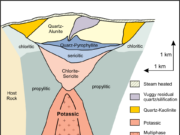
- Geological Context: A perfect pyrite cube in a sedimentary shale is likely barren. Pyrite found alongside quartz veins, shear zones, or intense hydrothermal alteration (where hot fluids have “cooked” the surrounding rock) has a much higher chance of carrying gold.
- Crystal Shape: While not a universal rule, heavily deformed, massive, or “spongy-looking” fine-grained pyrite often carries more invisible gold than perfectly formed, large, shiny cubes.
- The Ultimate Test: The only 100% reliable way to differentiate the two is to send a sample to a laboratory for a Fire Assay or geochemical analysis (like ICP-MS).
The Bottom Line: Pyrite may be the fool’s gold, but to a trained geologist, it is an essential “indicator mineral.” It tells a story of fluid movement, chemical reactions, and sometimes, millions of ounces of invisible gold waiting to be unlocked.



[…] The Iron Oxide Engine: IOCG deposits are defined by their sheer volume of iron oxides—specifically Magnetite and Hematite—which can make up 10% to over 50% of the rock mass. Unlike porphyry systems where sulfur is abundant, IOCGs are sulfur-poor. The hydrothermal fluids carry immense amounts of iron, but very little sulfur, meaning almost all the available sulfur is locked up in chalcopyrite (CuFeS₂) and bornite (Cu₅FeS₄), leaving very little room for “barren” pyrite. […]