Quartz is the most abundant and widely distributed mineral found at Earth’s surface. It is present and plentiful in all parts of the world, forming in igneous, sedimentary, and metamorphic rocks. Because it comes in almost every color imaginable—from clear (rock crystal) to purple (amethyst) to black (smoky quartz)—relying on color alone is the biggest mistake you can make in the field.
So, how do geologists confidently identify quartz without a laboratory? By looking at its physical properties. Here is your essential field guide to identifying it using simple, reliable tests.
1. The Hardness Test (The Ultimate Quartz Identifier)
The single most reliable field test for quartz is its hardness. Quartz is a very hard mineral, scoring a solid 7 on the Mohs Hardness Scale.
How to test it:
- The Glass Test: Quartz is harder than standard glass (which is about 5.5). If you take a sharp edge of your specimen and press it firmly against a glass bottle or a glass plate, it will easily leave a permanent scratch.
- The Steel Test: A steel pocketknife or a geological hammer has a hardness of around 5.5 to 6.5. If you try to scratch quartz with a steel blade, the blade will leave a metallic streak on the rock, but it will not scratch.
(Note: Always practice safety when doing scratch tests in the field to avoid slipping and cutting yourself.)
2. Look for Conchoidal Fracture (No Cleavage)
Minerals break in two ways: cleavage (breaking along flat, predictable planes) or fracture (breaking irregularly).
It has no cleavage. When it breaks, it does not form flat surfaces or perfect geometric steps. Instead, it breaks with a conchoidal fracture. This means the broken surface looks like the inside of a seashell—it features smooth, curved, scoop-like depressions with concentric ridges. If your mineral breaks like thick glass, it is very likely quartz.
3. Crystal Habit (The Hexagonal Prism)

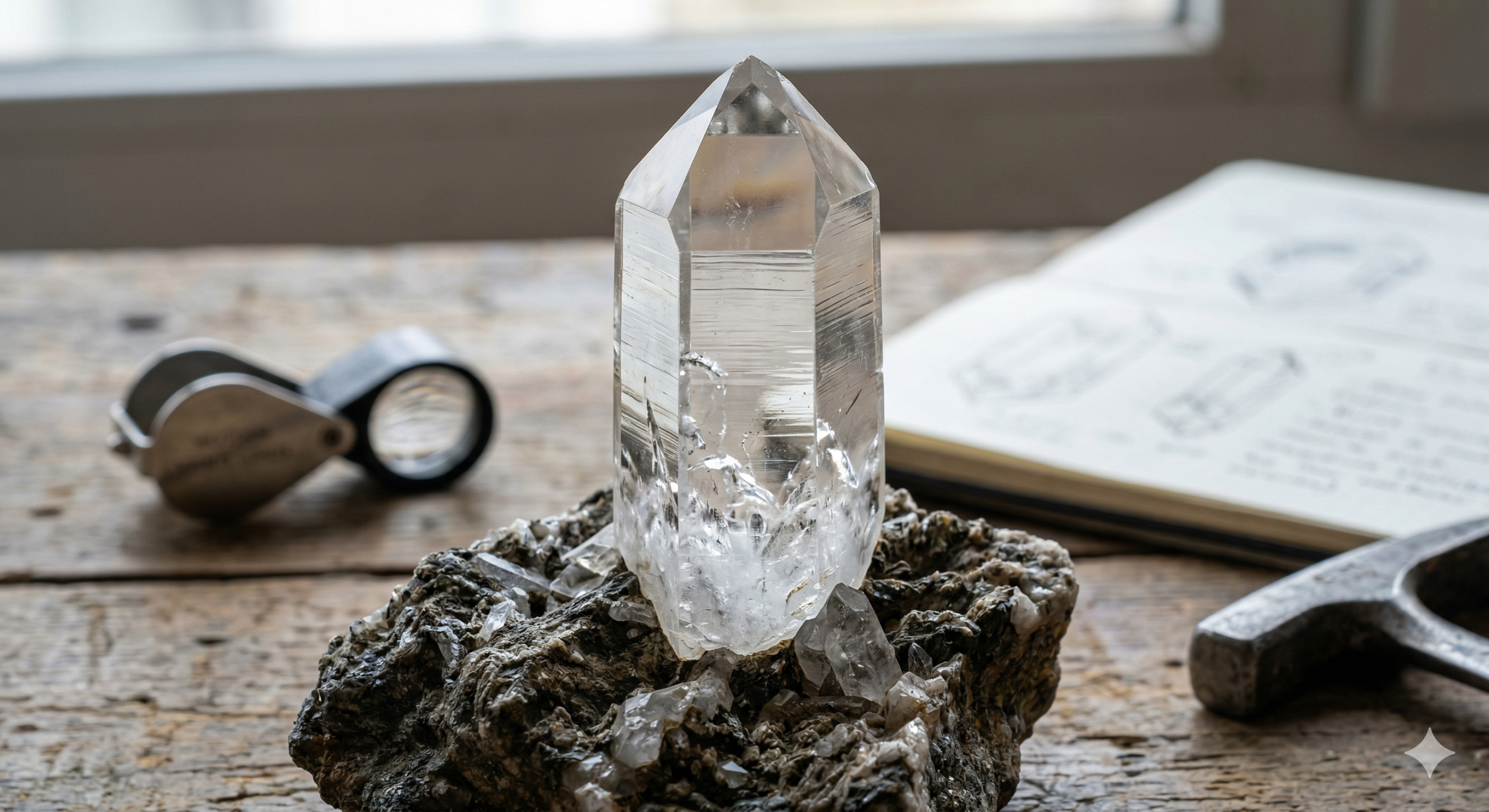
If you are lucky enough to find quartz that had room to grow into a crystal, its shape is a dead giveaway. It crystallizes in the hexagonal system.
Look for a six-sided prism (a column with six faces) that terminates in a six-sided pyramid at the top. Even if the crystal is broken, finding those distinct six-sided angles is a strong indicator of it.
4. Luster: The Glassy Shine
Luster describes how a mineral reflects light. Quartz has a vitreous luster, which is a geological term meaning it shines exactly like a piece of broken glass. It does not look metallic, greasy, or dull (unless it is heavily weathered).
Common Field Confusion: Quartz vs. Calcite

The most common mistake beginners make is confusing white or clear quartz with calcite. Here is how to instantly tell them apart in the field:
- Hardness: Quartz scratches glass; calcite (Mohs 3) cannot scratch glass and can be scratched by a copper penny.
- Acid Test: If you put a drop of weak hydrochloric acid (or even strong vinegar) on calcite, it will fizz and bubble (effervesce). Quartz will not react to acid at all.
- Cleavage: Calcite breaks into perfect rhombohedrons (slanted blocks). Quartz breaks like curved glass (conchoidal fracture).
Conclusion Next time you are out in the field, remember: don’t trust the color. Find a piece of glass to test its hardness, look for that glassy shine, and check the broken edges for curved, shell-like fractures. Once you master these three steps, identifying it becomes second nature.