When you look at a polished granite countertop or a massive mountain peak like El Capitan in Yosemite, you are looking at one of the most fundamental building blocks of the Earth’s continental crust. But how exactly did this incredibly hard, speckled rock form?
To understand granite, we have to answer one of the most common questions in geology: Is it intrusive or extrusive?
The short answer is: it is an intrusive igneous rock. Here is the complete geological breakdown of what that means, how it forms, and the visual evidence you can see with your own eyes.
What Does “Intrusive” Mean?

All igneous rocks are born from molten rock. However, geologists classify them into two main categories based on where that molten rock cools and solidifies:
- Extrusive (Volcanic) Rocks: Form when magma erupts onto the Earth’s surface as lava and cools very rapidly (e.g., basalt, obsidian).
- Intrusive (Plutonic) Rocks: Form when magma is trapped deep beneath the Earth’s surface. Insulated by the surrounding country rock, this magma chamber loses its heat incredibly slowly, sometimes taking millions of years to completely solidify.
Granite falls strictly into the intrusive category. It forms deep within the Earth’s crust in massive bodies of rock known as batholiths or plutons. We only see it at the surface today because millions of years of tectonic uplift and severe erosion have stripped away the miles of overlying rock that once buried it
The Evidence is in the Texture

You don’t need to be a professional geologist to prove that granite is an intrusive rock; the rock itself tells the story of its slow, underground birth. You just have to look at its texture.
Because the magma cooled very slowly underground, the chemical elements had a long time to move around and bond together, allowing large, distinct mineral crystals to grow. Geologists call this a phaneritic texture (coarse-grained).
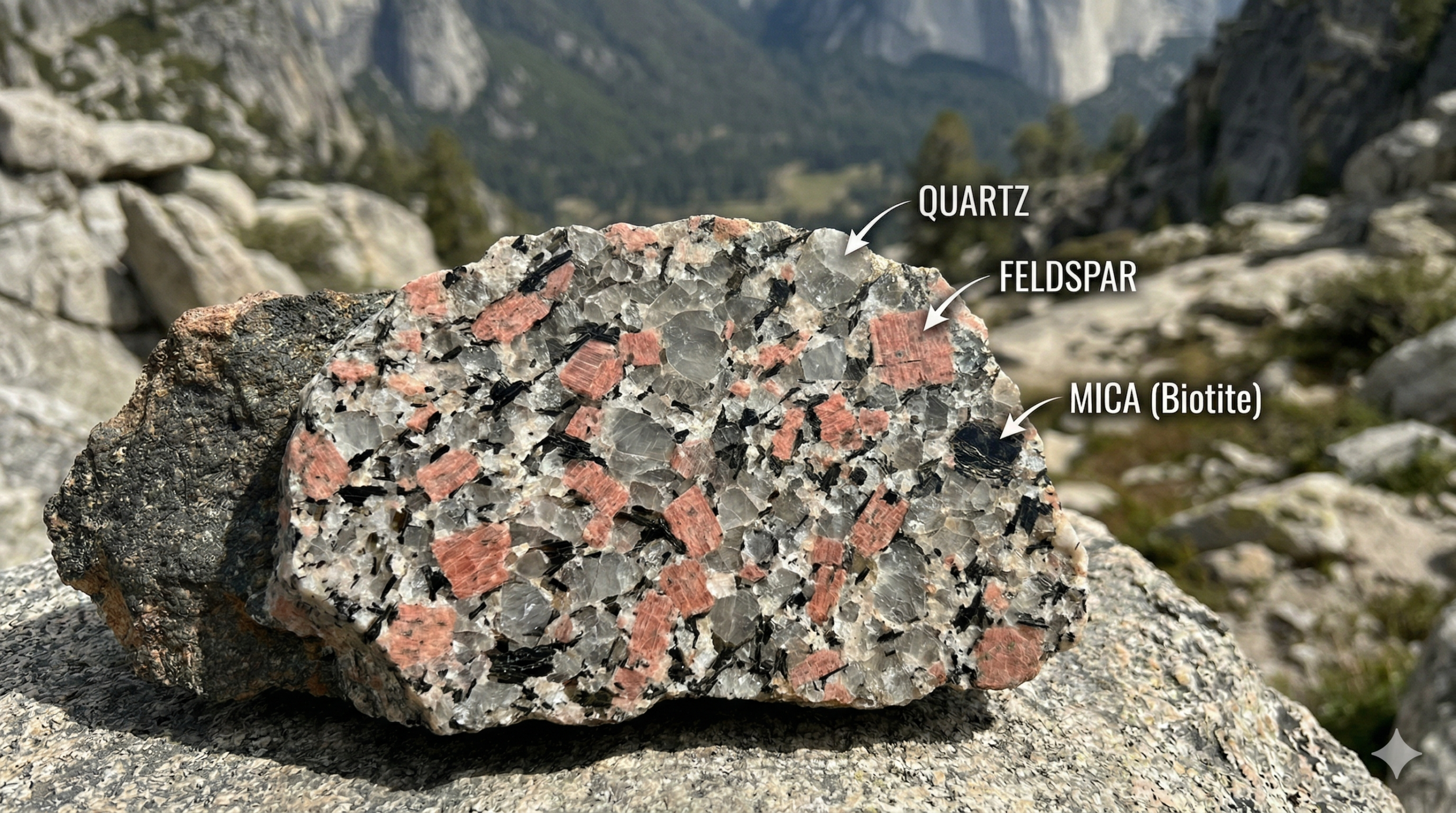
If you pick up a piece of granite, you can easily identify its three main mineral components with the naked eye:
- Quartz: Usually looks like irregular, glassy, gray or clear blobs.
- Feldspar (Orthoclase or Plagioclase): Forms the blocky, opaque crystals that give granite its dominant color (often white, pink, or red).
- Mica (Biotite or Muscovite): The shiny, dark, flaky minerals scattered throughout.
Granite vs. Rhyolite: The Extrusive Cousin
To truly understand granite, it helps to look at its extrusive equivalent: Rhyolite.
If the exact same highly silicic (felsic) magma that forms granite were to suddenly erupt out of a volcano onto the surface, it would cool so fast that large crystals wouldn’t have time to form. The resulting rock, rhyolite, has the exact same chemical composition as granite, but it looks completely different—it is fine-grained (aphanitic), meaning you usually cannot see the individual crystals without a microscope.
Summary
Granite is the ultimate example of an intrusive (plutonic) igneous rock. Its large, interlocking crystals of quartz, feldspar, and mica are the direct result of magma cooling extremely slowly deep within the Earth’s crust. So, the next time you see a piece of granite, remember that you are holding a frozen piece of a prehistoric, subterranean magma chamber.