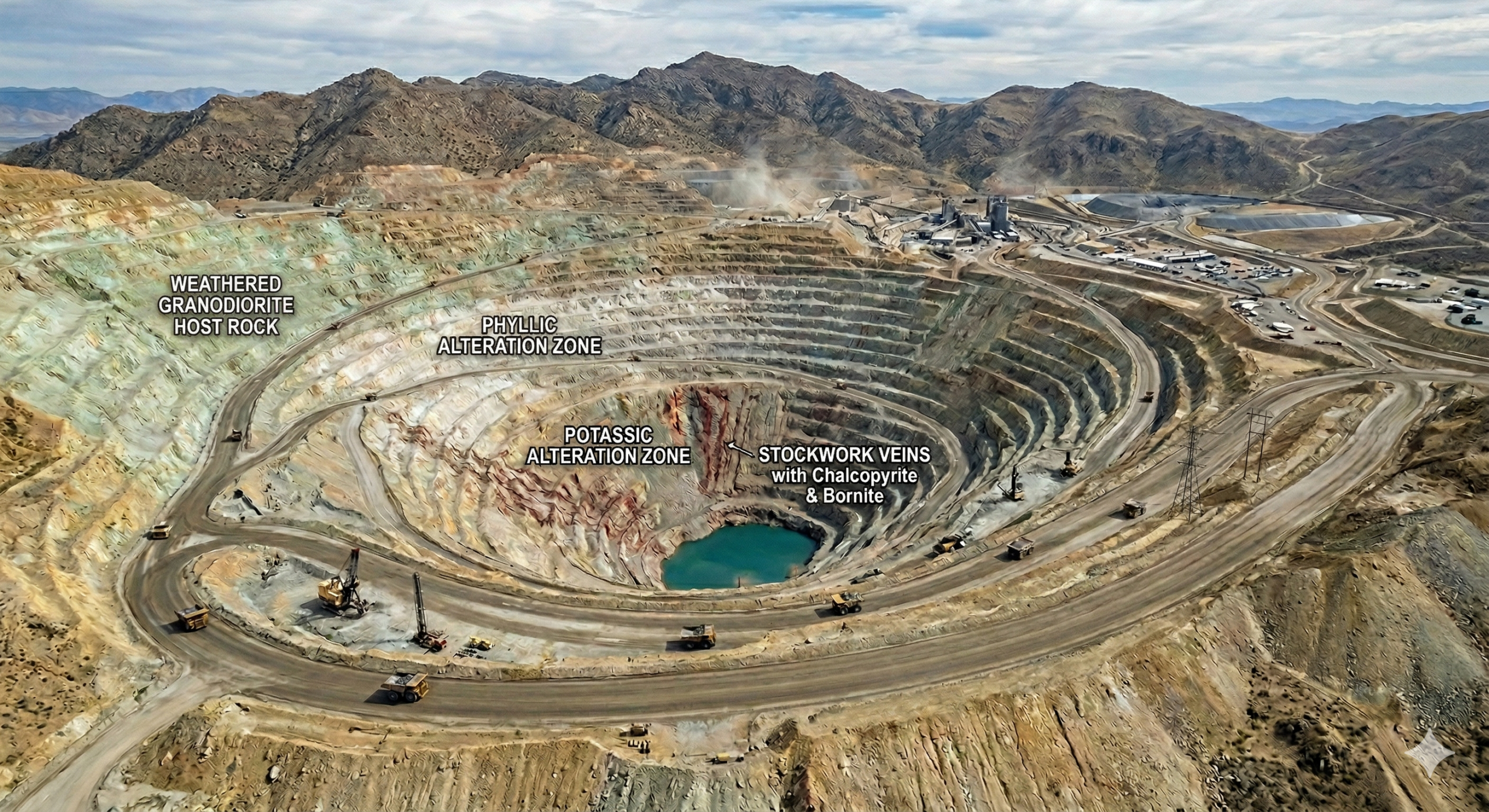
PORPHYRY COPPER DEPOSIT
The Giants of Economic Geology
When it comes to global metal production, porphyry deposits are the undisputed heavyweights. These massive, low-grade hydrothermal ore bodies are the world’s primary source of copper and molybdenum, and a major source of gold. Understanding porphyry systems is essential for any exploration geologist, as a single discovery can sustain a mining operation for decades.
1. Tectonic Setting and Genesis

Porphyry deposits are fundamentally linked to magmatic activity in subduction zones. They typically form in continental and island-arc settings (such as the Andes or the Ring of Fire) where oceanic crust subducts beneath another tectonic plate.
The process begins deep within the crust. As water-rich, intermediate to felsic magmas rise toward the surface (typically stalling 1 to 4 kilometers deep), they undergo fractional crystallization. This releases immense amounts of high-temperature, metal-rich magmatic fluids. The intense pressure of these exsolved fluids fractures the surrounding host rock, creating a highly permeable network for mineralization.
2. Mineralogy and Ore Textures
Unlike vein-type deposits where high-grade ore is concentrated in distinct bands, porphyry systems are characterized by large volumes of low-grade ore (0.3% to 1.5% Cu).
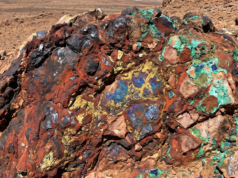
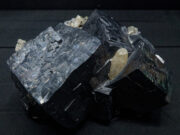
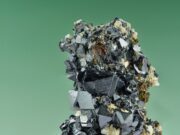
The primary copper-bearing minerals are chalcopyrite and bornite, often accompanied by molybdenite and native gold.
These minerals are typically deposited in two main ways:
- Disseminated: Fine-grained sulfide minerals scattered directly within the host rock matrix.
- Stockwork: A dense, multi-directional network of millimeter-to-centimeter scale quartz-sulfide veinlets that shattered the original rock.
3. Alteration and Zoning (The Lowell-Guilbert Model)
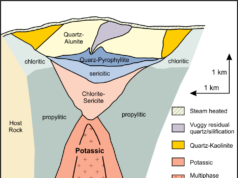
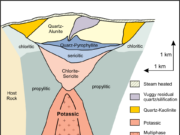
One of the most fascinating aspects of a porphyry system is its highly predictable hydrothermal alteration footprint. As the hot, acidic fluids migrate outward from the cooling magma chamber, they react with the host rocks, creating a concentric “bulls-eye” pattern of alteration zones.
- Potassic Zone (The Core): Characterized by secondary K-feldspar and biotite. This is the hottest zone and typically hosts the highest grades of copper and gold.
- Phyllic Zone (The Halo): Dominated by quartz, sericite, and abundant pyrite. This zone often forms a broad “pyrite halo” around the core.
- Argillic Zone: A shallower, cooler zone where feldspars are heavily altered into clay minerals like kaolinite.
- Propylitic Zone (The Fringes): The outermost and coolest alteration halo, marked by green minerals such as chlorite, epidote, and calcite.
4. Exploration Strategies
Finding a new porphyry deposit is like finding a needle in a geological haystack, but the massive alteration halos give geologists a distinct advantage. Exploration typically involves:
- Geochemistry: Soil and stream sediment sampling looking for pathfinder anomalies (Cu, Mo, Au, Ag, Zn, Pb).
- Geophysics: Induced Polarization (IP) surveys are highly effective because the disseminated pyrite in the phyllic zone creates a strong chargeability anomaly.
- Remote Sensing: Satellite imagery can detect the distinct color anomalies caused by the weathering of pyrite-rich zones into iron oxides (gossans).
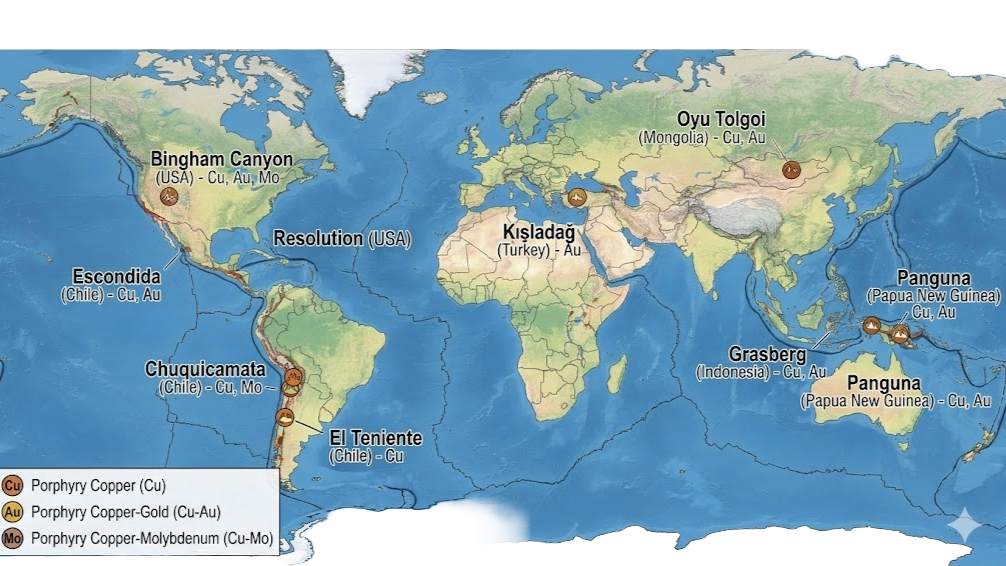

5. Iconic World Examples of Porphyry Deposits
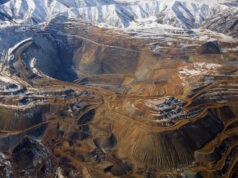
- Bingham Canyon (USA): One of the world’s largest and oldest open-pit mines, producing massive amounts of Cu, Au, Ag, and Mo for well over a century.
- Escondida (Chile): Located in the prolific Atacama Desert, this is currently the highest-producing copper mine globally.
- Grasberg (Indonesia): A world-class porphyry system boasting extraordinary copper and gold reserves, situated in a highly active island-arc tectonic setting.
- Chuquicamata (Chile): An iconic, massive open-pit operation renowned for its immense scale and molybdenum-rich copper ores.
- Oyu Tolgoi (Mongolia): One of the largest developing Cu-Au projects in the world, representing a massive new generation of porphyry discoveries.
- Kışladağ (Turkey): A prime example of a gold-rich porphyry system, standing as the largest gold mine in Europe.
- El Teniente (Chile): The world’s largest underground copper mine, showcasing just how deep the roots of these porphyry systems can extend.
- Panguna (Papua New Guinea): A historically significant Cu-Au porphyry deposit located in a classic southwestern Pacific island-arc setting.
- Resolution Copper (USA): A massive, deep-seated porphyry copper deposit currently under development, highlighting the future of deep geological exploration.