Opal: The Geology of Nature’s Kaleidoscope
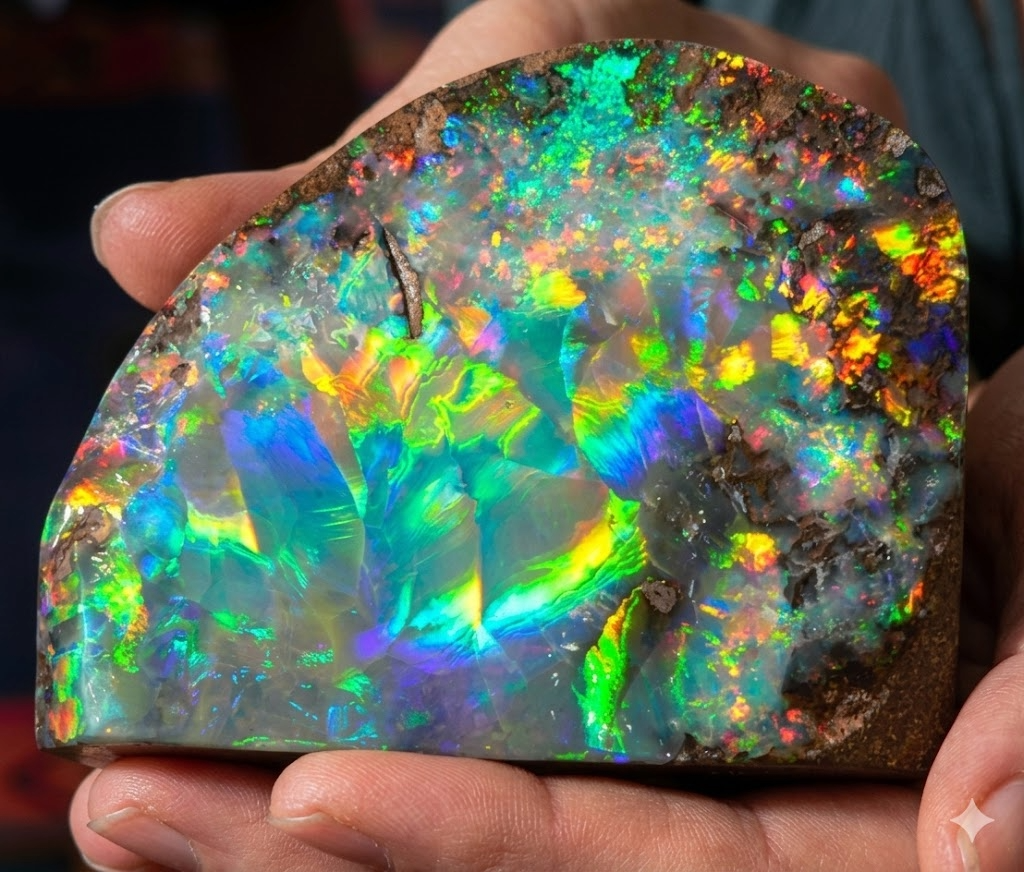
When it comes to gemstones, most are prized for their crystalline perfection. Opal, however, breaks all the rules. It is not a mineral in the strict geological sense, but rather a mineraloid. Lacking a defined crystal structure, opal compensates with a mesmerising optical phenomenon known as “play-of-color,” making it one of the most sought-after and unique gemstones on Earth.
1. What is Opal? (Composition and Structure)
Chemically, opal is hydrated silicon dioxide ($SiO_2 \cdot nH_2O$). It is essentially amorphous silica containing anywhere from 3% to 21% water within its structure.
Because it lacks a crystalline lattice, geologists classify it as a mineraloid. There are two primary categories of opal:
- Precious Opal: Exhibits the flashing “play-of-color.”
- Common Opal (Potch): Opaque or translucent, lacking any play-of-color, though it can still occur in beautiful pastel shades.
2. The Secret Behind the “Play-of-Color”
For centuries, the source of opal’s shifting colors was a mystery. It wasn’t until the invention of the electron microscope in the 1960s that geologists discovered the secret.
Precious opal is composed of billions of microscopic, perfectly spherical silica spheres arranged in an incredibly orderly, three-dimensional grid. When white light enters the stone, it passes through the microscopic gaps between these spheres. The light is diffracted (split) into its spectral colors.
- Smaller spheres produce blue and green flashes.
- Larger spheres (which are rarer) produce the highly prized red and orange flashes.
3. Geological Formation

Opal formation is a story of water and weathering. It typically forms in near-surface sedimentary environments or volcanic rocks that have been subjected to intense weathering.
- Silica Solution: Seasonal rains seep deep into the ground, dissolving silica from surrounding host rocks (like sandstone or volcanic ash).
- Deposition: During dry periods, much of the water evaporates, leaving behind a silica-rich gel in the cracks, voids, and even inside decomposing fossils.
- Solidification: Over millions of years, this gel hardens into solid opal. It is a very slow process; it is estimated that it takes about 5 to 6 million years to form just one centimeter of opal!
4. Major Global Sources
While opal can be found in various locations, a few iconic regions dominate the global supply:
- Australia: The undisputed king of opals, producing over 90% of the world’s precious opal. Famous mining towns like Coober Pedy (known for white opal) and Lightning Ridge (the only significant source of the incredibly rare Black Opal) are legendary in the gemstone world.
- Ethiopia: A relatively recent but massive player in the opal market. Ethiopian “Welo” opals are typically found in volcanic rocks (rhyolite) and are famous for their vivid play-of-color and hydrophane properties (the ability to absorb water).
- Mexico: Famous for its “Fire Opal,” which often lacks the play-of-color but glows with a uniform, intense translucent red, orange, or yellow hue.
Beyond the Gemstone: The Industrial Power of Opal While precious opal is globally renowned for its mesmerizing play-of-color in the gemstone market, its unglamorous cousin—common opal, particularly in the form of diatomaceous earth—holds immense hidden value in the industrial sector. Formed from the microscopic, amorphous silica shells of ancient fossilized algae, this naturally porous mineraloid is an industrial powerhouse. Due to its unique physical properties, including microscopic porosity, light weight, and a moderate hardness of 5.5 to 6.5 on the Mohs scale, industrial opal is essential for a wide range of applications. It serves as a highly efficient, chemical-free filtration medium for water purification and beverage brewing, acts as a gentle abrasive in everyday products like toothpaste and metal polishes, and provides excellent thermal insulation and high-capacity absorbency for hazardous liquid spills, proving that opal’s true geological worth extends far beyond the jeweler’s display.