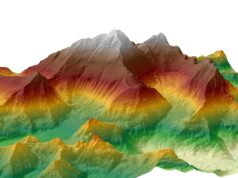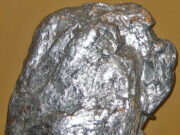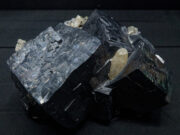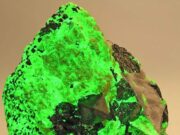
In Part 1, we start with the most crucial concept in exploration geochemistry: Pathfinder Elements.
In our “What Textures Tell Us?” series, we focused on the physical evidence we can see with our own eyes in the core shed. But what happens when the core looks completely barren? How do we find the hidden giants when there is no visible sulfide, no quartz veining, and the assay results show 0.00 g/t Gold?
Welcome to the world of Geochemical Vectors. In this new series, we will learn how to read multi-element assay data not just as a list of numbers, but as a 3D compass pointing directly to the ore body.
In Part 1, we start with the most crucial concept in exploration geochemistry: Pathfinder Elements.
What is a Pathfinder Element?
If you are looking for a fire, you don’t look for the flames first; you look for the smoke. Pathfinder elements are the “smoke” of a mineral system.
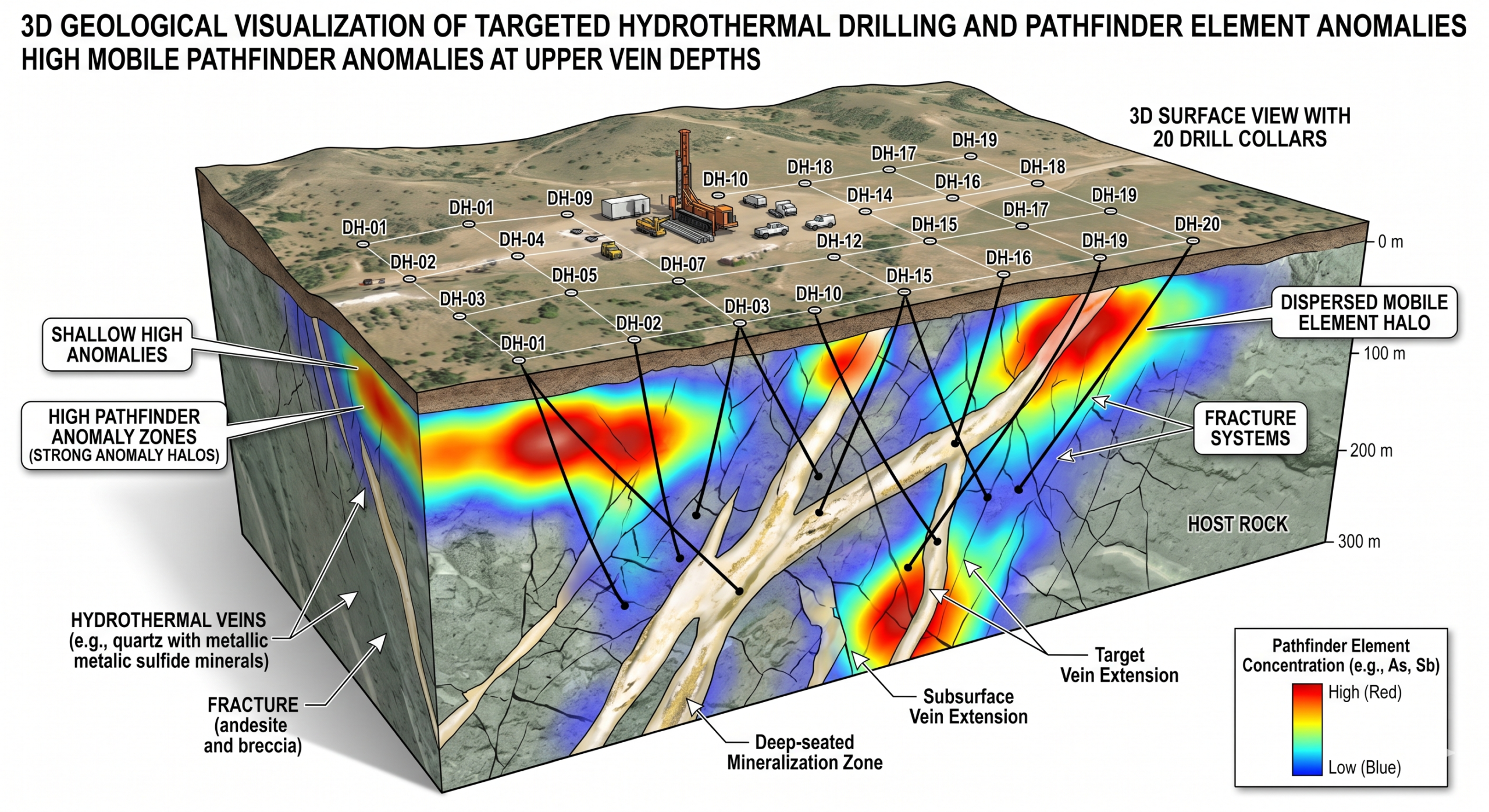
Elements like Gold (Au) or Copper (Cu) are often heavy, stubborn, and prefer to precipitate deep within the system. However, elements like Arsenic (As), Antimony (Sb), Mercury (Hg), and Bismuth (Bi) are highly mobile and volatile. Driven by hydrothermal heat, they escape the main depositional zone and travel hundreds of meters further along fractures and faults, creating massive, invisible “halos” above and around the hidden ore body.
1. The Epithermal Leakage (As, Sb, Hg)

Imagine drilling an area with intense clay (argillic) alteration but getting absolutely zero gold. A novice geologist might abandon the project. But an experienced exploration geologist looks at the 34-element assay sheet. If there is a spike in Mercury (Hg) and Antimony (Sb) near the surface, it means you are likely standing in the barren lithocap above an active epithermal system. The gold didn’t fail to form; it is simply waiting deeper down where the fluids actually boiled. The Hg and Sb are screaming, “Drill deeper!”
2. Porphyry Zoning (Bi, Te, Mo)

In Porphyry systems, pathfinder elements form distinct, predictable onion-like shells around the intrusive heat engine. While Copper and Gold sit in the potassic core, elements like Molybdenum (Mo) might form a shell just outside or overlapping it. Further out in the propylitic zone, where the rock looks like ordinary green andesite, subtle anomalies of Bismuth (Bi), Tellurium (Te), or Zinc (Zn) can point you toward the high-grade center.
From Excel to 3D Reality: Modeling the Halo
In modern Resource Geology, we do not just import Gold assays into Leapfrog Geo or Datamine. We import the pathfinders.
By creating interpolants (numeric models) of Arsenic or Antimony, we can visualize the geochemical dispersion halo in 3D space. Often, you will see a massive, mushroom-shaped cloud of Arsenic anomalies. By targeting the “root” or the hottest center of that 3D Arsenic shell, you drastically increase your chances of hitting the blind Gold deposit.
Stop looking only at the Au column. The secret is in the smoke.