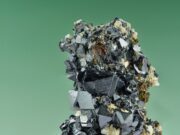
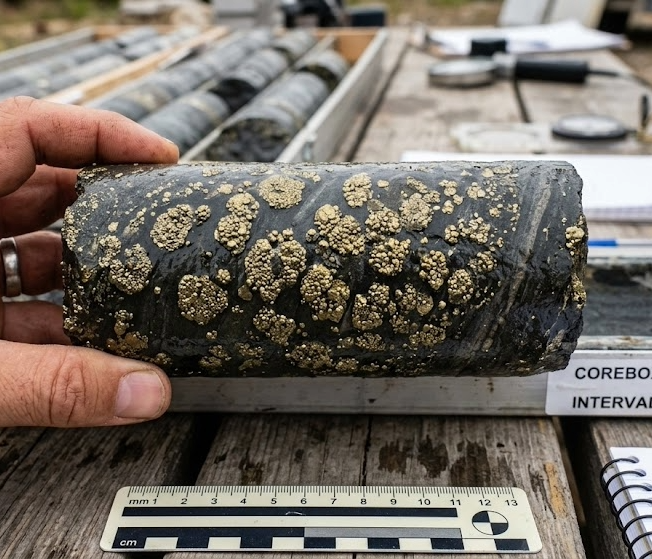
When magma-heated, metal-laden fluids erupt from seafloor fissures and collide with cold 2°C seawater, a massive chemical reaction begins. In these submarine furnaces (Volcanogenic Massive Sulfide – VMS and SEDEX systems), mineralization is no longer confined to narrow veins; it precipitates directly onto the seafloor as massive sulfide muds.In this installment of our series, we emerge from the underground hydrothermal veins and dive into the dark, freezing depths of the ocean floor.
When magma-heated, metal-laden fluids erupt from seafloor fissures and collide with cold 2°C seawater, a massive chemical reaction begins. In these submarine furnaces (Volcanogenic Massive Sulfide – VMS and SEDEX systems), mineralization is no longer confined to narrow veins; it precipitates directly onto the seafloor as massive sulfide muds.
Here are the signature textures we encounter in the core box from these unique exhalative deposits:
1. Massive Sulfide Banding

This is the most characteristic feature of VMS and SEDEX systems. When you open a core box, you will see that over 50% of the rock consists directly of sulfide minerals (pyrite, sphalerite, galena, chalcopyrite).
- Formation Mechanism: Metal-rich fluids periodically exhaling onto the seafloor accumulate layer by layer in a sedimentary depositional environment. These rhythmic pulses cause minerals to precipitate at different densities and temperatures, creating that spectacular, distinct banded structure.
2. Framboidal Pyrite: The Raspberry Texture

Looking like fine-grained black mud to the naked eye or under a hand lens, this structure presents a magnificent geometry under the microscope.
- Formation Mechanism: Named after the French word “framboise” (raspberry), this texture forms from the aggregation of microscopic, spherical pyrite crystals. When 350°C hot fluids erupting from those famous “black smoker” chimneys suddenly collide with freezing ocean water, rapid quenching occurs. Pyrite crystals precipitate instantly in these raspberry-shaped clusters before they have a chance to grow into larger distinct forms.
3. Different Pyrite Generations (Overprinting & Recrystallization)
In a VMS system, pyrite does not always remain in the same form. In drill cores, you can often observe large, cubic pyrites floating within a finer-grained or crushed pyrite matrix.
- Formation Mechanism: These systems are active for millions of years. Fine-grained sulfides formed in the early stages are subsequently reheated by the continuous upwelling of hot fluids (zone refining). This causes the redistribution of metals within the system and the overprinting of different generations of pyrite, with new crystals growing over or replacing the older ones.
From Visual Logging to 3D Reality: Modeling Complex Lenses
When modeling VMS and SEDEX systems in 3D environments, you cannot rely on broad grade shells as in porphyry systems, or planar veins as in epithermal systems.
Here, the ore body typically occurs as “stratiform” (layer-parallel) lenses that conform to the paleo-topography of the seafloor. These systems have often been subsequently folded and dismembered by later tectonic forces. Accurately reading the orientation of massive sulfide bands during core logging and correctly correlating these depositional signatures with the sedimentary host rocks is the absolute key to structurally domaining and connecting those complex, folded sulfide lenses in 3D space.