Before we look at the 34-element assay data or build complex grade distribution models, we must read the rocks. Every ore deposit is essentially a fossilized hydrothermal system. As geologists, recognizing specific textures during core logging is our first line of insight into the dynamic physical and chemical processes that occurred millions of years ago.
In Part 1 of this series, we will explore the fundamental textures formed at the heart of magmatic-hydrothermal transition zones and alteration halos.
1. Stockwork Veining: The Heartbeat of a Porphyry System

When examining core from the deep roots of a magmatic system, encountering stockwork veining is a definitive “eureka” moment.
What is it?
A stockwork is a complex, chaotic, and multidirectional network of closely spaced veinlets. Unlike continuous, singular planar veins, stockworks resemble a shattered glass pane filled with minerals.
The Formation Mechanism:
This texture is a direct result of extreme overpressuring. As a magma body cools and crystallizes, volatile-rich exsolved fluids accumulate in the intrusion’s cupola (roof). When fluid pressure exceeds both lithostatic pressure and the tensile strength of the host rock, a catastrophic hydraulic fracturing event occurs. The rock shatters, and mineral-rich fluids instantly rush into the newly formed multidirectional fractures, precipitating minerals like quartz, chalcopyrite, bornite, and molybdenite.
Where do we see it?
Stockwork textures are the classic, defining characteristic of Porphyry Copper-Gold systems.
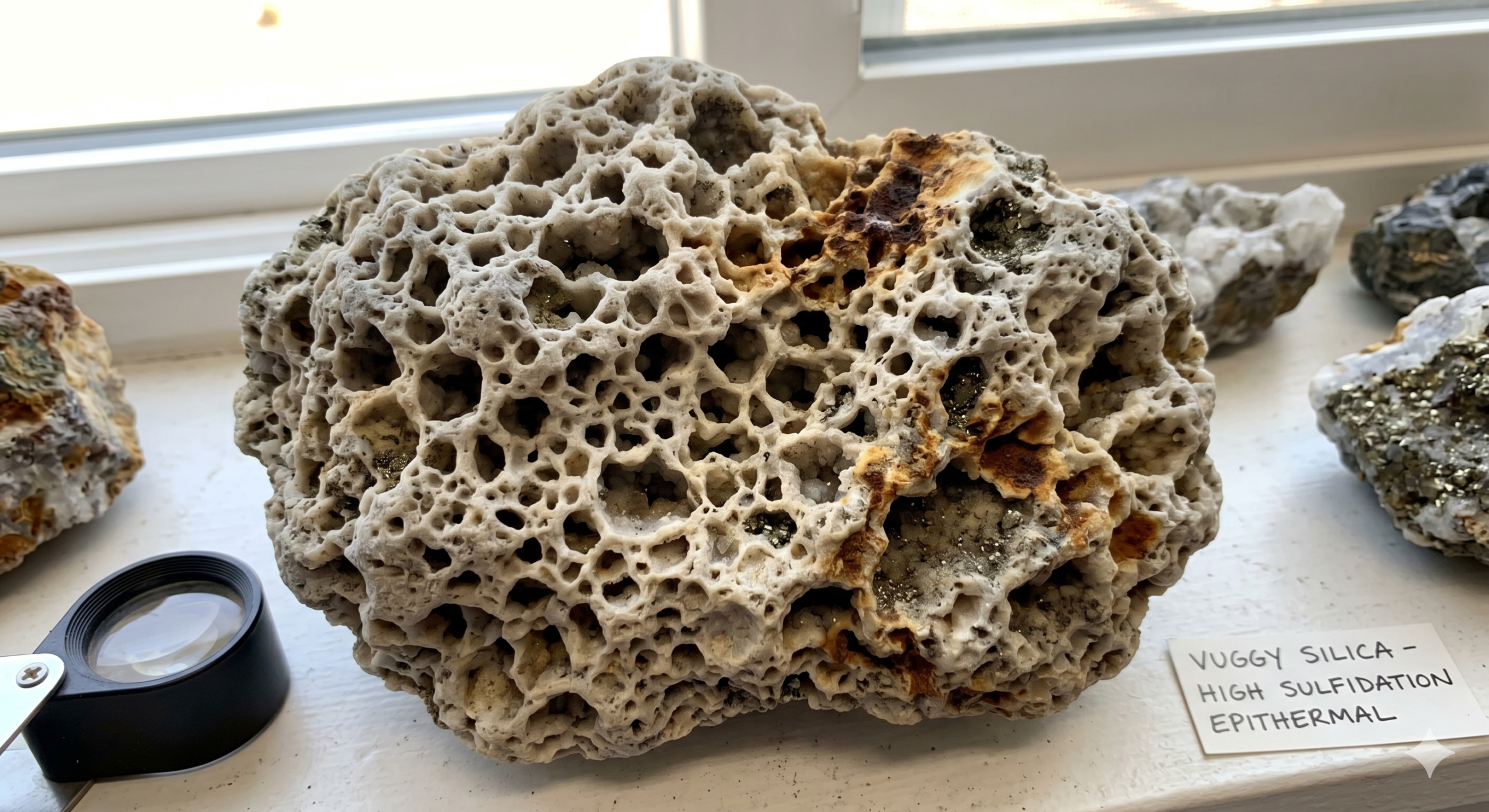
2. Vuggy Silica (Residual Quartz): The Acid-Washed Sponge

Moving slightly away from the deep porphyry environment towards shallower, more volatile systems, we encounter one of the most aggressive alteration textures in economic geology: vuggy silica.
What is it?
Vuggy silica presents as a highly porous, sponge-like rock consisting almost entirely of quartz. The cavities (vugs) are often lined with later-stage ore minerals.
The Formation Mechanism:
This texture tells a story of extreme, hyper-acidic fluid flow. Magmatic vapors rich in HCl and SO₂ ascend and condense into groundwater, creating highly corrosive fluids with a pH often dropping below 2. As this acid washes through the host rock, it aggressively leaches away almost all mobile elements—destroying feldspars, micas, and lithic fragments—leaving behind only the insoluble silica framework.
Where do we see it?
Phorphyry Cu-GoldWhile stockwork textures are the classic, defining characteristic of Porphyry Copper-Gold systems, they are by no means exclusive to them. You will also prominently find them in the footwall feeder zones (stringer zones) of Volcanogenic Massive Sulfide (VMS) deposits, representing the main pathways for upwelling hydrothermal fluids. Additionally, they frequently occur in Epithermal systems and Orogenic gold deposits where localized overpressuring and faulting shatter the host rock.
3. Disseminated and Replacement Textures: The Invisible Invasion

Not all fluid-rock interactions involve violent fracturing. Often, the process is a quiet, atom-by-atom invasion.
What is it?
- Disseminated: Ore minerals are scattered as fine specks throughout the host rock mass.
- Replacement: Hydrothermal fluids dissolve a primary mineral and simultaneously precipitate a new secondary mineral in its exact place, often preserving the original crystal shape (pseudomorphism).
The Formation Mechanism:
These textures form when reactive fluids permeate through the microscopic pore spaces and grain boundaries of a permeable host rock (like a limestone or a porous volcanic tuff). The fluid reacts chemically with the wall rock, causing sudden shifts in pH, temperature, or oxidation state, which forces sulfides to precipitate directly within the rock matrix.
Where do we see it?
These are ubiquitous across many deposit types, but they are particularly critical in Carlin-type gold deposits, Skarns, and the outer halos of Volcanogenic Massive Sulfide (VMS) systems.
From Visual Logging to 3D Reality
Recognizing these textures is only the first step. The true power of exploration geology is unlocked when we translate these qualitative visual observations into quantitative data. Accurately logging stockwork density or vuggy silica intensity allows us to build robust, geologically constrained 3D implicit models in software platforms like Leapfrog Geo or Datamine. By doing so, we ensure our resource estimations are driven by actual geology, not just mathematical algorithms.
Stay tuned for Part 2, where we will ascend further up the hydrothermal system to explore Epithermal Vein Textures, including crustiform-colloform banding and boiling indicators like bladed calcite.