The journey of hydrothermal fluids is a violent and dynamic one. When deep-seated, mineral-rich fluids ascend through crustal fracture networks, they don’t simply cool down; they undergo sudden, dramatic depressurization. It is in these moments of “flashing” or boiling that the carrying capacity of the fluid collapses, forcing precious and base metals to precipitate. However, the fluid leaves behind a diary of its journey.
In part two of our series, we dive deep into the heart of epithermal and hydrothermal vein systems to decode the specific textures that point directly to the highest grade mineralization.
The Heartbeat of the Vein: Crustiform and Colloform Banding

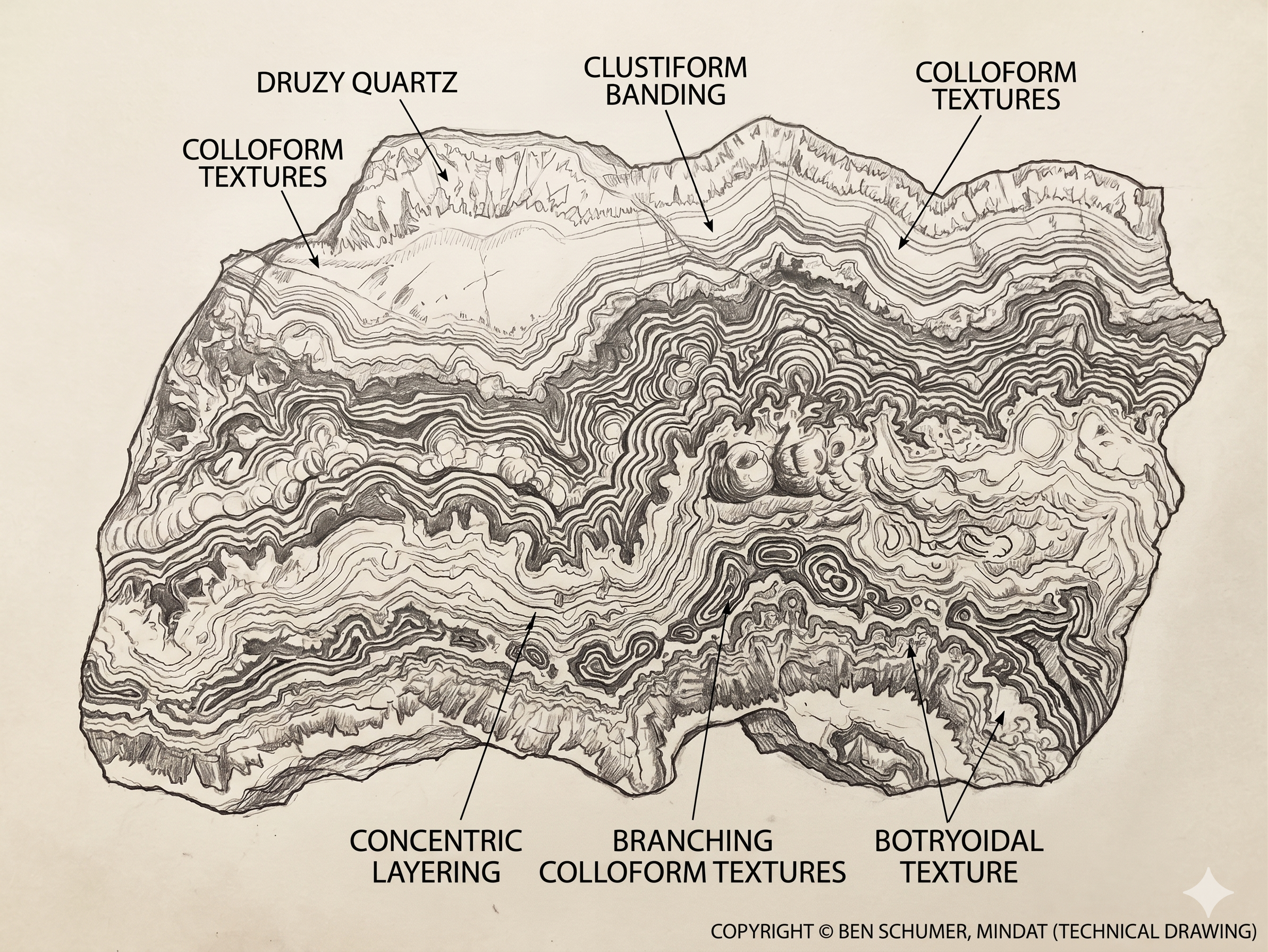
Symmetrical banding along vein margins is a classic hallmark of epithermal systems, but the specific type of banding tells a much deeper story about fluid dynamics.
- Crustiform Banding: This texture forms when minerals (typically quartz, adularia, or carbonates) grow inward from the fracture walls. It represents the “crack-seal” kinematic mechanism. The fault opens, pressure drops, a micro-layer precipitates, and the fault seals again. Each band is a single seismic event.
- Colloform Banding: Recognized by its rounded, botryoidal, or kidney-like appearance, colloform textures indicate extremely rapid precipitation from a colloidal silica gel rather than a true solution.
- The “Ginguro” Secret: In low-sulfidation epithermal systems, look for the Ginguro bands. These are distinct, dark gray to black millimeter-scale bands composed almost entirely of fine-grained electrum, silver sulfosalts (like pyrargyrite), and sulfides. If you spot Ginguro banding, you are looking at the highest-grade “bonanza” zone of the vein.
The Ultimate Boiling Indicator: Bladed Calcite (and Quartz Pseudomorphs)

Perhaps the most critical texture an exploration geologist can find in a drill core is bladed calcite, or its silica-replaced equivalent.
When ascending fluids reach a critical depth where hydrostatic pressure drops below the fluid’s vapor pressure, boiling occurs. Boiling forces the rapid exsolution of CO₂ and H₂S gases. The loss of CO₂ drastically changes the fluid’s pH, forcing calcite to precipitate instantly in a distinctive platy, bladed, or lattice-like structure.
More importantly, the simultaneous loss of H₂S gas destroys the gold-bisulfide complexes (Au(HS)₂⁻) that carry gold in solution. Therefore, where the fluid boils (bladed calcite), gold instantly dumps. Over time, these calcite blades are often dissolved by later acidic, silica-rich fluids, leaving behind hollow casts or quartz pseudomorphs that perfectly preserve the bladed texture. Finding this texture defines the exact “boiling horizon” elevation of your deposit.
Hydraulic Fracturing: Hydrothermal Breccias

Hydrothermal fluids are highly pressurized. When the fluid pressure exceeds the lithostatic pressure and the tensile strength of the host rock, a violent subterranean explosion occurs, resulting in hydrothermal brecciation.
- Jig-Saw Breccias: If the clasts of the host rock look like they could fit perfectly back together, the brecciation occurred via hydraulic jacking with minimal transport.
- Milled/Fluidized Breccias: If the clasts are highly rounded and suspended in a matrix of “rock flour” or hydrothermal cement, it indicates a high-energy environment with significant vertical transport—often associated with phreatic or phreatomagmatic explosive events. The matrix of these breccias is frequently the primary host for sulfide mineralization.
Bridging Textures with 3D Geochemical Assay Data
Visual textures in core logging are invaluable, but their true power is unlocked when integrated with spatial software.
When correlating multiple underground veins using 34-element ICP-MS geochemical analysis data in geological modeling software like Datamine or Leapfrog Geo, these visual textures become the structural anchor points of the grade distribution model.
For instance, identifying the bladed quartz pseudomorph horizon in the core visually aligns perfectly with the sudden vertical spike in pathfinder elements like Antimony (Sb), Arsenic (As), and Thallium (Tl) in the assay data. By modeling the upper limits of the crustiform banding and breccia matrices, geologists can accurately predict the plunge of high-grade ore shoots, transforming qualitative logging observations into hard, quantitative 3D block models.