PART 1: The Low-Sulfur Paradox & The Iron Heart

Most copper-gold systems (like porphyries) are driven by sulfur, resulting in massive pyrite halos. IOCGs completely break this rule. This part explores the unique chemistry of these giants.
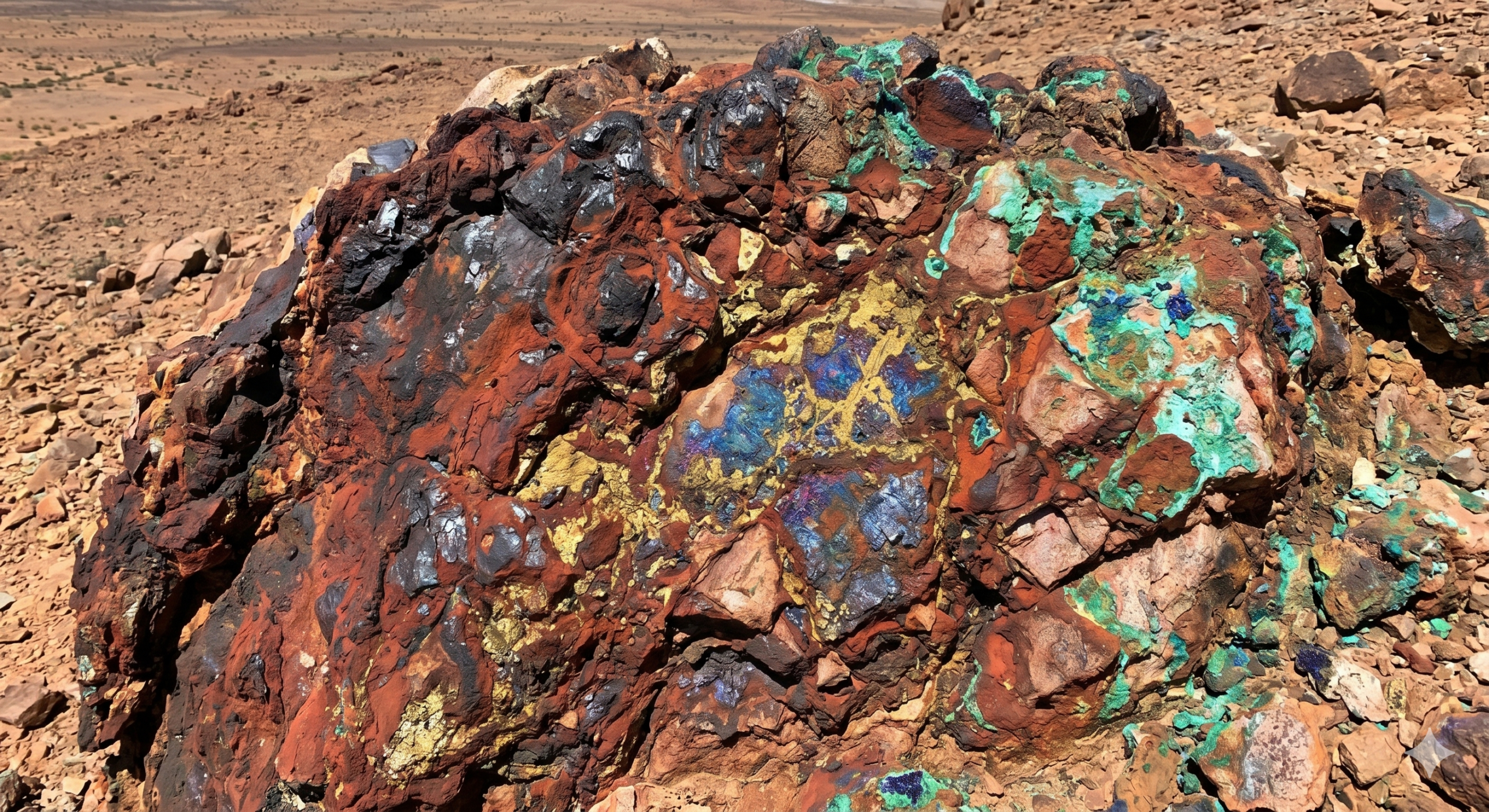
- The Iron Oxide Engine: IOCG deposits are defined by their sheer volume of iron oxides—specifically Magnetite and Hematite—which can make up 10% to over 50% of the rock mass. Unlike porphyry systems where sulfur is abundant, IOCGs are sulfur-poor. The hydrothermal fluids carry immense amounts of iron, but very little sulfur, meaning almost all the available sulfur is locked up in chalcopyrite (CuFeS₂) and bornite (Cu₅FeS₄), leaving very little room for “barren” pyrite.
- The Hematite vs. Magnetite Transition: The oxidation state dictates the deposit type. Deep, hotter, and more reduced zones are dominated by Magnetite (often hosting apatite). As fluids move upward and interact with cooler, more oxidized meteoric waters, the system transitions to Hematite. The highest grade Copper-Gold-Uranium zones are typically found precisely at this Magnetite-to-Hematite transition.
- Extreme Brecciation: IOCGs are not typically formed by quiet, passive fluid flow. They are characterized by violent, explosive, multi-stage hydrothermal brecciation. The ore is often found within the matrix of these massive, chaotic breccia bodies.
PART 2: Regional Alteration & The “Sodic-Calcic” Footprint
You don’t just stumble upon an IOCG; you follow a footprint that can be tens of kilometers wide. This part focuses on the massive alteration halos.
- The Deep Sodic-Calcic Zone: Before you ever see copper or gold, you will encounter the regional-scale “bleaching” of the host rocks. Massive volumes of Albite (sodic) and Actinolite/Diopside (calcic) alter the regional crust. This deep, high-temperature alteration strips metals from the surrounding rocks, preparing the “soup” for the main mineralizing event.
- Potassic to Hydrolytic: As you move closer to the core and upward in the system, the alteration transitions to intense potassic alteration (K-feldspar, giving rocks a distinct salmon-pink color) and eventually to chlorite-sericite in the hematite zones.
PART 3: The Geophysicist’s Dream – Vectoring with Gravity and Magnetics
Because IOCGs are often completely blind and buried under hundreds of meters of cover, traditional surface geochemistry often fails. This part covers why geophysics is the ultimate tool for IOCG exploration.
- The Gravity-Magnetic Offset: This is the golden rule of IOCG exploration.
- Magnetics: The deep magnetite roots create a massive, blazing high on a magnetic survey.
- Gravity: Hematite is significantly denser than the surrounding rocks, creating a massive gravity anomaly.
- The Target: The best Cu-Au grades usually do not sit in the dead center of the magnetic high. They sit in the Gravity High / Magnetic Low offset zone (where magnetite has been overprinted and oxidized to hematite). If you only drill the magnetic bullseye, you might just hit barren magnetite.
- Structural Architecture: IOCGs require deep crustal-scale faults (like the Gawler Craton structures) to tap into mantle-derived fluids. Modeling the intersection of these deep-tapping faults with the geophysical anomalies is the only way to effectively target an IOCG.