Part 1: Introduction to Metamorphism – The Earth’s Pressure Cooker
Introduction Unlike igneous rocks that cool from melted magma, or sedimentary rocks built from surface debris, metamorphic rocks are the ultimate shape-shifters. The word itself comes from Greek (meta = change, morph = form). These rocks are fundamentally transformed by intense heat, pressure, and hot chemical fluids deep within the Earth’s crust—all without ever melting. If the rock melts, it becomes magma, restarting the igneous cycle.
The Three Agents of Metamorphism:
Heat (Temperature): The most crucial factor. Heat provides the energy required to break existing chemical bonds within minerals, allowing atoms to migrate and recrystallize into new, more stable minerals. Geothermal gradients and nearby magma intrusions are the primary heat sources.
Pressure (Stress): * Lithostatic Pressure: Uniform pressure from all directions due to the weight of overlying rocks. It compresses the rock, making it denser.
Directed Pressure (Differential Stress): Unequal pressure, usually caused by tectonic plates colliding. This stress forces minerals to align, creating a layered texture.
Hydrothermal Fluids: Hot, water-rich fluids circulating through rock pores act as chemical messengers. They dissolve ions and transport them, accelerating chemical reactions and introducing new elements to the rock system (a process known as metasomatism).

Part 2: Foliated Rocks – The Tectonic Barometer
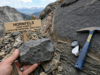
When rocks are subjected to immense directed pressure (differential stress) during mountain-building events (regional metamorphism), their minerals align perpendicularly to the direction of the stress. This alignment creates a banded or layered appearance known as foliation.
The evolution of foliated rocks perfectly illustrates the concept of “metamorphic grade” (the intensity of heat and pressure). Let’s follow the transformation of a simple shale as it gets buried deeper into the Earth:
Slate (Low Grade): The first step. The microscopic clay minerals in shale align perfectly, creating a rock that breaks into flat, smooth sheets (slaty cleavage). It has a dull, matte finish.
Phyllite (Low to Medium Grade): As temperature and pressure increase, clay minerals begin to grow into larger mica crystals (muscovite and chlorite). While still too small to see individually, these micas give phyllite a distinct, wavy, and silky sheen (phyllitic luster).
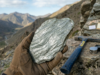
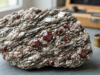
Schist (Medium to High Grade): The micas have now grown large enough to be easily seen with the naked eye, giving the rock a highly sparkling appearance. Schist often hosts striking “porphyroblasts”—large, newly formed crystals like garnet or staurolite that grow within the micaceous matrix.
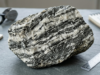
Gneiss (High Grade): Under extreme conditions near the melting point, the minerals completely segregate into distinct light (quartz/feldspar) and dark (biotite/amphibole) bands. This “gneissic banding” represents the highest grade of foliation before the rock begins to melt.

Part 3: Non-Foliated Rocks – The Result of Pure Heat
Not all metamorphic rocks have layers. Non-foliated rocks lack this banded texture. This usually happens for two reasons: either the metamorphism was driven primarily by heat without directed pressure (Contact Metamorphism), or the original rock was composed of minerals that simply don’t align well under stress (like pure quartz or calcite).
Common Non-Foliated Rocks:
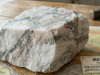
Marble: Born from limestone or dolostone. The microscopic calcite fossils and crystals in the original limestone recrystallize into larger, interlocking calcite crystals. It is beautiful, easily sculpted, but reacts vigorously with weak acids.
Quartzite: The metamorphic product of quartz-rich sandstone. The sand grains and the silica cement binding them recrystallize together, creating a rock so incredibly hard and dense that it breaks through the quartz grains rather than around them.
Hornfels: A massive, hard rock formed through “contact metamorphism” when a host rock is essentially baked by an intruding magma chamber.
Part 4: Metamorphic Facies – Reading the Earth’s Thermometer
For professional geologists, identifying a metamorphic rock is just the beginning. By analyzing the specific mineral assemblages within a rock, geologists can determine the exact temperature and pressure conditions the rock experienced millions of years ago. This is known as the Metamorphic Facies concept.
Certain minerals, known as index minerals (e.g., Chlorite, Biotite, Garnet, Kyanite, Sillimanite), only form under very specific temperature and pressure ranges. By mapping these minerals in the field, geologists can reconstruct the ancient tectonic environments, tracing the buried roots of long-gone mountain ranges and ancient subduction zones.