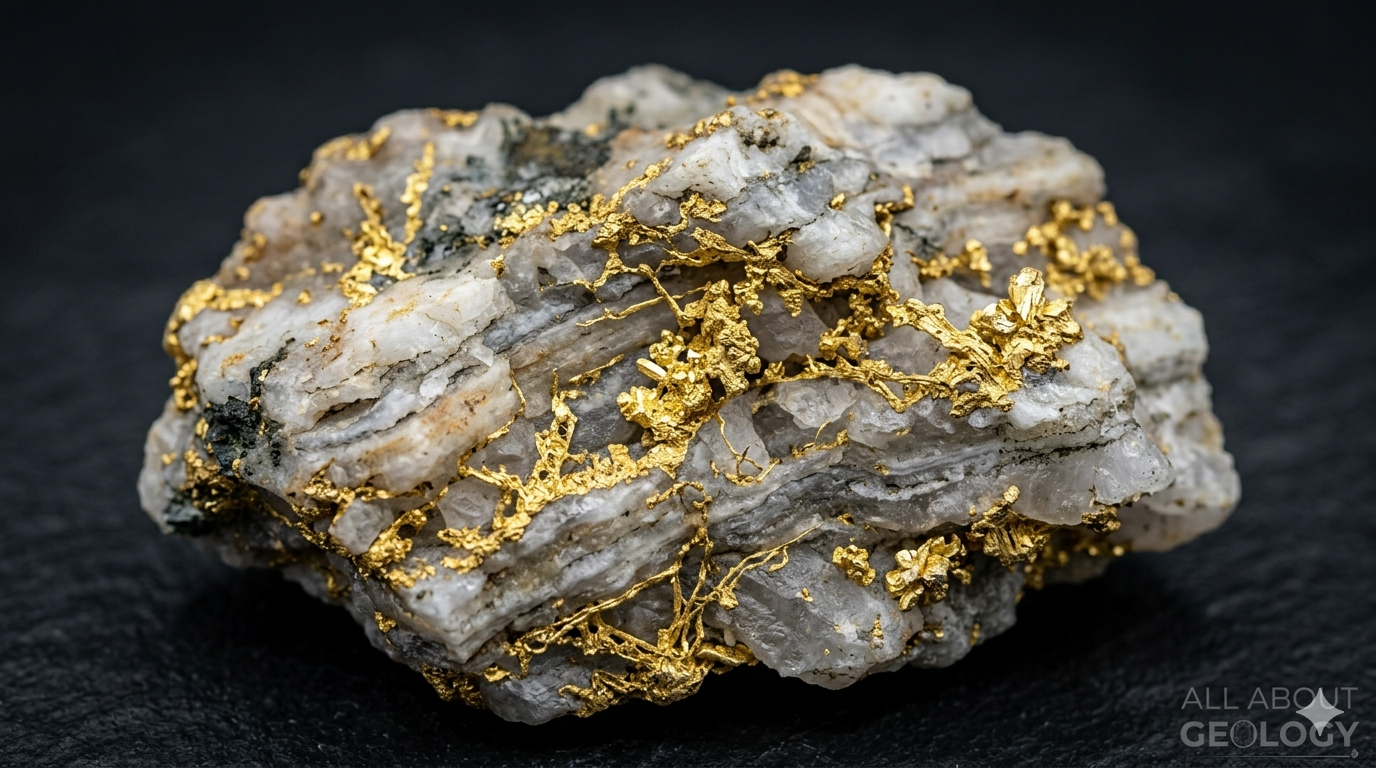
The Anatomy of Orogenic Gold: Structural Controls, Deep Fluids, and Hidden Vectors
In the realm of economic geology, Orogenic Gold deposits form the backbone of global gold production. Yet, exploring for them requires moving past rudimentary geological concepts and understanding the extreme mechanical and chemical engines that operate kilometers beneath the Earth’s surface.
For exploration managers, senior geologists, and mining investors, success doesn’t come from randomly drilling quartz veins. It comes from decoding structural traps, understanding fluid mechanics, and identifying invisible geochemical vectors. Here is the deep anatomy of orogenic gold systems.
PART 1: The Deep Engine: Seismic Pumping & Fault-Valve Behavior

Gold does not accumulate slowly over millions of years through gentle fluid flow. The formation of high-grade orogenic gold veins is a violent, instantaneous process driven by crustal tectonics. To find the gold, we must first understand the earthquake.
The fundamental mechanism driving this is Richard Sibson’s Fault-Valve Model. Deep within the metamorphic crust (typically 5 to 15 kilometers down), metamorphic dehydration reactions produce massive volumes of highly pressurized, gold-bearing, and CO₂-rich fluids. These fluids become trapped beneath impermeable rock layers, building up supralithostatic pressure.
When the pressure exceeds the rock’s tensile strength, a seismic rupture (an earthquake) occurs. This rupture acts as a sudden “valve,” fracturing the rock and creating an instant vacuum. The highly pressurized fluids are violently pumped upward into the newly formed fracture network.
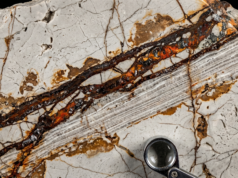
The resulting flash vaporization—caused by the catastrophic pressure drop—forces the fluid to instantly dump its dissolved payload. Silica precipitates as quartz, and the gold crashes out of the solution in a matter of seconds. An economic quartz vein is, in reality, the fossilized scar of an ancient seismic event.
PART 2: Structural Traps: Decoding the Riedel Shear System
A common and highly expensive mistake in exploration is targeting the massive, first-order regional faults (e.g., the main shear zone). While these massive structures act as the primary plumbing system transporting fluids from the deep crust, they are usually barren. The fluids move too fast and the pressure is too high for significant gold precipitation.
The economic payload is almost always found in the second and third-order structures.
To drill successfully, exploration teams must conduct rigorous kinematic analysis to decode the Riedel Shear System. The gold precipitates where the rock is pulling apart, creating areas of low pressure. Key targets include:
- Dilational Jogs: Step-overs in the fault system where the movement creates a pull-apart basin or void. These are the most common sites for massive ore shoots.
- R and R’ Shears: Conjugate fractures that form at specific angles to the main shear direction.
- Saddle Reefs: Voids created in the hinge zones of tightly folded sedimentary layers.
If you don’t understand the kinematics and the stress regime of your structural trap, your drill core will come up empty, even if you are mere meters away from a high-grade shoot.
PART 3: Beyond Arsenic: Advanced Geochemical Pathfinders & Invisible Gold
Structural modeling tells you where to look, but geochemistry confirms what you are looking at. While traditional pathfinders like Arsenic (As) and Antimony (Sb) are standard, advanced exploration requires looking deeper into the lattice.
1. The Risk of Refractory “Invisible” Gold
Visible, free-milling gold in quartz is the dream, but the reality is often much more complex. In many high-grade orogenic systems, the gold is completely invisible. It substitutes into the atomic lattice of sulfide minerals, primarily pyrite and arsenopyrite. This “refractory gold” cannot be extracted through simple gravity or cyanidation circuits; it requires expensive roasting or pressure oxidation (POX). Identifying whether a deposit is free-milling or refractory early in the exploration phase is critical for accurate CAPEX/OPEX modeling.
2. CO₂ Phase Separation in Fluid Inclusions
Orogenic gold fluids are famously rich in carbon dioxide. Under a petrographic microscope, analyzing fluid inclusions within the quartz veins can reveal CO₂ phase separation (unmixing of liquid and vapor CO₂). If you observe this unmixing in your core samples, you are looking at the exact physical mechanism that triggered gold precipitation. It is one of the strongest vectors pointing toward an economic ore zone.
3. Deep vs. Shallow Geochemical Vectors
Not all pathfinders are created equal. They zone vertically based on temperature and depth:
- Shallow/Cooler Vectors: Mercury (Hg), Antimony (Sb), and Arsenic (As) dominate the upper portions of the system.
- Deep/Hotter Vectors: If your geochemical assays are returning anomalous Tellurium (Te), Bismuth (Bi), and Tungsten (W), you are likely vectoring into the deeper, hotter roots of the orogenic system, closer to the primary fluid source.
Conclusion
Exploring for orogenic gold is an exercise in structural geometry and thermodynamic forensics. By shifting focus from generic quartz veins to structural kinematics, seismic pressure drops, and atomic-level pathfinders, exploration teams can drastically improve drill success rates and unlock world-class deposits.