When we think of mining, we often picture drilling deep into the continental crust. However, some of the richest and most compact accumulations of base and precious metals on Earth were actually born at the bottom of ancient oceans.
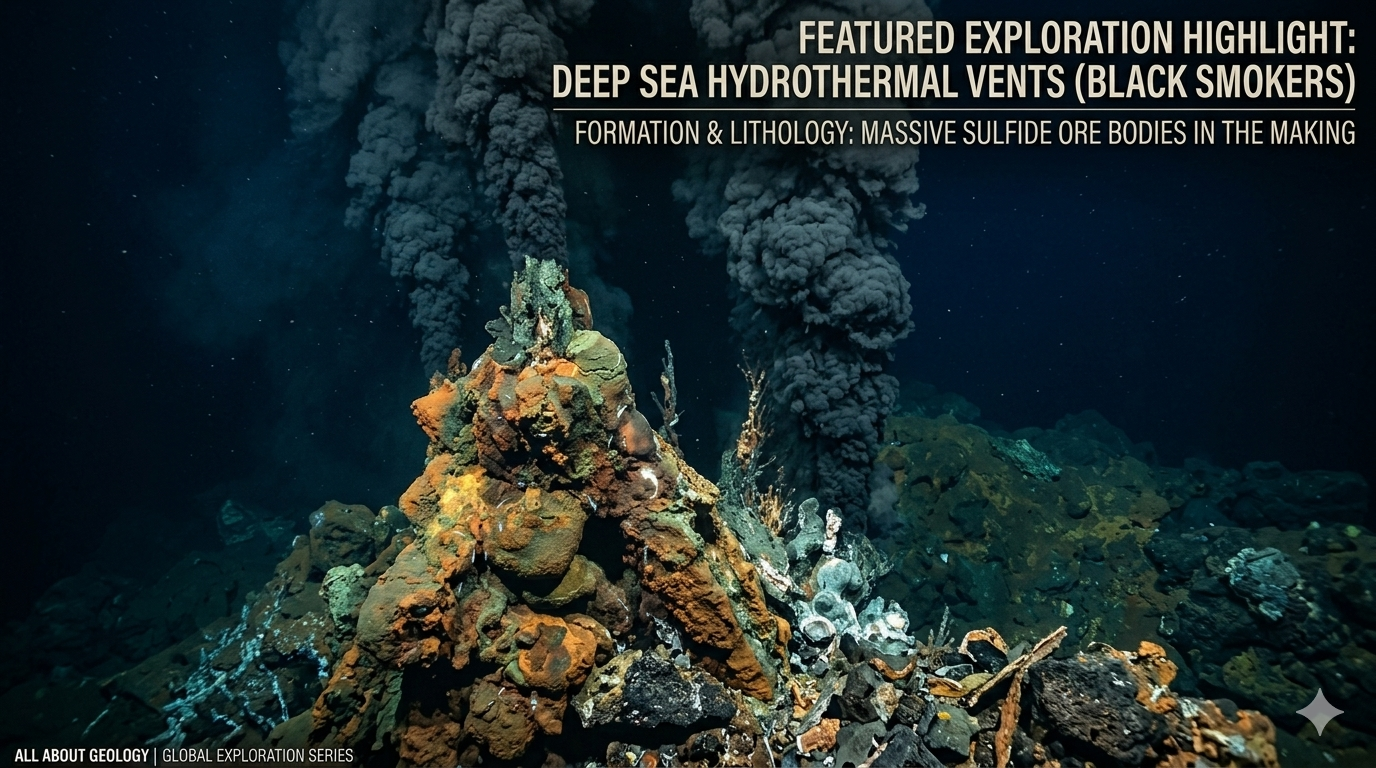
These are Volcanogenic Massive Sulfide (VMS) deposits—fossilized remnants of deep-sea hydrothermal vents, commonly known as “black smokers.” Today, these ancient seafloor environments have been pushed onto land by tectonic forces, providing modern exploration geologists with highly profitable targets for Copper (Cu), Zinc (Zn), Lead (Pb), Gold (Au), and Silver (Ag).
Here is the complete breakdown of what VMS deposits are, how they form, and the distinct subtypes you need to know.
What is a VMS Deposit?
VMS deposits are accumulations of massive sulfide minerals (typically >40% sulfide by volume) that precipitate directly onto, or just below, the seafloor. They are fundamentally linked to submarine volcanism and extension centers, such as mid-ocean ridges, island arcs, and back-arc basins.
Because they form simultaneously with the surrounding volcanic and sedimentary rocks, VMS deposits are syngenetic and stratiform (layered within the rock strata), often forming distinct lens-like or mound-shaped ore bodies.
The Formation Mechanism: How “Black Smokers” Make Ore
The genesis of a VMS deposit is a spectacular display of thermodynamics and fluid chemistry:
- The Heat Source: A shallow magmatic intrusion beneath the seafloor provides intense heat.
- Convection and Leaching: Cold, heavy seawater penetrates deep into the oceanic crust through faults and fractures. As it approaches the magma, the water is superheated (up to 400°C) and becomes highly acidic. This aggressive fluid dissolves base metals (Cu, Zn, Pb) and sulfur from the surrounding volcanic rocks.
- Ascent and Venting: The superheated, metal-rich fluid becomes buoyant and rapidly rises back to the surface through deep fracture zones (forming a stringer/stockwork zone).
- Precipitation: The moment this 400°C metal-laden fluid hits the near-freezing (2°C) seawater, it undergoes a massive thermal and chemical shock. The metals instantly precipitate as fine sulfide particles, looking like black smoke. Over thousands of years, these particles accumulate to form massive sulfide mounds and chimneys on the seafloor.
Key VMS Classification: The 5 Major Subtypes

Not all seafloor environments are the same. Geologists classify VMS deposits based on their host rock lithology, which directly influences the metals they contain.
1. Cyprus Type (Mafic-Dominated)
- Host Rocks: Ophiolites (slices of ancient oceanic crust), predominantly basalts.
- Metals: Copper (Cu) and Zinc (Zn).
- Classic Example: Troodos Massif in Cyprus. These form at mid-ocean ridges and are typically pyrite and chalcopyrite-rich.
2. Besshi Type (Mafic-Siliciclastic)
- Host Rocks: Interbedded marine sedimentary rocks (turbidites, mudstones) and mafic volcanics (basalts).
- Metals: Copper (Cu), Zinc (Zn), and notable Cobalt (Co).
- Classic Example: Besshi mine in Japan. These deposits are heavily drawn out and layered, forming in sediment-rich back-arc basins.
3. Kuroko Type (Bimodal-Felsic)
- Host Rocks: Felsic volcanics (rhyolites, dacites) mixed with minor mafic rocks.
- Metals: The most diverse! Rich in Copper (Cu), Zinc (Zn), Lead (Pb), Gold (Au), and Silver (Ag).
- Classic Example: The Kuroko district in Japan. Kuroko translates to “black ore” in Japanese, named after the dark, sphalerite and galena-rich ore. These form in island arc settings.
4. Abitibi / Noranda Type (Bimodal-Mafic)
- Host Rocks: Dominated by mafic volcanic rocks (basalt/andesite) but with significant felsic volcanic layers.
- Metals: Copper (Cu) and Zinc (Zn), with minor Gold (Au).
- Classic Example: Kidd Creek in the Abitibi Greenstone Belt, Canada. These are massive, incredibly rich deposits that drive a large portion of North American base metal mining.
5. Bathurst Type (Felsic-Siliciclastic)
- Host Rocks: Felsic volcanics heavily interbedded with thick sequences of marine sediments.
- Metals: Lead (Pb), Zinc (Zn), and Copper (Cu).
- Classic Example: Bathurst Mining Camp, Canada.
The Principal Ores: What Are We Mining?
When you drill into a VMS target, the mineralogy is distinct and heavily zoned from the deep feeder pipe to the massive top:
- Core / Feeder Zone: Chalcopyrite (Copper) and Pyrite. Often found in quartz-sulfide stockwork veins.
- Massive Mound (Upper Zone): Sphalerite (Zinc) and Galena (Lead), often with significant inclusions of Gold and Silver.
- The Cap: Barite and Chert (silica) often form a protective cap over the massive sulfide lens, preserving it from weathering.

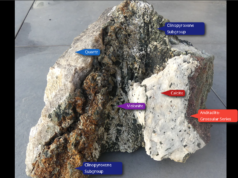
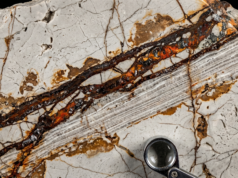

[…] Volcanogenic Massive Sulfide (VMS) Deposits […]
[…] Volcanogenic Massive Sulfide (VMS) Deposits […]
[…] Volcanogenic Massive Sulfide (VMS) Deposits […]
[…] Volcanogenic Massive Sulfide (VMS) Deposits […]