If you want to understand the history of an igneous rock, you don’t need a complex laboratory. You just need to look at its texture. In geology, the word “texture” doesn’t mean how the rock feels in your hand; it refers to the size, shape, and arrangement of its mineral crystals.
The two most fundamental textures every geologist must master are phaneritic and aphanitic. Understanding the difference between a phaneritic vs aphanitic texture is the key to unlocking whether a rock was born in a fiery volcanic eruption or slowly crystallized miles beneath the Earth’s crust.
Here is your definitive guide to reading igneous rock textures in the field.
The Golden Rule of Magma: Cooling Rate Dictates Crystal Size
Before diving into the specific textures, we must establish the fundamental rule of igneous petrology: The cooling rate of magma determines the size of the crystals.
- Slow cooling (deep underground) allows atoms plenty of time to organize and grow into large, visible crystals.
- Rapid cooling (at or near the surface) freezes the melt quickly, resulting in microscopic crystals.
With this rule in mind, let’s look at the two main textures.
1. Phaneritic Texture: The “Slow Cookers” (Intrusive)

The term phaneritic comes from the Greek word phaneros, meaning “visible.”
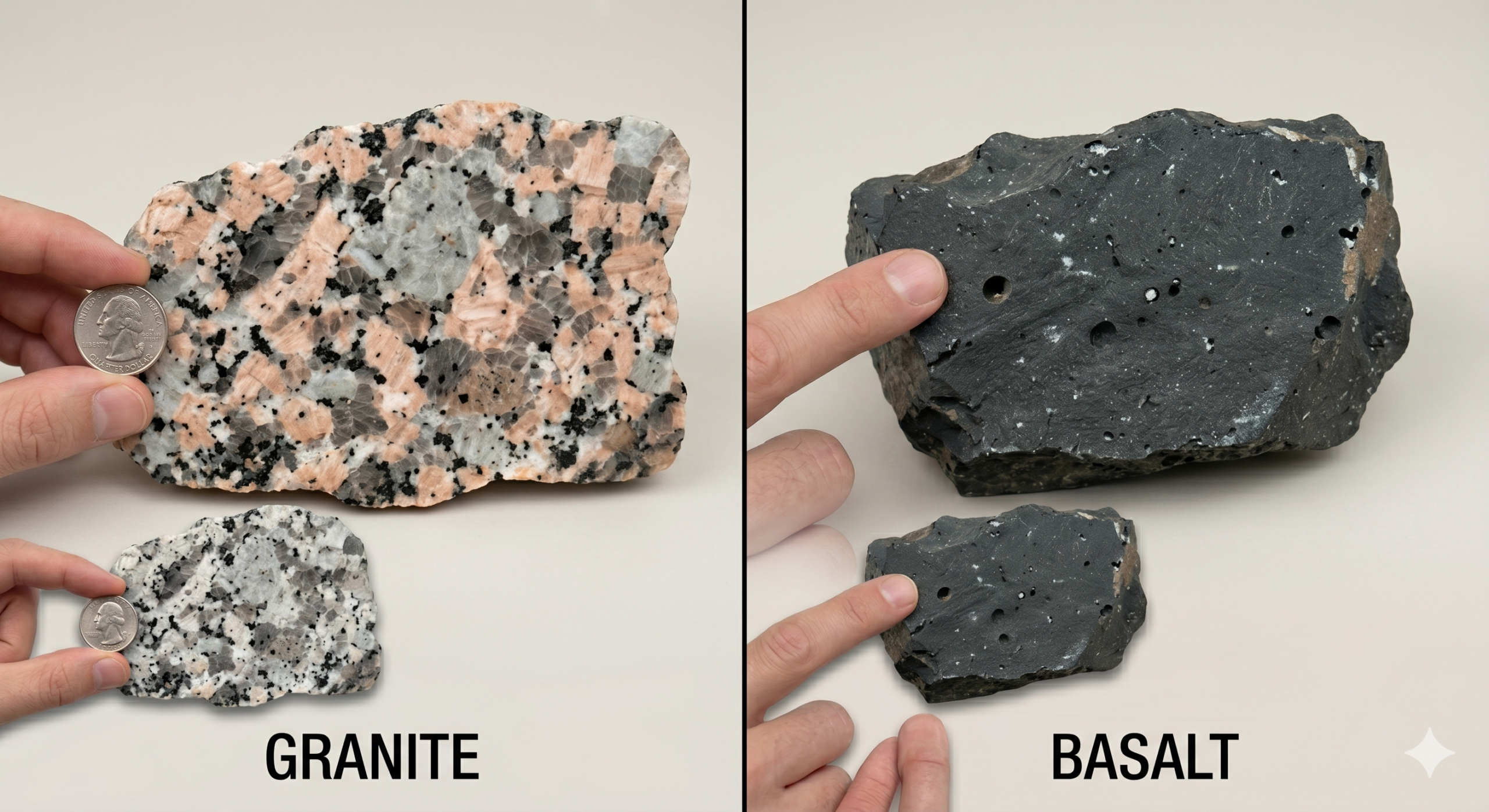
If an igneous rock has a phaneritic texture, it means the individual mineral crystals are large enough to be seen clearly with the naked eye (typically larger than 1 mm). You do not need a hand lens to distinguish the different minerals in these rocks.
How it Forms
Phaneritic textures are the hallmark of intrusive (plutonic) igneous rocks. Magma gets trapped deep within the Earth’s crust in large chambers (plutons or batholiths). Surrounded by insulating country rock, this magma cools incredibly slowly—sometimes over millions of years. This extended timeframe allows large, interlocking crystals of quartz, feldspar, and mafic minerals to grow.
Common Phaneritic Rocks
- Granite: The classic example, featuring visible crystals of quartz, potassium feldspar, and biotite mica.
- Diorite: Often called the “salt and pepper” rock due to its mix of white plagioclase and black hornblende.
- Gabbro: The dark, heavy equivalent of granite, rich in pyroxene and calcium-rich plagioclase.
2. Aphanitic Texture: The “Fast Chillers” (Extrusive)

The term aphanitic comes from the Greek word aphanes, meaning “invisible.”
If a rock has an aphanitic texture, it is incredibly fine-grained. The individual crystals are so small that you cannot distinguish them with the naked eye. To see the mineral composition of an aphanitic rock, a geologist must use a 10x hand loupe or a petrographic microscope.
How it Forms
Aphanitic textures indicate extrusive (volcanic) igneous rocks. This occurs when magma erupts onto the Earth’s surface as lava. Exposed to the cool atmosphere or ocean water, the lava chills rapidly. The atoms do not have time to migrate and build large crystal lattices, resulting in a massive, uniform appearance.
Common Aphanitic Rocks
- Basalt: The dark, dense rock that makes up the oceanic crust, extrusive equivalent of gabbro.
- Andesite: A medium-gray volcanic rock common in subduction zones, extrusive equivalent of diorite.
- Rhyolite: The light-colored, extrusive equivalent of granite, often showing flow bands.
The Hybrid: Porphyritic Texture
Nature doesn’t always stick strictly to the rules. Sometimes, a rock will display both textures simultaneously. This is called a porphyritic texture, where large, distinct crystals (phenocrysts) are embedded in a fine-grained, aphanitic matrix (groundmass).
The Geological Story: This indicates a two-stage cooling history. The magma began cooling slowly deep underground, forming the large phenocrysts. Then, a sudden volcanic eruption brought the mixture to the surface, where the remaining liquid chilled rapidly into the fine-grained groundmass.
Check our website for more geological news.



wonderful points altogether, you simply won a new reader.
What may you suggest in regards to your submit that you made
a few days in the past? Any certain?
Hi there everyone, it’s my first visit at this website,
and paragraph is really fruitful in favor of me, keep up posting these posts.
I’m extremely impressed with your writing talents and also with
the layout in your weblog. Is that this a paid theme or
did you customize it your self? Anyway keep up the excellent high quality writing,
it’s rare to peer a great weblog like this one these days..
I have read so many articles or reviews regarding the blogger lovers
except this piece of writing is in fact a pleasant piece of writing, keep
it up.
I like reading through a post that will make men and women think.
Also, many thanks for allowing for me to comment!
You have made some good points there. I looked on the internet for more information about the issue and found most individuals will go along with your views on this website.
Hey this is kind of of off topic but I was wanting
to know if blogs use WYSIWYG editors or if you have to manually code with HTML.
I’m starting a blog soon but have no coding knowledge so
I wanted to get advice from someone with experience.
Any help would be greatly appreciated!