The Earth’s Porous Time Capsule and Ultimate Reservoir
What is Sandstone?

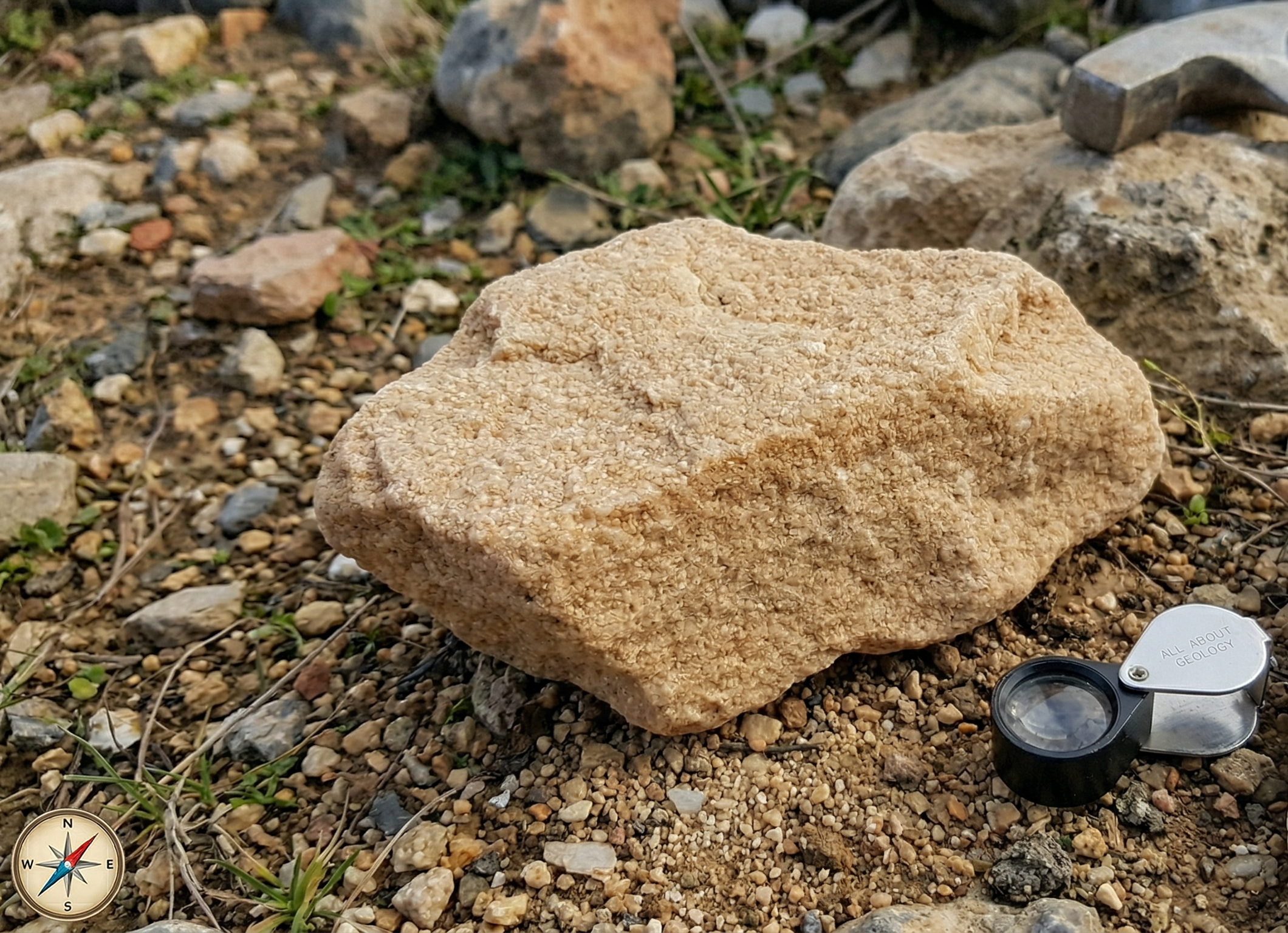
Sandstone is a clastic sedimentary rock composed primarily of sand-sized silicate grains. To a geologist, “sand” is not a specific mineral, but rather a specific grain size: any particle measuring between 0.0625 mm and 2 mm in diameter. When millions of these tiny grains are compacted and cemented together over geological time, they form sandstone.
Because it is highly resistant to weathering, sandstone creates some of the world’s most spectacular landscapes, from the towering red cliffs of the Grand Canyon to the delicate arches of Utah. But its true value lies underground: its unique porous structure makes it the most important reservoir rock on the planet.
The Ingredients of Sandstone: Grains, Matrix, and Cement
A solid piece of sandstone is made up of three distinct components:
1. The Framework Grains
These are the primary building blocks. Because they must survive long journeys down rivers or extensive wind erosion in deserts, only the most chemically and physically stable minerals persist.
- Quartz: The undisputed king of sandstone grains. It is extremely hard (Mohs 7) and highly resistant to chemical weathering.
- Feldspar: Less stable than quartz, its presence indicates that the sediment was buried quickly before it could weather into clay.
- Lithic Fragments: Tiny pieces of older rocks (like basalt or schist) that haven’t broken down into individual minerals yet.
2. The Matrix
This is the fine-grained material (silt and clay) that gets trapped in the spaces between the larger sand grains during deposition. A sandstone with very little matrix is considered “clean” and highly porous, while one packed with mud is “dirty” and impermeable.
3. The Cement
This is the natural glue that binds the loose sand into a solid rock. Mineral-rich groundwater flows through the buried sand, precipitating minerals in the empty pore spaces. The type of cement completely dictates the final color and hardness of the rock:
- Silica Cement (SiO₂): Creates an incredibly hard, pale, or gray sandstone (sometimes turning it into Quartzite).
- Calcite Cement (CaCO₃): Forms a softer rock that fizzes under hydrochloric acid testing.
- Iron Oxide Cement (Hematite/Limonite): Acts as a natural pigment, painting the sandstone in striking shades of red, orange, and brown.
Classifying Sandstone: It’s Not All Just Sand

Geologists classify sandstone based on the ratio of quartz, feldspar, and lithic fragments, as well as the amount of muddy matrix present. The four primary types are:
- Quartz Arenite: The “purest” sandstone, consisting of more than 90% quartz grains with very little matrix. These form in high-energy environments like beaches, where relentless wave action washes away all the lighter clays and softer minerals.
- Arkose: A sandstone containing at least 25% feldspar. Because feldspar weathers quickly, Arkose tells a story of rapid erosion and deposition, typically found very close to the granitic mountains where the sand originated.
- Lithic Sandstone: Packed with fragments of pre-existing rocks. These often form near active volcanic arcs or rising mountain ranges.
- Graywacke: The “dirty” sandstone. It contains more than 15% muddy matrix. Graywackes are typically formed in deep ocean basins by underwater avalanches of sediment called turbidity currents.
Reading the Ripples: Sedimentary Structures
This rock is nature’s ultimate recording device. Because sand is easily shaped by wind and water before it turns to stone, sandstone outcrops are famous for preserving dynamic sedimentary structures:
- Cross-Bedding: Dramatic, sweeping, angled layers within the rock. These are the preserved slip-faces of ancient desert sand dunes or underwater river sandbars.
- Ripple Marks: Corrugated patterns on the rock surface, freezing the exact direction and rhythm of ancient river currents or coastal waves.
The Economic Powerhouse
Sandstone is vastly more than just a building material, though it has been used to construct everything from ancient temples to modern facades. Its true economic power lies in its porosity (the empty space between grains) and permeability (how well those spaces connect).
- Hydrocarbon Reservoirs: The vast majority of the world’s recoverable petroleum and natural gas is trapped within the microscopic pores of buried sandstone layers.
- Aquifers: Sandstone beds act as colossal underground sponges, holding and filtering the freshwater that sustains modern agriculture and cities.
- Uranium Host Rock: In specific geological settings, the groundwater flowing through porous sandstone precipitates heavy metals, creating highly concentrated, roll-front uranium deposits.