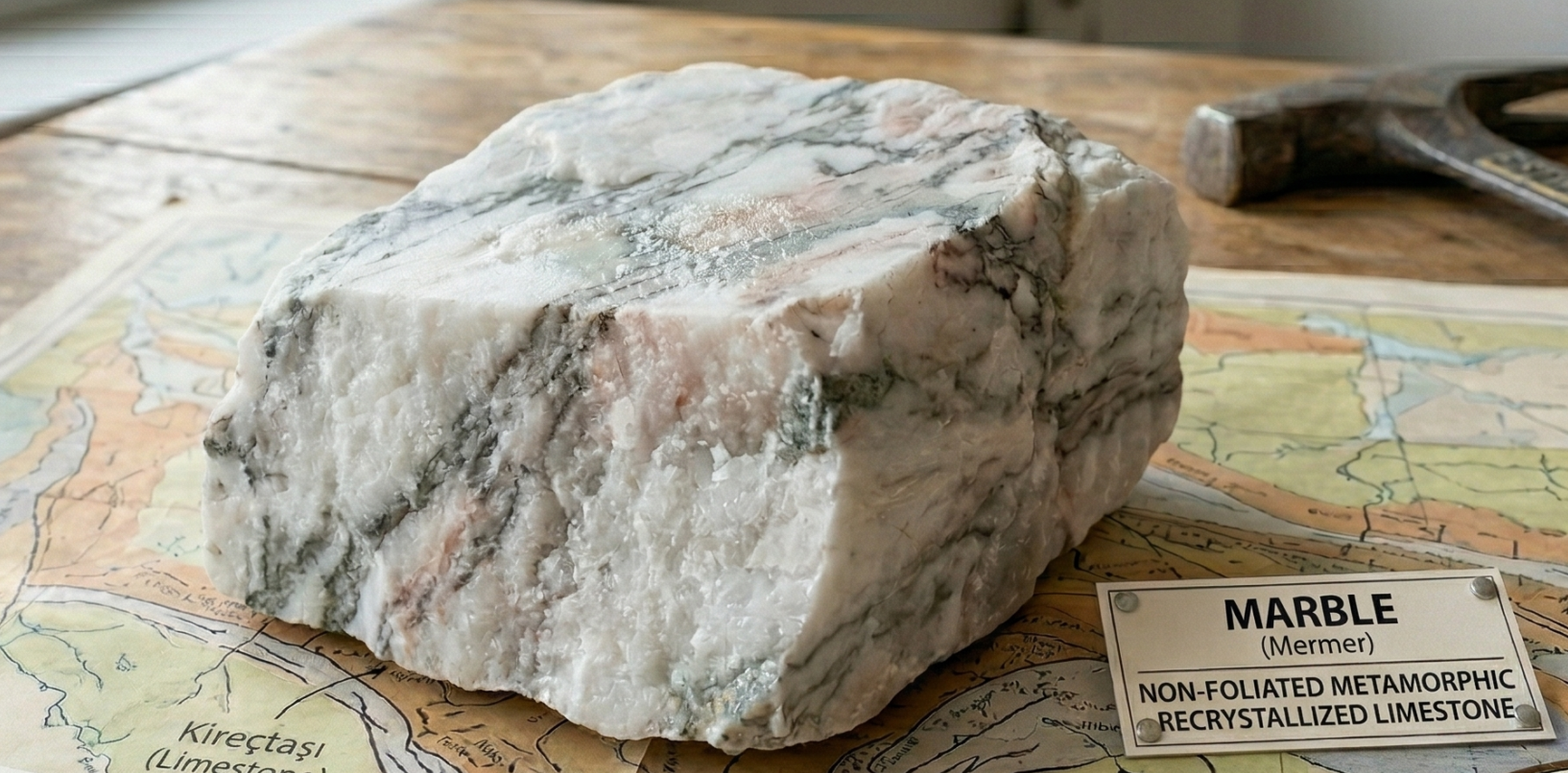
The Recrystallized Majesty of Carbonate Rocks
Marble is a non-foliated metamorphic rock that has long been synonymous with sculptural beauty and architectural elegance. To a geologist, however, it is primarily defined by its origin story: Marble is the final product of intense transformation, representing the complete metamorphosis of a sedimentary parent rock—most commonly limestone.
The Protolith Connection: It is Recrystallized Limestone
This is the single most important geologic fact about marble. It does not simply “resemble” limestone; it is limestone that has undergone a profound structural and mineralogical change.
The parent rock (protolith), limestone, is composed of calcium carbonate ($CaCO_3$), often originating as accumulating seashells, coral, and microscopic organisms in warm, shallow seas. When this limestone is subjected to the intense heat and directed pressure of regional metamorphism (during mountain-building events) or the intense heat of contact metamorphism (near a volcanic intrusion), the original textures and structures of the limestone are completely obliterated.
This process is called Recrystallization. The microscopic carbonate grains and fossil fragments in the limestone are dissolved, merge, and then solidify again, growing into larger, interlocking, granoblastic crystals of calcite or dolomite. Think of it like a dense sugar cube transforming into a giant cluster of sparkling sugar crystals. This complete textural reset destroys all original fossils and bedding planes, resulting in a dense, crystalline mosaic of minerals.
How Marble Forms: The Agents of Change
While recrystallization is the mechanism, the primary environmental factors driving the transformation of limestone into marble are:
- Heat: This is the critical component. Heat from tectonic forces or nearby magma provides the energy needed for recrystallization. Temperatures ranging from 300°C to 800°C are common.
- Pressure: The immense lithostatic pressure from overlying rock, combined with directed pressure from tectonic plate collisions, compresses the carbonate crystals together, eliminating pore space and creating the characteristic non-foliated, granular texture.
Field Identification: How to Spot Marble
Jeologlar, sahada mermeri tanımlamak için birkaç temel teste güvenir:
- The Acid Test: This is the definitive field test for carbonate rocks. If a drop of dilute hydrochloric acid (HCl) is placed on a clean marble surface, it will vigorously effervesce (fizz). This reaction confirms the presence of calcium carbonate. (Dolomitic marble, derived from dolostone, fizzes much less vigorously or only when powdered).
- Hardness: Pure marble consists of calcite, which has a Mohs hardness of 3. This means marble can be easily scratched by a steel nail or a hard geological hand lens frame (which Gökhan Usta always keeps handy, as seen in previous field scenarios like image_247.png). In contrast, Quartzite, which can sometimes look similar, has a hardness of 7 and cannot be scratched by steel.
- Texture: It has a perfectly granoblastic texture. When viewed through a hand lens, it looks like tightly interlocked, often sugary or sandy-looking grains that lack any preferential alignment or banding.
Color and Impurities (Veining)
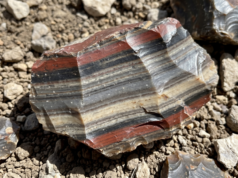
While pure marble is the classic, flawless white of many famous statues, the vast majority of marble possesses characteristic colorful swirling veins and clouds. These “veins” are not a result of metamorphism but are inherited from impurities within the original sedimentary limestone protolith:
- Black/Gray Marble: High organic carbon content in the limestone (derived from anoxic organic matter).
- Green Marble (like Serpentine Marble): Formed from limestones with high silica or magnesia impurities, which transform into metamorphic serpentine or olivine.
- Red/Pink Marble: Derived from limestone rich in iron oxide (hematite).