The Silky Transition in the Metamorphic Sequence
What is Phyllite?
Phyllite is a medium-grade, foliated metamorphic rock that holds a very specific place in the grand geologic rock cycle. It represents the crucial transitional bridge between low-grade slate and high-grade schist. To the untrained eye, it might look like a slightly shiny piece of slate, but to a geologist, that distinct sheen tells a story of increasing heat, pressure, and mineral transformation deep within the Earth’s crust.
The Formation: A Step Up from Slate
The story of phyllite begins with a fine-grained protolith, typically shale or mudstone, which first metamorphoses into slate. When that slate is buried even deeper and subjected to the continued, intense directed pressure and rising temperatures of regional metamorphism (often associated with mountain-building events), it transforms into phyllite.
During this process, the microscopic clay minerals that make up the slate begin to undergo recrystallization. They grow into tiny, new flakes of mica—primarily muscovite, chlorite, or biotite—along with graphite. While these newly formed mica crystals are still too small to be seen individually with the naked eye (unlike in schist), they are large enough to fundamentally change how the rock interacts with light.

Field Identification: Spotting the “Phyllitic Luster”
When you are mapping in the field, phyllite is usually quite easy to distinguish from its close relatives (slate and schist) if you know what to look for:
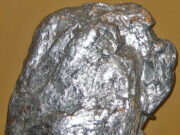
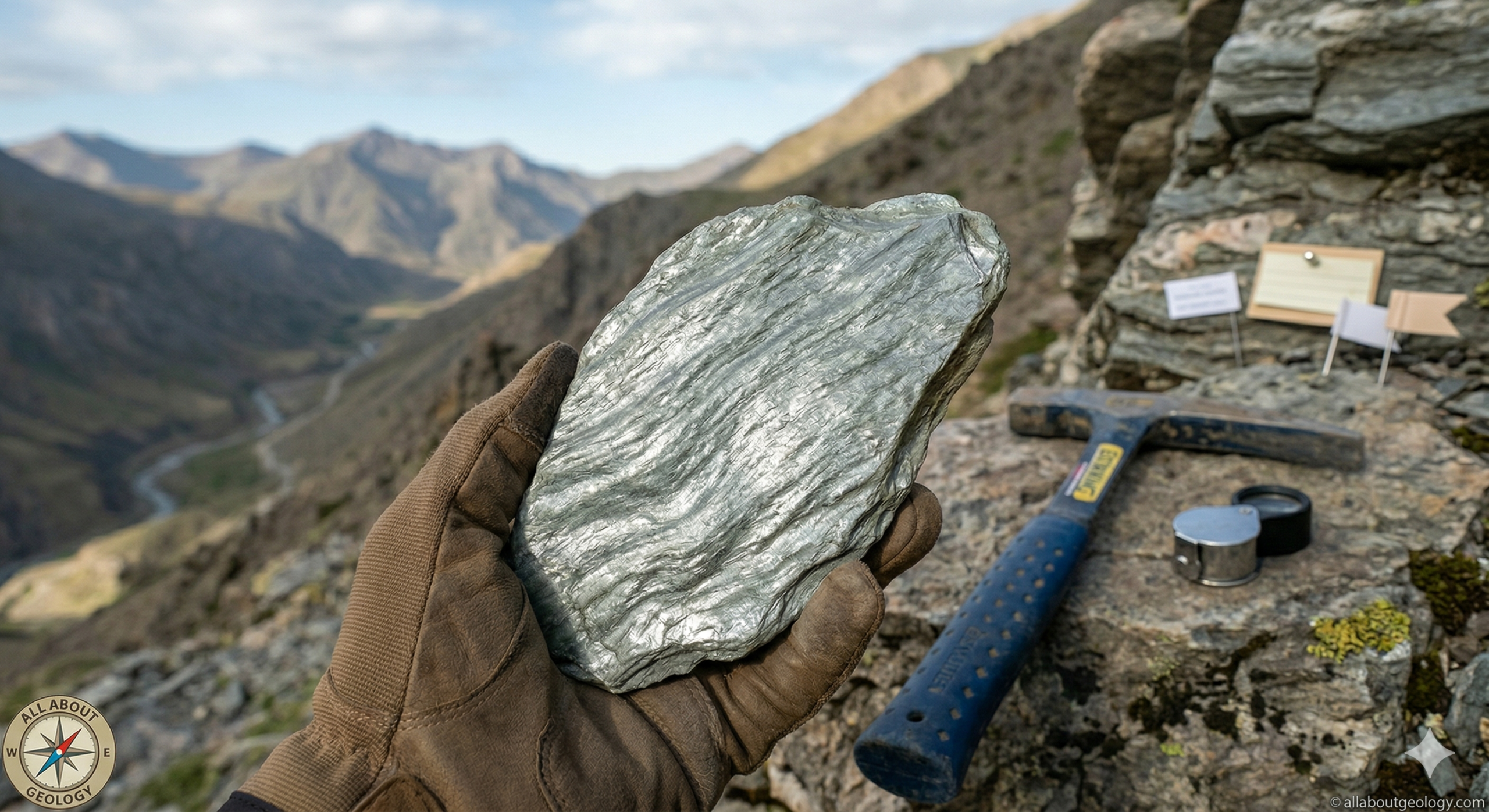
- The Phyllitic Luster: This is the most definitive characteristic of phyllite. Because the microscopic mica flakes align parallel to the direction of stress, the rock develops a highly reflective, silky, or satiny sheen on its cleavage surfaces. When you rotate a piece of phyllite in the sunlight, it catches the light beautifully. Slate, by comparison, is distinctly dull and matte.
- Wavy Foliation: While slate tends to break into perfectly flat, rigid sheets (slaty cleavage), the foliation in phyllite is often slightly wrinkled, corrugated, or wavy.
- Color: Phyllite is most commonly silvery-gray, but depending on the mineral composition, it can also appear greenish (if chlorite is abundant) or dark black (if rich in graphite).
- Texture: It feels slightly smoother or greasier to the touch compared to the rougher feel of a standard mudstone or slate.
Geologic Significance and Use
Finding a phyllite outcrop indicates that the region experienced low-to-medium grade regional metamorphism. It tells a structural geologist that temperatures were likely between 200°C and 400°C, marking a significant step up in the geothermal gradient compared to slate zones.
Historically, because of its tendency to split into sheets (though not as perfectly as slate), some stronger phyllites have been used for roofing tiles or decorative landscaping stones. However, its primary value is scientific: it is the perfect visual representation of a rock caught in the middle of an intense, millions-of-years-long transformation.