
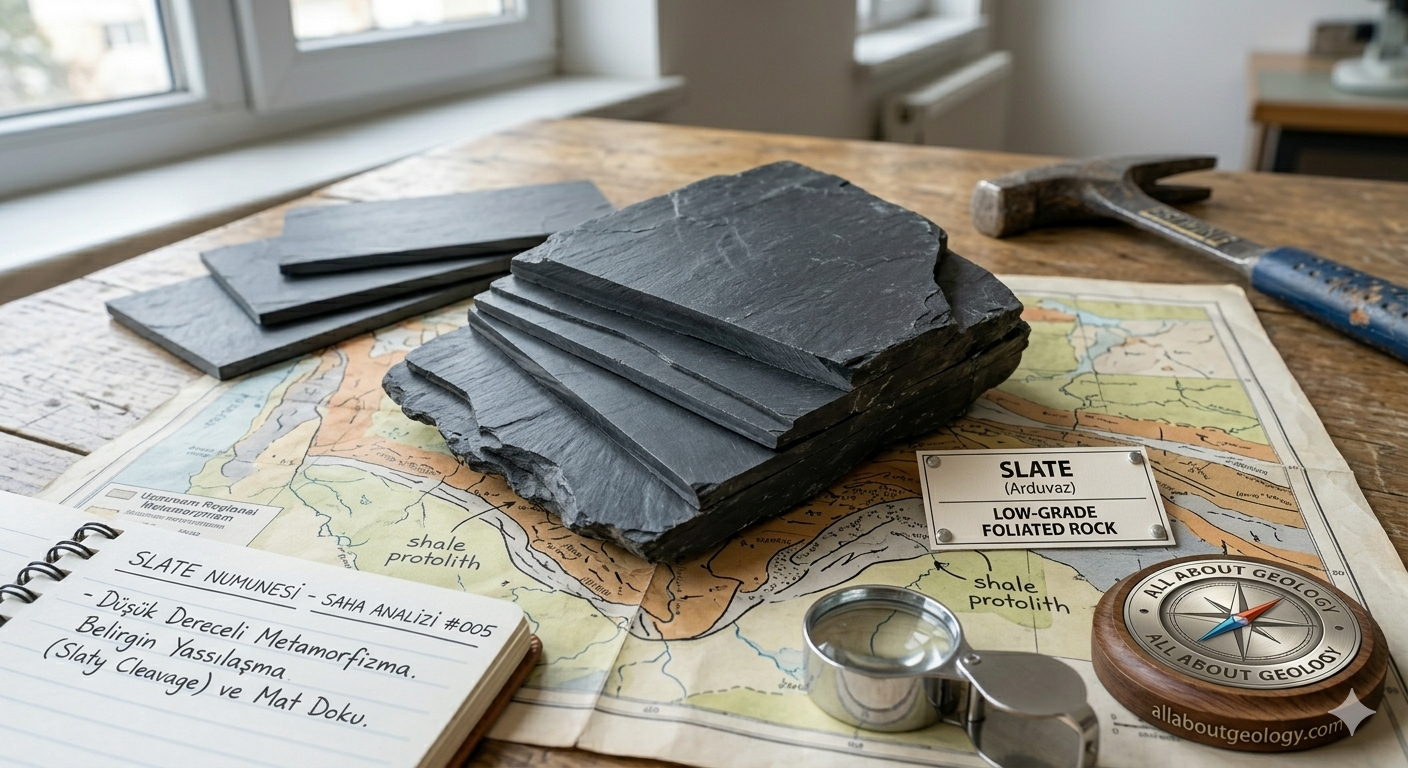
What is Slate?
Slate is a fine-grained, foliated metamorphic rock that forms under low-grade regional metamorphism. Known for its remarkable ability to split into thin, smooth, and incredibly flat sheets, this rock represents the very beginning of the tectonic transformation process. Before it was subjected to the immense pressures of the Earth’s crust, slate was once a simple sedimentary rock, typically shale or mudstone composed of microscopic clay minerals and volcanic ash.
How Does Slate Form? (The Geologic Process)

The journey of slate begins deep within the Earth during mountain-building events (orogenies). As tectonic plates collide, the buried shale is subjected to two critical factors:
- Low Heat: Temperatures roughly ranging from 200°C to 300°C.
- Directed Pressure: Immense differential stress squeezes the rock from specific directions.
Under these conditions, the original clay minerals within the shale begin to recrystallize into new, flat-platy minerals like muscovite mica and chlorite. The intense directed pressure forces these microscopic flakes to align perfectly perpendicular to the direction of the stress. This flawless parallel alignment is what creates the rock’s defining structural characteristic: slaty cleavage.
Field Identification: How to Spot Slate
For geologists in the field, distinguishing slate from its sedimentary parent (shale) or its higher-grade successor (phyllite) requires a keen eye. Here is a quick field guide:
- Texture & Cleavage: Slate breaks cleanly along natural planes of weakness into flat, rigid sheets. If you tap two pieces of high-quality slate together, they will produce a sharp, ringing “clink” sound—unlike the dull “thud” produced by shale.
- Luster: It has a perfectly dull, matte finish. If the surface starts to show a wavy, silky, or slightly reflective sheen, the rock has likely progressed to the next metamorphic grade: Phyllite.
- Grain Size: The mineral crystals in slate are aphanitic (far too small to be seen with the naked eye or even a standard 10x geologist’s hand lens).
- Color Variations: While dark gray to black is the most common (due to preserved carbonaceous material), slate can also be green (chlorite-rich), red/purple (iron oxide-rich), or brown.
Mineral Composition
Even though you cannot see the individual grains, a petrographic microscope analysis of slate typically reveals a dense matrix of:
- Quartz
- Muscovite or Illite
- Chlorite
- Minor amounts of hematite, pyrite, or graphite, depending on the original depositional environment of the protolith.
Practical and Architectural Uses
Because of its unique slaty cleavage and extremely low water absorption index (often less than 0.4%), slate has been a highly valuable engineering and architectural material for centuries. It is naturally fireproof and frost-resistant, making it the premier choice for high-quality roofing tiles. Historically, it was also used for school chalkboards and electrical switchboards (due to its thermal and electrical insulating properties). Today, massive precision-cut slabs of slate remain the absolute gold standard for the flat beds of professional billiard tables.

[…] begins with a fine-grained protolith, typically shale or mudstone, which first metamorphoses into slate. When that slate is buried even deeper and subjected to the continued, intense directed pressure […]