

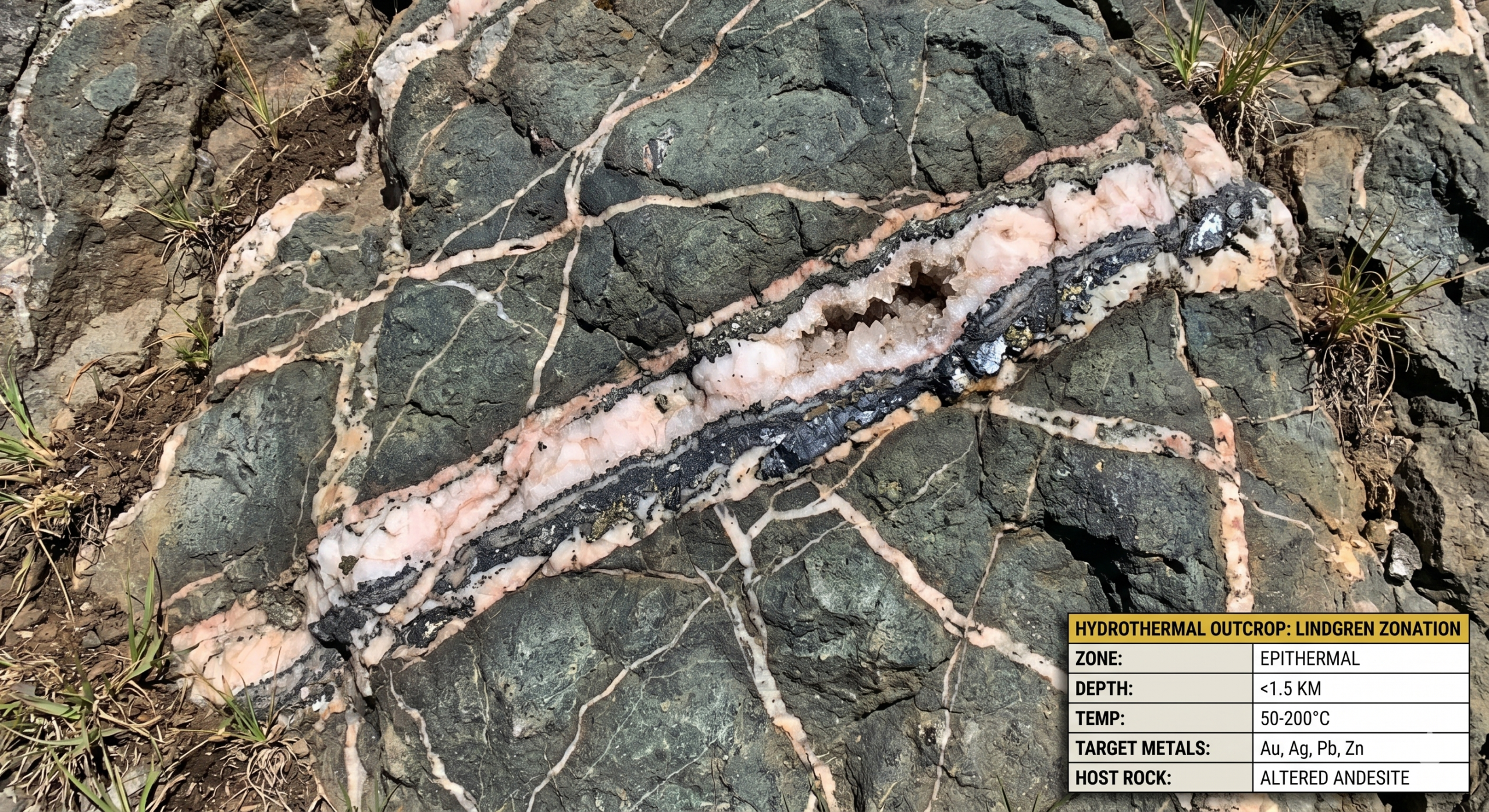
If you are exploring for world-class gold, silver, copper, or zinc deposits, you are essentially looking for the fossilized footprints of ancient, boiling water systems.
In economic geology, Hydrothermal Ore Deposits account for the vast majority of the world’s precious and base metal production. The term hydrothermal translates to “hot water.” However, in a geological context, this is not ordinary water. It is a highly pressurized, superheated, and chemically aggressive fluid capable of dissolving solid metals, transporting them for miles through the Earth’s crust, and depositing them in concentrated, mineable zones.
To successfully explore for these ore bodies, a geologist must understand the complete anatomy of a hydrothermal system.
The Anatomy of a Hydrothermal System
For a hydrothermal deposit to form, three critical components must align perfectly in time and space: The Source, The Pathway, and The Trap.
1. The Source (Fluids and Metals)
Where does this metal-rich boiling water come from? Hydrothermal fluids generally originate from two main sources:
- Magmatic Fluids: As a deep magma chamber cools and crystallizes into solid rock (like granite), it expels water and volatile gases (like sulfur and chlorine) that were trapped in the melt. These magmatic fluids are incredibly hot and heavily loaded with dissolved metals.
- Meteoric Fluids: Rainwater and surface water that percolate deep into the crust through faults. As this water descends, it is heated by the geothermal gradient or a nearby magma chamber. It acts like a hot acid bath, leaching trace metals from the surrounding country rock as it circulates.
2. The Pathway (Structural Controls)
Fluids cannot move through solid, unbroken rock. They need a highway. This is why hydrothermal deposits are almost always structurally controlled. Faults, shear zones, and breccia pipes act as permeable conduits. Tectonic activity fractures the Earth’s crust, creating open spaces and pressure vacuums that draw the high-pressure fluids upward toward the surface.
3. The Trap (Precipitation Mechanisms)
Metals do not stay dissolved in the fluid forever. To create an ore deposit, the fluid must drop its metallic cargo. This process, called precipitation, is triggered by sudden changes in the fluid’s physical or chemical environment:
- Boiling: As fluids rise to shallower depths, a sudden drop in pressure causes the fluid to flash-boil. This leaves the metals behind, precipitating rapid, high-grade mineralization (often seen as banded quartz veins).
- Cooling: Mixing with cold, shallow groundwater rapidly lowers the temperature of the hydrothermal fluid, forcing metals out of solution.
- Wall-Rock Reaction: When acidic fluids hit a reactive rock layer (like limestone), the chemical neutralization forces minerals to precipitate out.
The Lindgren Classification: Zoning by Depth and Temperature

As hydrothermal fluids travel upward from the deep magmatic source to the shallow surface, they continuously cool and lose pressure. Because different metals precipitate at different temperatures, the ore deposits naturally arrange themselves into distinct vertical zones.
Geologists use the classic Lindgren Classification to navigate these systems.
1. Hypothermal Deposits (The Deep Inferno)
Hypothermal deposits represent the deepest and hottest roots of the hydrothermal system, forming directly above or within the cooling magmatic intrusions.
- Depth: Greater than 3 kilometers.
- Temperature: 300°C to 500°C.
- Pressure: Extremely high (Lithostatic).
- Target Metals: This high-temperature environment is the primary domain for Tin (Cassiterite), Tungsten (Wolframite), and Molybdenum. It also hosts deep, coarse-grained gold-quartz veins.
- Geological Footprint: You will often find these deposits associated with deep-seated plutons and high-temperature alteration minerals like tourmaline, topaz, and garnet.
2. Mesothermal Deposits (The Middle Ground)
As the fluids migrate further up the structural pathways, they enter the meso (middle) zone. The pressure drops significantly, and the temperature cools, creating a highly productive chemical environment.
- Depth: 1.5 km to 3 km.
- Temperature: 200°C to 300°C.
- Target Metals: This zone is globally recognized for massive base metal sulfides. It is highly prospective for Copper (Chalcopyrite), Zinc (Sphalerite), and Lead (Galena).
- The Gold Connection: Crucially, the world-famous “Orogenic Gold” deposits—which form in major metamorphic shear zones and produce a massive percentage of global gold—are generally formed within this mesothermal temperature window.
3. Epithermal Deposits (The Shallow Gold Rush)
The epi (shallow) zone is the top of the hydrothermal system. Here, rising magmatic fluids often collide and mix with cold, descending meteoric groundwater. This dramatic mixing and boiling create spectacular, high-grade deposits.
- Depth: Surface down to approximately 1.5 kilometers.
- Temperature: 50°C to 200°C.
- Target Metals: This zone is the ultimate target for Gold and Silver “bonanza” veins. It is also the primary environment for low-temperature metals like Mercury (Cinnabar) and Antimony (Stibnite).
- Field Clues: Epithermal systems are famous for intense, visually striking wall-rock alteration, including vast zones of silicification, argillic (clay) alteration, and vuggy silica.
(Want to learn how to target the high-grade core of a shallow system? Read our comprehensive Deep Dive into Epithermal Gold-Silver Deposits here.
Conclusion: Reading the Rocks
Understanding hydrothermal systems is the core of mineral exploration. By identifying the minerals in a hand sample or drill core, a geologist can accurately determine the formation temperature. By identifying the temperature, you can locate exactly where you are in the Lindgren model—allowing you to point your drill rig precisely toward the heart of the ore body.

[…] Hydrothermal Ore Deposits […]
[…] Hydrothermal Ore Deposits […]
[…] Hydrothermal Ore Deposits […]
[…] Hydrothermal Ore Deposits […]
[…] Hydrothermal Ore Deposits […]
[…] Hydrothermal Ore Deposits […]