
The Earth’s Ultimate History Book
What Are Sedimentary Rocks?
If igneous rocks are born from fire and metamorphic rocks are forged under pressure, sedimentary rocks are the patient historians of the Earth’s surface. They are the only type of rock that forms from the accumulation and consolidation of pre-existing materials—ranging from fragments of older rocks and minerals to the remains of living organisms.
Although they make up only a small fraction of the Earth’s total crust by volume, sedimentary rocks are incredibly important because they cover about 75% of the Earth’s land surface. Every fossil ever discovered, every drop of groundwater we drink, and the vast majority of the world’s oil and natural gas reserves are hosted within these rocks.
The Making of a Sedimentary Rock: Lithification
The journey from loose surface dirt to a solid rock is a multi-step geological process called lithification. It involves four primary stages:
Weathering and Erosion: Existing rocks (igneous, metamorphic, or even other sedimentary rocks) are broken down into smaller pieces by wind, water, ice, and chemical reactions.
Transportation: These broken fragments, called sediments, are carried away from their source by rivers, glaciers, or wind.
Deposition: As the transporting agent loses energy (for example, a river entering a calm ocean), the sediments settle and accumulate in layers (strata).
Compaction and Cementation: Over millions of years, as more layers pile up, the weight compresses the bottom layers (compaction). Mineral-rich groundwater seeps through the tiny spaces between the grains, depositing minerals like calcite (CaCO₃), silica (SiO₂), or iron oxide, which act as a natural glue holding the rock together (cementation).
The Great Divide: Clastic vs. Non-Clastic Sedimentary Rocks
Geologists classify sedimentary rocks based on the origin of the materials that formed them. The most fundamental division separates these rocks into two main categories: those made of broken pieces (Clastic) and those formed by chemical or biological processes (Non-Clastic).
1. Clastic (Detrital) Sedimentary Rocks

The word “clastic” comes from the Greek word klastos, meaning “broken.” These are the most common type of sedimentary rocks, formed entirely from the compacted and cemented fragments (clasts) of pre-existing rocks. They are further classified by the size of their grain particles:
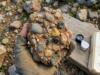
Conglomerate & Breccia: Made of large, visible pebbles or boulders. Conglomerates have rounded clasts (indicating they traveled far in a turbulent river), while breccias have angular clasts (indicating they were deposited very close to their source, like a rockfall).
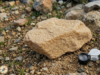
Sandstone: Composed of sand-sized grains, most commonly quartz. Sandstones are highly porous, making them excellent reservoir rocks for underground water aquifers and hydrocarbons.
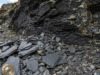
Shale and Mudstone: Formed from the finest microscopic clay and silt particles settling in very calm environments, like deep ocean basins or quiet lakes. Shale is famous for its fissility—its ability to split into paper-thin layers.
2. Non-Clastic Sedimentary Rocks

Unlike clastic rocks, non-clastic rocks do not form from physical fragments of older rocks. Instead, they form from dissolved minerals precipitating out of water, or from the accumulation of biological remains. This group is divided into two distinct sub-categories:
A. Chemical Sedimentary Rocks
These rocks form when water bodies (like shallow seas or saline lakes) become supersaturated with dissolved minerals. As the water evaporates, the minerals precipitate and crystallize to form solid rock.
Evaporites: Classic examples include Rock Salt (Halite) and Rock Gypsum, which form in arid climates where evaporation exceeds precipitation.
Chemical Limestone: Formed by the direct, inorganic precipitation of calcium carbonate (CaCO₃) from marine water.
Chert: A very hard, dense rock composed of microcrystalline silica (SiO₂), historically prized by early humans for making sharp cutting tools and arrowheads.
B. Organic (Biochemical) Sedimentary Rocks
These non-clastic rocks are the ultimate biological time capsules, formed from the accumulated remains of once-living organisms.
Fossiliferous Limestone: Formed in shallow, warm marine environments from the accumulation and compaction of calcium carbonate shells, coral debris, and marine skeletons.
Coal: A completely different type of organic rock. Coal is formed from the remains of ancient plant material (trees, ferns) that accumulated in oxygen-poor swamp environments and were subjected to intense heat and pressure over millions of years, turning into combustible carbon.

Sedimentary Structures and Beds: Reading the Strata
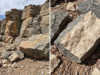
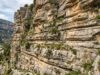
The most defining and easily recognizable feature of any sedimentary rock outcrop is its layered appearance. These layers are called beds or strata (singular: stratum). The formation of these beds is governed by fundamental geological laws:
The Principle of Original Horizontality: Sediments are almost always deposited in flat, horizontal layers under the influence of gravity. If we see tilted or folded beds today, we know that tectonic forces altered them after they turned into rock.
The Law of Superposition: In an undisturbed sequence of rocks, the oldest layers are at the bottom, and the youngest layers are at the top.
Beyond simple layering, the dynamic forces of water and wind leave permanent signatures within the beds, known as sedimentary structures:
Cross-Bedding: Inclined layers within a thicker bed, indicating that the sand was moved by wind (like desert dunes) or water currents (like river channels).
Ripple Marks: Small waves of sand preserved on the surface of a rock layer, showing the direction of ancient water currents or wave action.
Mud Cracks: Polygonal patterns formed when wet mud dries and shrinks, indicating an environment that was alternately wet and dry, such as a tidal flat or a shallow lakebed.
Depositional Environments: Where do they form?
A “depositional environment” is the specific geographic setting where sediments accumulate. Each environment leaves a unique chemical, biological, and physical fingerprint on the resulting sedimentary bed. We categorize these into three main zones:
Continental (Terrestrial): Environments on land, including rivers (fluvial), lakes (lacustrine), deserts (aeolian), and glaciers. These typically deposit clastic rocks like conglomerates, sandstones, and mudstones.
Transitional: The dynamic zones where land meets the sea, such as deltas, beaches, and tidal flats. These areas often feature a mix of clastic and organic materials, heavily influenced by tides and waves.
Marine: The vast ocean basins. Shallow marine environments (continental shelves) are factories for fossiliferous limestone and coral reefs. Deep marine environments, far from land, are where microscopic clay and plankton shells slowly settle to form thick beds of shale and chalk.
The Economic Power of Sedimentary Basins
Sedimentary beds are not just academic curiosities; they are the primary host for the world’s most critical economic resources. When thick sequences of sedimentary rocks accumulate in large depressions called sedimentary basins, incredible things happen:
Hydrocarbon Reservoirs: Over 80% of the world’s petroleum and natural gas is found in sedimentary basins. Organic-rich shales act as the “source rock” generating the oil, while porous sandstones and limestones act as the “reservoir rock” holding it like a giant sponge.
Placer Deposits: Heavy, valuable minerals like gold, platinum, and diamonds are often concentrated by river currents and deposited within gravel beds, eventually becoming conglomerates.
Evaporite Beds: Massive layers of rock salt and gypsum, crucial for the chemical and construction industries, are mined directly from ancient dried-up sea beds.
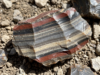
Banded Iron Formations (BIFs): The vast majority of the iron ore mined globally today comes from ancient sedimentary beds formed in the primordial oceans billions of years ago.